
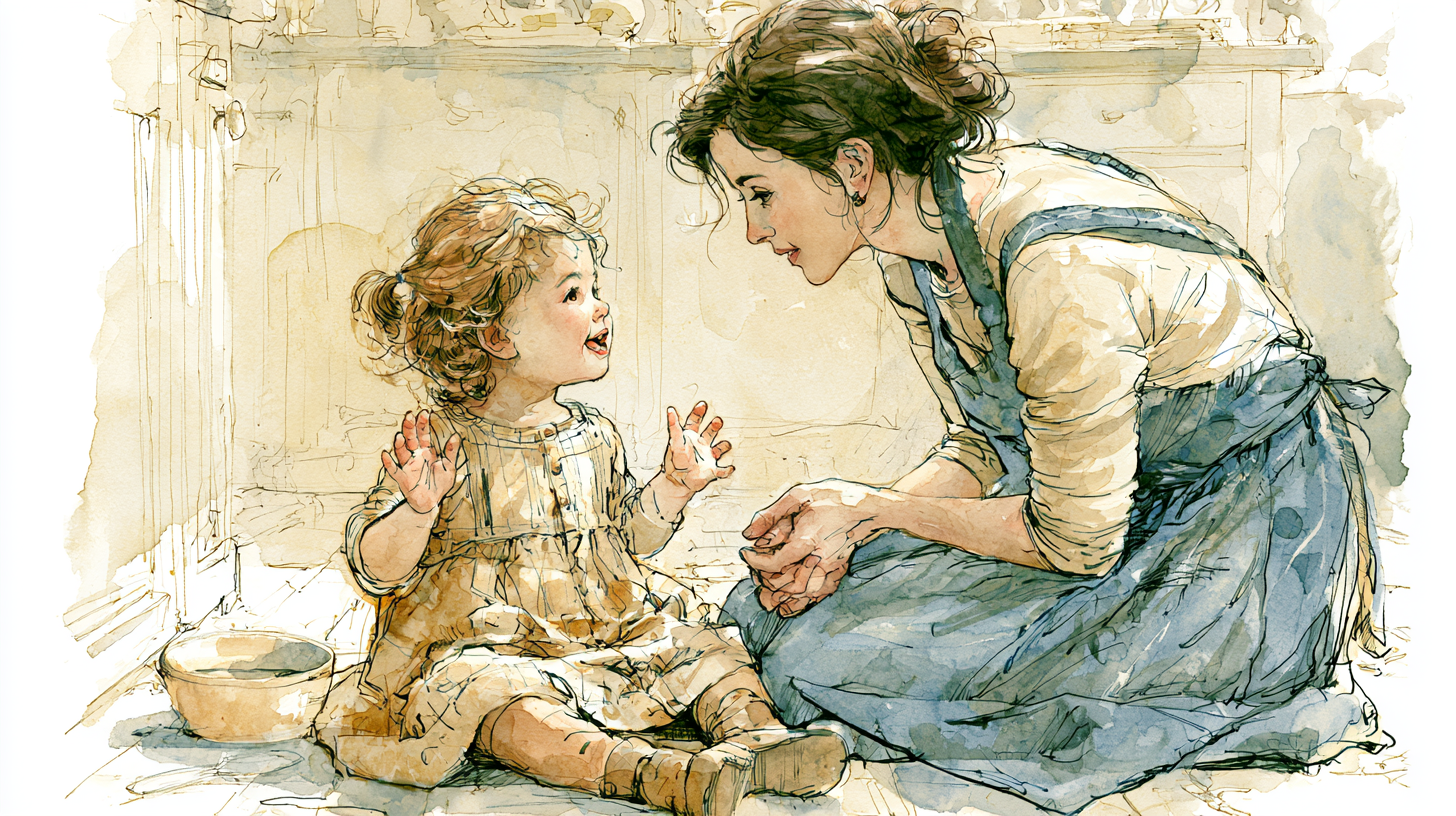
She talks all day. She narrates the car ride, argues with the dog, and delivers long confident speeches over breakfast. And you catch maybe one word in four. Somewhere in there is a child with a great deal to say and no reliable way to get it across, and somewhere in you is a worry that has been gently waved off at least twice.
The waving off usually sounds reasonable. She is only three. Her cousin was late too. Some children take their time. All of that can be true, and your concern can still be worth acting on, because what you are describing is not the same thing as a quiet late talker.
Plenty of speech with low clarity is its own picture
There is a name for it. Speech and language therapists talk about intelligibility, meaning how much of what a child says can actually be understood, and they treat it separately from how much a child says. A toddler can be at the top of the range for one and well below it for the other.
What you are seeing is a child whose communication drive is entirely intact. The rhythm is there. The intonation rises and falls in the right places. She takes her turn in a conversation, waits for your answer, gets frustrated when it does not match. Every social piece of language is present and working. What has not come together yet is the sound system underneath it, the set of consonants and syllable shapes that turn intention into words other people can decode.
This particular combination gets overlooked more than almost any other, and the reason is uncomfortable: she does not look worried about it. A child who is silent in the corner raises an eyebrow. A child who chatters cheerfully at the receptionist while nobody understands a word tends to get called a character, and everyone moves on.
The number that ends the argument
You will get further if you can name a benchmark instead of a feeling. The one most pediatricians still reference is a rough rule of quarters: about a quarter of what a one-year-old says is understandable to someone outside the family, about half at two, about three quarters at three, and essentially all of it by four.
Two honest caveats. These figures came from parent estimates, and newer research that used real strangers listening to recordings with no context puts the same milestones later. So the rule of quarters is a flag rather than a verdict, and a child sitting slightly under it at three is not in trouble.
That said, it gives you something concrete. If the people who live with her, who have every possible clue about context and routine and what she wanted five minutes ago, are catching a handful of words, she is well below any version of that benchmark. That is not a wait and see number.
Rule out hearing before anything else
Before any theory about neurodivergence, get her hearing checked, and ask specifically about fluid behind the eardrum rather than settling for a general pass.
Glue ear is common in the toddler years, often painless, and it comes and goes. A child can hear well enough at the appointment and be listening through cotton wool for the six weeks before it. Speech is built from what a child hears, so a child receiving muffled and inconsistent input will produce muffled and inconsistent speech. It is the single most fixable thing on this list, and it is missed constantly in children who chatter, because nobody suspects a hearing problem in a child who will not stop talking.

There's a story for this exact struggle
The Mosquito Who Thought He Was a Dragonfly
Raised by dragonflies after a summer storm, Miro learns one night that the world sometimes sees him differently than the family who loves him — and that being misunderstood isn’t the same as being bad.
Free to read. You'll also get five free articles a week. Unsubscribe anytime.
A family history lowers the threshold, it does not raise it
When several people in a household are already diagnosed, two opposite things tend to happen. Sometimes everything gets attributed to the family pattern before anyone looks properly. Other times a parent talks themselves out of raising it, because they have already been the family that asks a lot of questions, and there is a real fear of being seen as the one who collects labels.
Neither serves the child. A dense family history is a reason to look sooner and more carefully, not later. It is also worth separating the questions rather than stacking them. Speech intelligibility is assessable now, at three, by a speech and language therapist. Broader developmental questions can run alongside on their own timeline, and if you want the map for that part, we cover the pathways in how to actually get a diagnosis for your child.
How to get seen
In most places you can refer your child to a speech and language therapist yourself, without waiting for a doctor to agree with you first. Ask what the self-referral route is called where you live, since the name changes from system to system while the door is usually open.
Three things make that first appointment far more productive:
- A short video. Two minutes of her talking normally at home is worth more than any description you can give. Children reliably go quiet in unfamiliar rooms, and a clinician who only meets the quiet version is working with the wrong sample.
- A word list. Write down the words your family understands and what she says for each. That list is her sound system in miniature, and a therapist will read patterns in it immediately.
- What happens when she is not understood. Does she repeat it louder, try a different word, take your hand and show you, give up, or fall apart? That reaction says a great deal about how much this is already costing her.
What helps at home in the meantime
Resist the urge to ask her to say it again. A third attempt rarely produces a clearer word, and it teaches her that talking to you is a test she keeps failing.
Say back the part you did catch, and guess out loud at the rest. Something like: you want the blue one, or the blue thing over there? She gets to confirm or correct with a nod, the conversation keeps moving, and she stays in it.
Let gesture, pointing and signs run alongside her speech rather than instead of it. Giving a child a working channel does not slow down the spoken one. It takes the pressure off, and pressure is what makes a struggling talker stop trying.
Narrate more and question less. A child who is hard to understand spends much of the day being interrogated, and it is a relief to spend some of it just being talked with.
What to hold onto
She has language. She has a great deal of it, and she has been generous with it all day long in a household that only catches a fraction. The gap is between her intention and her sound system, and that gap is one of the most workable things in this entire field.
The concern you were talked out of is a reasonable one. Being early costs almost nothing. Being late costs a year.
Put it into practice
The word list, the reactions, what shifted after a cold, the weeks it seemed to get worse: that is the record a clinician will want, and it is hard to reconstruct from memory at the appointment. LightMap gives you one place to log what you notice as you notice it, then shows you the pattern underneath so you can walk in with something better than a hunch.
Start your free 14-day trial of LightMap.
Sources: American Speech-Language-Hearing Association practice portal on speech sound disorders; research on speech intelligibility norms by age (Flipsen; PMC); DSM-5-TR criteria for speech sound disorder; research on the relationship between early speech difficulty and later literacy outcomes (PMC).
For education and reflection, not medical advice. Our terms
See what's underneath
Understand the why, not just the what
LightMap turns scattered hard days into a pattern you can see. Start by logging one moment tonight.
Find out why it keeps happening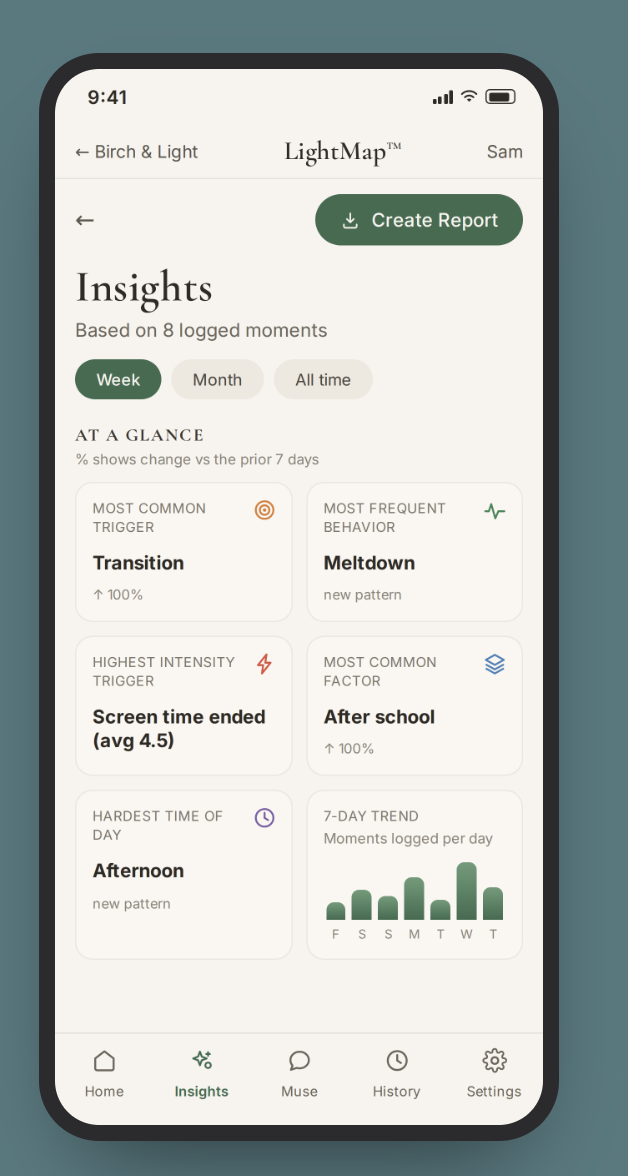

Part of the award-winning Birch & Light Method, honored with the Mom's Choice Gold Award for excellence in family resources.
Before you go, grab the free guide
The 3 body-state triggers under most meltdowns, a script for the 30 seconds before it tips over, and a reset for after. Free.

You'll get the guide instantly, plus five free articles in your inbox every week. Real challenges (meltdowns, school mornings, picky eating, big feelings) and how to actually handle them. Unsubscribe anytime.
A story to read together
Sometimes the easiest way in is a story you read side by side.
- The Mosquito Who Thought He Was a Dragonfly
Raised by dragonflies after a summer storm, Miro learns one night that the world sometimes sees him differently than the family who loves him — and that being misunderstood isn’t the same as being bad.
Read the story  Otto Filled Everything
Otto can't stop filling things with water. His family doesn't understand — until Grandma Willow helps them listen to what his body is actually asking for.
Read the story
Researched and drafted with AI assistance, reviewed before publication. Editorial standards