
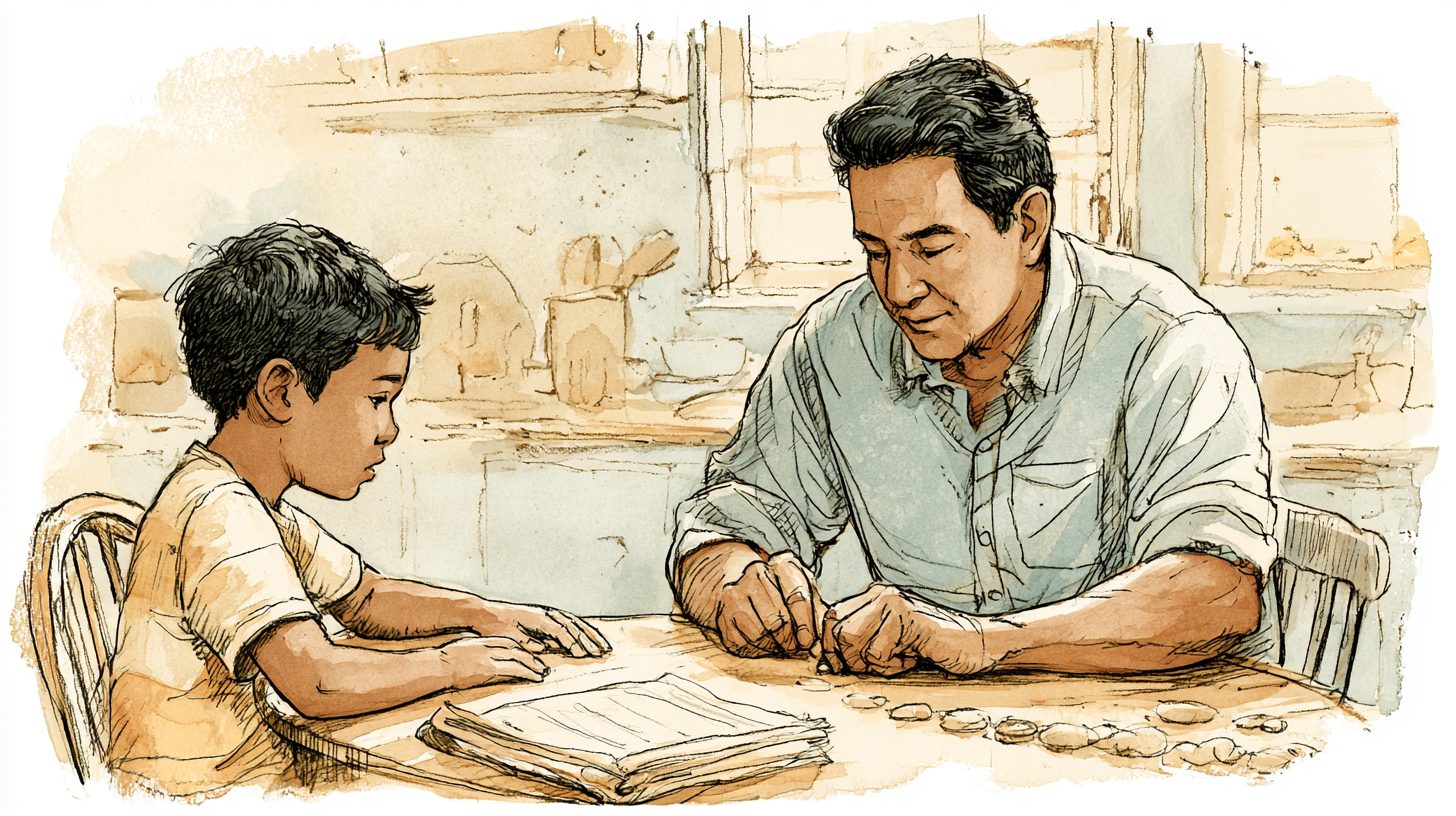
You have a report, a word, and a strange hollow feeling that nobody warned you about. Possibly relief. Possibly devastation. Quite likely both at once, which is the part that makes people feel they are handling it badly.
You are not handling it badly. This diagnosis lands differently from almost any other, and the reason is simple: nothing about your child changed this week. She is the same child she was on Monday. What changed is your understanding of her, and that turns out to be a much stranger thing to absorb than a change in her.
Why the relief and the grief arrive together
The relief is because things finally line up. The meltdowns after school, the friendship that never quite worked, the homework that took four hours, the sense that you were doing something wrong and could not find what: all of it now has a shape. That is an enormous weight off, and it is real.
The grief is quieter and takes longer to name. It is not grief for your child, whatever you might fear about yourself for feeling it. It is grief for a set of assumptions you did not know you were carrying. The easy version of school. The obvious version of independence. The picture of eighteen or twenty five that you had never consciously described but had absolutely built.
Both are legitimate. Feeling them simultaneously is not confusion, it is an accurate reading of a complicated situation.
The guilt about before
This is the one almost nobody says out loud, so here it is. Most parents, within days of a diagnosis, start replaying years of moments and reinterpreting them. The consequence that did not work. The time you lost your temper because she would not put her shoes on. The school reports you took at face value. The times you thought she was being difficult on purpose.
That reckoning is normal and it is brutal, and it usually peaks a few weeks in rather than immediately.
What is worth holding onto is this. You were working from the information you had, and the information you had was wrong, and it was wrong because the systems around her missed it too. Recognizing it now is what gives her the next ten years with a parent who understands. Children are considerably more forgiving of the years before understanding than parents are of themselves, particularly when what follows is different.
What actually changes
Not her. Your interpretation.
That sounds like a small thing and it is the whole thing, because interpretation drives everything you do. A child who will not start her homework looks like defiance under one reading and looks like an initiation problem under another, and those two readings produce completely different evenings. Most of what improves in the first year after a diagnosis is not a new technique. It is parents responding to what is actually happening.
What also changes is access. The diagnosis is the key that opens school support, accommodations, therapies, and in many places funding. That is the practical reason to have it written down even where you already knew.
What people will say that is not true
That everyone is a bit like that these days. Traits exist on a spectrum in the population, and a diagnosis is given when those traits cost a child meaningfully in daily life. Those are different statements.
That she does not look autistic, or cannot have ADHD because she can focus on things she loves. Both of these come from a picture built out of a very narrow version of each, usually a young white boy, and they miss a large share of children entirely, girls especially.
That she will grow out of it. She will grow, and her presentation will change a great deal, and the underlying wiring stays. What that means in practice is that the goal is not a child who no longer needs support. It is a young adult who knows what she needs and can ask for it.
That you should try a particular diet, supplement, or protocol that cured someone's nephew. There is a large industry positioned around newly diagnosed parents, and it works because you are frightened and willing. Nothing needs deciding this month.

There's a story for this exact struggle
The Mosquito Who Thought He Was a Dragonfly
Raised by dragonflies after a summer storm, Miro learns one night that the world sometimes sees him differently than the family who loves him — and that being misunderstood isn’t the same as being bad.
Free to read. You'll also get five free articles a week. Unsubscribe anytime.
Before you go, grab the free guide
The 3 body-state triggers under most meltdowns, a script for the 30 seconds before it tips over, and a reset for after. Free.

You'll get the guide instantly, plus five free articles in your inbox every week. Real challenges (meltdowns, school mornings, picky eating, big feelings) and how to actually handle them. Unsubscribe anytime.
The fear about the future
Nearly every parent has the same three questions and does not ask them. Will she have friends. Will she be able to live on her own. Will she be happy.
Nobody can answer those for your particular child, and anyone who does is guessing. What is worth knowing is that the answers are not written by the diagnosis. They are written far more by whether a child grows up believing there is something wrong with her, or believing she works differently and knows how to work with it. That second thing is largely built at home, and you have just been handed the information you needed to build it.
The other useful thing to know: a lot of what looks alarming at seven is not predictive of anything at twenty. Development is uneven rather than linear, and it keeps going long after the point where you were told to expect it to stop.
How long the adjustment takes
Longer than you would like, and less long than it feels in month one.
The first weeks are reading everything and feeling like you are behind. Around a month or two, the reinterpretation of the past does its work and is painful. By three to six months most parents describe a settling, where the diagnosis stops being the main subject of every day and becomes background information. Somewhere in the first year, most families reach the point where they stop thinking of it as news.
You will also have relapses, usually triggered by a school transition, a birthday, or seeing a similarly aged child do something easily. Those are normal rather than a sign you have not accepted it.
What this builds
Late in the article on purpose, because in week one a list of strengths reads as someone trying to make you feel better about something you did not consent to. None of this makes the hard parts easier and you do not have to feel positive about any of it yet.
But these children reliably arrive at some things their peers do not.
They know themselves early. A child who has had to understand why her brain does what it does has spent years on a question most adults never touch.
They tend to be honest, in a way that costs them socially at nine and serves them enormously at thirty.
They are often extraordinarily capable in the areas that hold them, because interest driven attention goes far deeper than the dutiful kind, and depth is what expertise is made of.
They notice unfairness. Children who have been on the wrong side of a rule that did not fit them grow up unusually alert to other people being treated badly.
And they become adults who can say what they need, provided the adults around them treated needing things as ordinary rather than shameful. That last part is yours, and you are already doing it by being here.
She will read this version of you later
Worth keeping in mind as you talk to family, teachers, and her. Autistic and ADHD adults describe with real precision how the adults in their childhood spoke about them, including conversations they were not supposed to have heard.
That does not mean performing serenity you do not feel. It means finding somewhere other than in front of her to put the hardest of it, and letting what she overhears be a parent working out how to help rather than a parent grieving her.
Find the other parents
The same thing that steadies families through any diagnosis applies here. The isolation lifts the moment you are in a room, or a group, where nobody needs the situation explained to them and nobody offers advice about screen time.
You are days or weeks into this and already reading about how to do it well. That is not a parent who is failing to cope. That is what coping looks like from the inside, before there is any evidence yet.
If the diagnosis came alongside another one, hearing autism and ADHD together covers that particular version. And when you are ready to tell her, how to talk to your child about it is worth reading before the conversation rather than after.
The first year is mostly learning what her patterns actually are, and it is hard to see them while you are inside the days. LightMap gives you one place to log what you notice as you notice it, and a few months in you are reading a pattern rather than a memory.
Sources: peer-reviewed research on autism camouflaging/masking and delayed diagnosis (Frontiers in Psychiatry, 2025); resilience research on protective adult relationships (Werner & Smith, Kauai Longitudinal Study).
Watching together helps too: Your Amazing ADHD Brain is a short video that explains the ADHD brain to kids, in language a nine year old can hear without shame.
For education and reflection, not medical advice. Our terms
See what's underneath
Understand the why, not just the what
LightMap turns scattered hard days into a pattern you can see. Start by logging one moment tonight.
Log today's hard moment, no account needed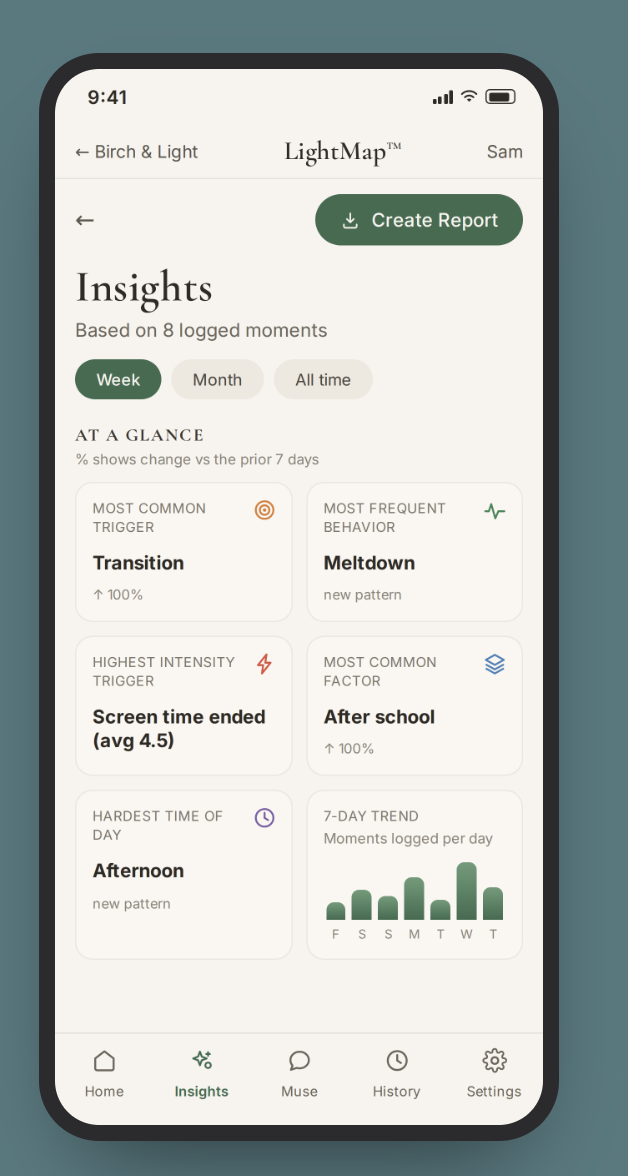

Part of the award-winning Birch & Light Method, honored with the Mom's Choice Gold Award for excellence in family resources.
A story to read together
Sometimes the easiest way in is a story you read side by side.
- The Mosquito Who Thought He Was a Dragonfly
Raised by dragonflies after a summer storm, Miro learns one night that the world sometimes sees him differently than the family who loves him — and that being misunderstood isn’t the same as being bad.
Read the story  Otto Filled Everything
Otto can't stop filling things with water. His family doesn't understand — until Grandma Willow helps them listen to what his body is actually asking for.
Read the story
Researched and drafted with AI assistance, reviewed before publication. Editorial standards