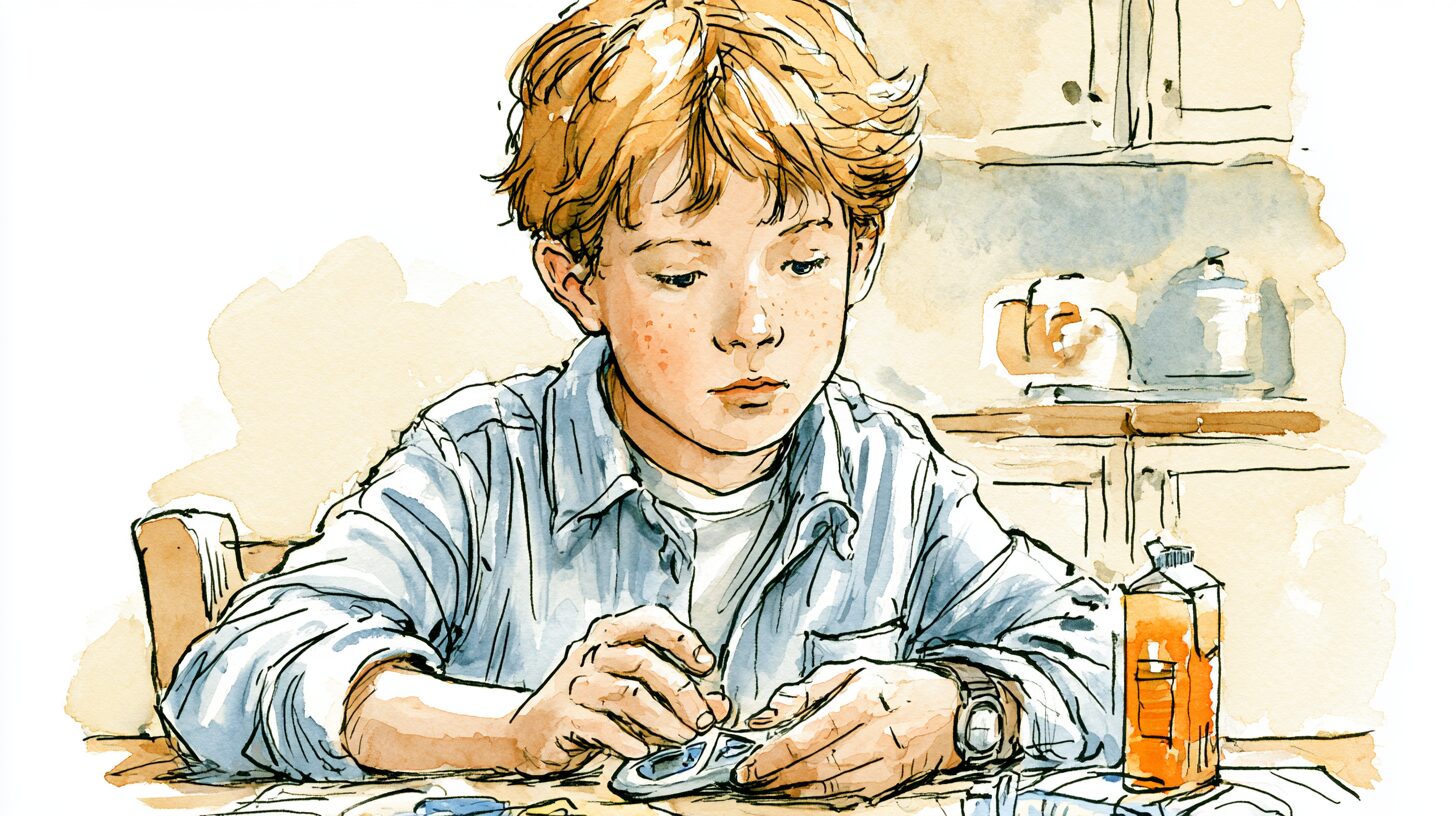
Hair pulling and skin picking in children are body-focused repetitive behaviors, formal diagnoses known as trichotillomania and excoriation disorder. They are not habits, defiance, or self-harm. The body is regulating stress or boredom, which is why telling a child to stop fails. Habit reversal training has the best evidence.
You found the hair first. A thin patch above one ear, then eyelashes, then a bald spot she has been arranging her parting to hide.
She says she does not know she is doing it. You believe her and you do not, at the same time, and you have no idea what to do next.
What these are
Body-focused repetitive behaviors, usually shortened to BFRBs, are a family of self-grooming behaviors that have gone past the point of harm. The main ones are hair pulling, known clinically as trichotillomania, and skin picking, known as excoriation disorder. Nail biting, cheek and lip biting, and hair chewing belong to the same family.
Both trichotillomania and excoriation disorder are formal diagnoses in the DSM-5-TR, grouped with obsessive-compulsive and related disorders. They are not habits, and they are not the same as self-harm, because the intent is not to cause pain or injury. The damage is a side effect of something the body is doing for another reason.
Onset is often around puberty, though it happens younger, and it occurs at higher rates alongside ADHD, autism, anxiety, and OCD.
I have watched this in my own house. One of my children spent months clipping at the skin and nails on their feet, past the point of sore, past the point of bleeding, and no amount of asking them to stop made the slightest difference. It looked like a very bad habit. I did not know until much later that it had a name, a category, and a body of research behind it, or that the reason none of my interventions worked was that I had misunderstood what the behavior was for.
Two modes, and why the difference matters
Automatic. Outside awareness. It happens while reading, watching television, in the car, doing homework. She genuinely does not notice until afterwards, which is why "just stop" lands as an accusation of lying.
Focused. In response to an urge or a feeling, with some awareness. There is often a specific sensory target: the hair that feels different, the rough patch of skin, and the pull or the pick delivers a satisfying finish.
Most children do both, and each needs a different response. Automatic pulling needs awareness and barriers. Focused pulling needs the underlying state addressed.
What it is doing for her
Regulation, in both directions. It calms when things are too much and it provides input when things are too little, which is why it spikes during stress and during boredom, and why it clusters around homework, screens, and bedtime.
That is also why removing it without replacing it rarely works. You are taking away a tool that is doing a job.
What should I stop doing?
Telling her to stop. She knows. She has told herself a thousand times.
Watching and pointing it out. Constant monitoring turns a private behavior into a shared surveillance problem, adds shame, and shame reliably increases the behavior.
Punishment or removing privileges. This is not a compliance issue and consequences cannot reach it.
Making her feel bad about her appearance. Comments about how her hair used to look, however gently meant, land as confirmation that she has ruined something.
While you're here, take the guide
What's Underneath is free: the three body-state triggers under most meltdowns, what to say in the minute before it tips over, and how to reset afterward.

You'll get the guide instantly, plus five free articles in your inbox every week. Real challenges (meltdowns, school mornings, picky eating, big feelings) and how to actually handle them. Unsubscribe anytime.
What actually helps
The intervention with the best evidence is habit reversal training, often within a broader model that maps out the specific triggers. It has three parts.
Awareness training. Noticing the hand rising, and noticing the situations where it happens: which room, which activity, which time of day.
Competing response. Doing something incompatible with the behavior for a short period once the urge is noticed, such as closing a fist or sitting on the hands, so the urge passes without the pull.
Stimulus control. Changing the environment so the behavior is harder and a substitute is easier. Fidget toys with a similar sensory quality, a textured object for picking hands, hair tied up, gloves or plasters at high-risk times, better lighting or a covered mirror where mirror picking is the pattern.
This approach has been tested in children. Franklin and colleagues compared a behavioral therapy protocol with a minimal attention control in 24 children and teens ages 7 to 17 with trichotillomania and found it effective, with results that held over time.
None of this is willpower. It is engineering.
When should I take her to a doctor?
See someone if skin is infected or not healing, if hair loss is significant, and always if she is eating the hair. Swallowed hair can form a mass in the stomach that requires surgical removal, and this is the one genuinely urgent complication in this category.
For treatment, look for a psychologist trained in habit reversal specifically. General talk therapy aimed at feelings does not tend to reduce the behavior on its own.
The part that matters most
Shame is the engine here. Children with BFRBs hide them, often successfully, for years. They wear hoods and long sleeves, they arrange their hair, they avoid swimming and sleepovers, and they carry a private belief that they are disgusting.
The most useful thing you can say is that this is a known thing with a name, that plenty of people have it, that it is not a character flaw, and that you are not going to police it. Then help her build the environment that makes it less available.
If anxiety is the state underneath, how reassurance can maintain anxiety is relevant, and setting up a calm down space covers building alternative regulation.
Track the conditions rather than the count: what she was doing, what time, how the day had gone, whether anyone had commented. Logged in LightMap, that shows whether this is boredom-driven, stress-driven, or both, which is what determines whether you change the environment or address the load.
She is not doing this to herself on purpose, and she is not doing it at you. Her body found a way to manage something, and it needs a better one.
Sources: DSM-5-TR criteria for trichotillomania and excoriation disorder; TLC Foundation for Body-Focused Repetitive Behaviors clinical resources and the Comprehensive Behavioral model; peer-reviewed research on habit reversal training and behavioral treatment outcomes for BFRBs (PMC; Journal of the American Academy of Child and Adolescent Psychiatry); research on the co-occurrence of BFRBs with ADHD, autism, anxiety, and OCD (PMC); case literature on trichophagia and trichobezoar formation requiring surgical intervention (PMC).
Franklin ME, Edson AL, Ledley DA, Cahill SP. Behavior therapy for pediatric trichotillomania: a randomized controlled trial. Journal of the American Academy of Child and Adolescent Psychiatry. 2011;50(8):763-771.
For education and reflection, not medical advice. Our terms
See what's underneath
Understand the why, not just the what
LightMap reads your hard days together and gives you answers. Start with one moment today.
Start with 3 moments Not sure where to start? Ask me.Message Tara on WhatsApp. It really is me, I read everything and will personally respond.Click here to message Tara →

Part of the award-winning Birch & Light Method, honored with the Mom's Choice Gold Award for excellence in family resources.
A story to read together
Sometimes the easiest way in is a story you read side by side.
 The Mosquito Who Thought He Was a Dragonfly
Raised by dragonflies after a summer storm, Miro learns one night that the world sometimes sees him differently than the family who loves him — and that being misunderstood isn’t the same as being bad.
Read the story Otto Filled Everything
Otto can't stop filling things with water. His family doesn't understand — until Grandma Willow helps them listen to what his body is actually asking for.
Read the story
If today was one of those days
A few more from the library, free to read.
Researched and drafted with AI assistance, reviewed before publication. Editorial standards