
You ask him to go upstairs, get his shoes, and put them by the door. He goes upstairs. Ten minutes later he is on his bed with a toy and no shoes anywhere.
It looks like not listening. It looks like not caring. It is very often neither.
What DLD is
Developmental language disorder is a difficulty understanding and using language that is not explained by hearing loss, autism, intellectual disability, or another known cause. It was previously called specific language impairment, and the name changed to reflect how often it occurs alongside other conditions rather than in isolation.
It affects roughly seven percent of children. That is about two in an average classroom, more common than autism, and most parents and a fair number of teachers have never heard of it.
It is not the same as a speech sound difficulty. A child with an articulation problem is hard to understand. A child with DLD may be perfectly clear and still not follow what was said, or struggle to assemble what they want to say.
Receptive and expressive
Receptive is taking language in. Following multi-step instructions, understanding questions, keeping up with a long explanation, catching figurative or abstract language.
Expressive is putting language out. Finding the word, building the sentence, telling an event in order, giving enough information for a listener who was not there.
Receptive difficulty is the one that gets missed, because it is invisible. A child who talks fluently is assumed to understand fluently, and those are separate systems.
What to look for
- Instructions with more than one step routinely fall apart, especially the later steps
- Vague language: thing, stuff, that one, the word gone from the tip of the tongue
- Stories told out of order, with the listener left to work out who is who
- Answers that are slightly off the question asked
- Copying peers to work out what to do rather than acting on what was said
- Trouble with jokes, idioms, sarcasm, and anything that is not literal
- Difficulty learning to read, since reading is built on the language system
- Fatigue and shutdown after a school day of continuous listening
Why it gets called defiance
This is the part that matters most, because it changes how a child is treated for years.
An adult gives an instruction. The child does not do it, or does part of it, or does something adjacent. From the outside that is non-compliance, and non-compliance gets consequences. The child, who did not fully receive the instruction, is now being punished for something he could not act on and cannot explain.
The same mechanism produces the ADHD referral, since not following instructions is on every attention checklist. Plenty of children have both, and DLD alone can produce that presentation without any attention difficulty at all.
It also produces anxiety. Rates of emotional and social difficulty are substantially higher in children with DLD, which makes sense: spending every day in an environment where you catch most but not all of what is said is genuinely stressful.
While you're here, take the guide
What's Underneath is free: the three body-state triggers under most meltdowns, what to say in the minute before it tips over, and how to reset afterward.

You'll get the guide instantly, plus five free articles in your inbox every week. Real challenges (meltdowns, school mornings, picky eating, big feelings) and how to actually handle them. Unsubscribe anytime.
Getting it assessed
The professional is a speech and language therapist or pathologist. Ask for a full language assessment covering receptive and expressive language separately, not a speech sound screen and not a quick conversational check. A child who chats easily can pass an informal look and still have significant receptive difficulty.
In American schools, speech and language services are available through an IEP, and the evaluation can be requested from the district in writing. Ask for reading to be assessed at the same time, given the overlap with dyslexia.
What actually helps, starting today
These cost nothing and change a household quickly.
- One instruction at a time. Not three chained together.
- Shorter sentences, ordinary words, and a pause between them.
- Wait. Processing time can be several seconds, and repeating the sentence during that window restarts the whole process.
- When you do repeat, use the same words first. Instant rephrasing gives him a second sentence to decode rather than another chance at the first.
- Check by asking him to tell you the plan, not by asking whether he understood. He will say yes.
- Write it or draw it. Visual instructions stay still while spoken ones vanish.
- Give the word when he is hunting for it, unless he has asked you not to.
Assume incomprehension before defiance. It costs nothing to check, and it is right more often than most of us expect.
When the pattern is already being read as opposition, when anxiety looks exactly like defiance covers the same misreading from a different angle. If reading is also affected, dyslexia shares a foundation with DLD and frequently occurs with it. For younger children whose speech itself is hard to understand, this piece on toddler speech clarity is the better starting point.
Log the misses rather than the outcome: what exactly was said, how many steps it contained, how much noise was in the room, what he did instead. In LightMap, a few weeks of that shows whether the failures track sentence length and complexity, which is the pattern a language assessment is built to confirm.
He is not ignoring you. Some of what you said did not arrive.
Sources: CATALISE consensus statements on terminology and identification of developmental language disorder (Bishop et al.; PMC); Norbury et al. on the prevalence of language disorder in a population cohort (Journal of Child Psychology and Psychiatry; PMC); DSM-5-TR criteria for language disorder; RADLD (Raising Awareness of Developmental Language Disorder) resources; American Speech-Language-Hearing Association practice portal on spoken language disorders; peer-reviewed research on the co-occurrence of DLD with reading difficulty and with emotional and behavioral difficulties (PMC).
For education and reflection, not medical advice. Our terms
See what's underneath
Understand the why, not just the what
LightMap reads your hard days together and gives you answers. Start with one moment today.
Start with 3 moments Not sure where to start? Ask me.Message Tara on WhatsApp. It really is me, I read everything and will personally respond.Click here to message Tara →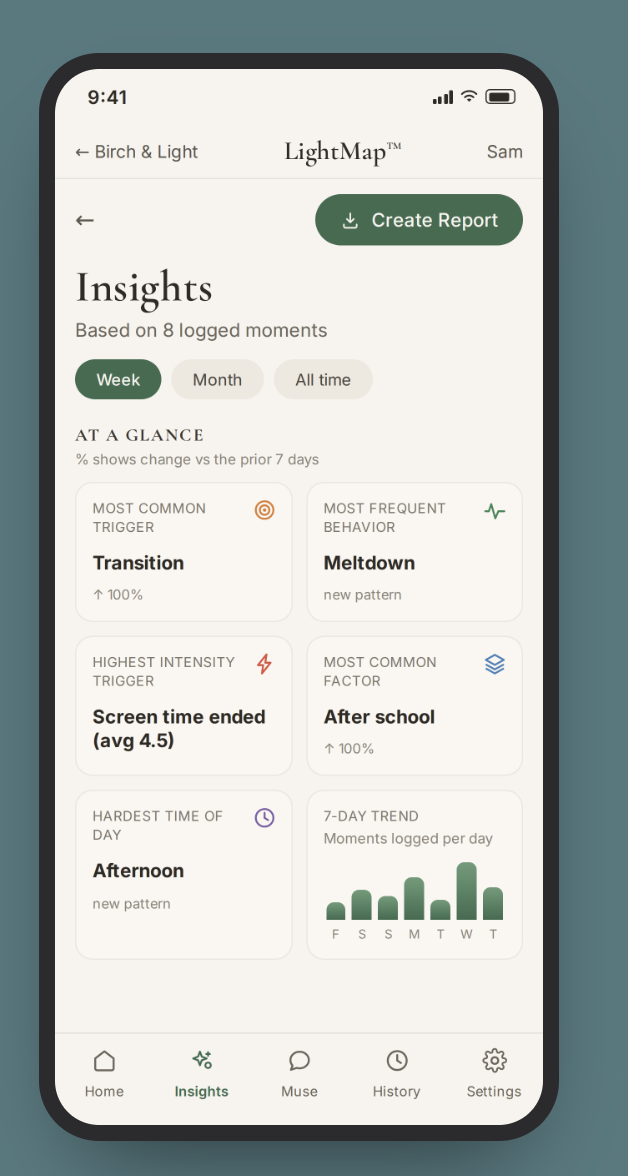

Part of the award-winning Birch & Light Method, honored with the Mom's Choice Gold Award for excellence in family resources.
A story to read together
Sometimes the easiest way in is a story you read side by side.
 The Mosquito Who Thought He Was a Dragonfly
Raised by dragonflies after a summer storm, Miro learns one night that the world sometimes sees him differently than the family who loves him — and that being misunderstood isn’t the same as being bad.
Read the story Otto Filled Everything
Otto can't stop filling things with water. His family doesn't understand — until Grandma Willow helps them listen to what his body is actually asking for.
Read the story
If today was one of those days
A few more from the library, free to read.
Researched and drafted with AI assistance, reviewed before publication. Editorial standards