

You find the wrappers first. Then a stash in the closet, or under the bed, or at the back of a drawer. Then you realize she has been getting up in the night to eat it, and that a jar you bought two days ago is empty.
The instinct is to treat this as a discipline problem, because it involves sneaking and it feels like it is about honesty. It is almost never about honesty, and treating it that way tends to make it worse. Here is what is usually going on underneath.
Start with the medication question
If your child takes a stimulant, look here before anywhere else, because this is the single most common explanation and the one most often missed.
Stimulants suppress appetite. Not slightly, and not only at lunchtime. A medicated child frequently eats very little from morning until late afternoon, and because she is not complaining and not obviously unwell, the amount she has actually eaten goes unnoticed. Then the medication wears off, and her body spends the evening and the night trying to make up a whole day of missed intake.
Children in this situation are genuinely, physically hungry. The hiding is not part of the hunger, it is a response to what happens when they eat openly, which is usually a comment about how much, or how late, or what kind.
If this fits, it is a conversation with the prescriber rather than a behavior plan. Dose, timing, and formulation all affect how long the suppression lasts and when the rebound lands, and adjusting them often resolves the whole picture. Say at that appointment that she is eating almost nothing during the day and waking at night to eat, because that combination gets a different response from a prescriber than a general mention of appetite.
Hunger signals that arrive late and loud
Plenty of neurodivergent children have a weak or delayed sense of what is happening in their own bodies. Hunger does not register as a gentle prompt an hour before dinner. It registers as nothing at all, and then it registers as urgent.
That is why a child can refuse lunch entirely and then eat with an intensity that looks alarming. She was not being difficult at lunch and she is not being greedy now. Her body skipped the part in the middle where most people notice they are getting hungry.
The same mechanism makes it hard for her to notice when she has had enough, which is why eating can continue past the point an adult would stop.
Food as regulation
Sweet and fatty foods are reliably, immediately rewarding, and for a brain that struggles to generate that feeling on its own, they do something. Reaching for them at the end of a long day of holding it together is not weakness or defiance, it is a child finding a lever that works.
Worth noticing when the stashes get raided. If it clusters after hard days, difficult evenings, or bad weeks at school, then food is doing a job, and removing it without replacing the function will not go well.
Why the secrecy grows
This is the part that turns a manageable thing into a persistent one.
A child eats openly. An adult comments, gently and reasonably. The child registers that eating is watched. She eats where nobody is watching. The adult discovers wrappers, and now there is a conversation about lying as well as one about food. The child concludes that the problem is being caught rather than the eating itself, and gets better at not being caught.
None of that requires anyone to have done anything cruel. Ordinary, well meant comments are enough to start it.
Why locking the cabinets backfires
It is the obvious move and it usually escalates things.
Restricting access confirms what the hoarding was already assuming, which is that food is something that has to be secured before someone stops you. Children respond by taking more when they get the chance, hiding it better, and taking from other places, at school, at friends' houses, out of bags. The eating does not reduce. It relocates and becomes harder to see.
It also adds shame to something that was previously just a habit, and shame is the ingredient that makes this hard to unwind years later.
For children with a history of real food scarcity, including many adopted and fostered children, locking food is even more likely to entrench the behavior, because it confirms an experience they have already had.

There's a story for this exact struggle
The Mouse Who Heard Everything
Mina Mouse hears every creak the old house makes at night. The story gently shows that her brain isn’t broken — it’s working overtime to keep her safe — and what changes when someone sits beside her in the dark.
Free to read. You'll also get five free articles a week. Unsubscribe anytime.
Before you go, grab the free guide
The 3 body-state triggers under most meltdowns, a script for the 30 seconds before it tips over, and a reset for after. Free.

You'll get the guide instantly, plus five free articles in your inbox every week. Real challenges (meltdowns, school mornings, picky eating, big feelings) and how to actually handle them. Unsubscribe anytime.
What tends to work instead
Make some food openly and permanently hers. A basket in her room, or a labeled shelf she can reach, that she can take from without asking and without anyone remarking on it. It feels counterintuitive, and it is the intervention that most reliably reduces hoarding, because there is nothing left to sneak.
Keep it stocked without commentary. The point is reliability. If it empties and gets refilled without a discussion, the message is that food is not scarce and not monitored. If it empties and produces a conversation, you are back where you started.
Move eating earlier where you can. If medication is flattening her appetite during the day, the windows before it takes effect and after it wears off matter, and food offered in those windows without pressure tends to land better than food offered at the times she is least able to eat.
Say nothing about quantity. Not amounts, not timing, not what kind, and nothing at all about her body. This is the hardest one and it does the most work.
Handle the night stash matter of factly. Something to eat by her bed, agreed in advance, removes the need to raid the kitchen and removes the night time secrecy in one move.
The night waking itself
Worth mentioning to her pediatrician separately, because there are a few different things it can be. Sometimes it is straightforward hunger from an under eaten day. Sometimes a child wakes for other reasons and eats because she is awake. And occasionally children eat during partial arousals from sleep with little or no memory of it afterwards, which is a sleep issue rather than an eating one and gets managed differently.
You can usually tell the difference by asking in the morning, without any edge in the question, whether she remembers.
When it is worth asking for more help
Most of what is described here is ordinary in ADHD households and settles once the medication timing and the access are sorted out. Some things are worth raising with your pediatrician rather than managing at home.
Eating to the point of pain or distress. Any evidence of getting rid of food afterwards. Real distress, guilt, or self criticism around eating or her body. Hoarding food until it spoils. Marked changes in weight in either direction. Or eating that seems driven by something more like compulsion than hunger.
None of those mean something is badly wrong. They mean the picture is bigger than appetite and deserves someone looking at it properly rather than a parenting strategy.
What to say when you find the stash
As little as possible, and nothing in the moment that sounds like being caught.
Something flat works best. That you have noticed she gets hungry at night, that being hungry is completely reasonable, and that you are going to sort out somewhere she can keep food so she does not have to go downstairs. No question about why, no reference to the wrappers, no talk about honesty.
What you are aiming for is a child who stops needing to hide, and the fastest route there is removing every reason to.
If she is medicated and the appetite piece is the driver, whether the medication is still working for her is the conversation to have next. And if the stashes cluster after hard days, why small things land so heavily covers what she may be managing.
When it happens, what kind of day preceded it, and how much she actually ate before it: those three together usually reveal the pattern within a couple of weeks. LightMap is a place to log them without making it a subject in the house.
This is general information for parents, not medical or nutritional advice. Any concern about your child's eating, growth, or medication belongs with their doctor.
Sources: FDA prescribing information for stimulant medications on appetite suppression; peer-reviewed research on appetite, growth, and rebound eating in children treated with stimulants (PMC; Journal of the American Academy of Child and Adolescent Psychiatry); American Academy of Pediatrics guidance on monitoring growth and nutrition during ADHD treatment.
For education and reflection, not medical advice. Our terms
See what's underneath
Walk into the next appointment with a pattern
LightMap turns scattered hard days into a pattern you can see. Start by logging one moment tonight.
Log today's hard moment, no account needed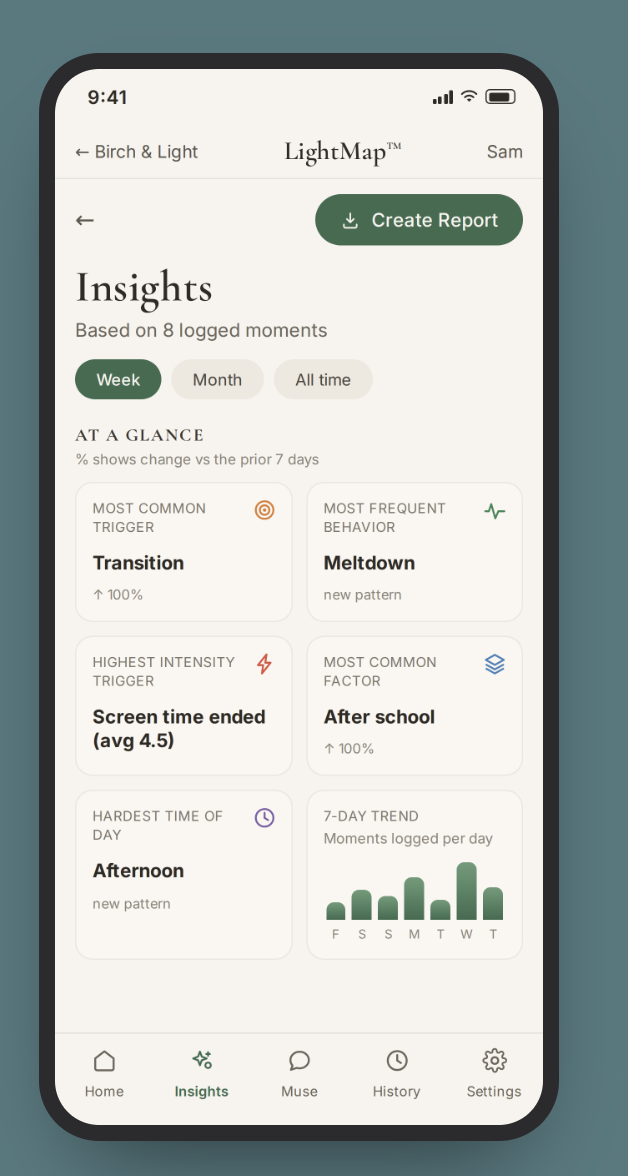

Part of the award-winning Birch & Light Method, honored with the Mom's Choice Gold Award for excellence in family resources.
A story to read together
Sometimes the easiest way in is a story you read side by side.
- The Mouse Who Heard Everything
Mina Mouse hears every creak the old house makes at night. The story gently shows that her brain isn’t broken — it’s working overtime to keep her safe — and what changes when someone sits beside her in the dark.
Read the story  When Axel's Engine Stayed On
After a big, exciting day, Axel's body is tired but his engine won't quiet down. A gentle story about overstimulated kids who can't settle — and the calm grown-ups who help them.
Read the story
Researched and drafted with AI assistance, reviewed before publication. Editorial standards