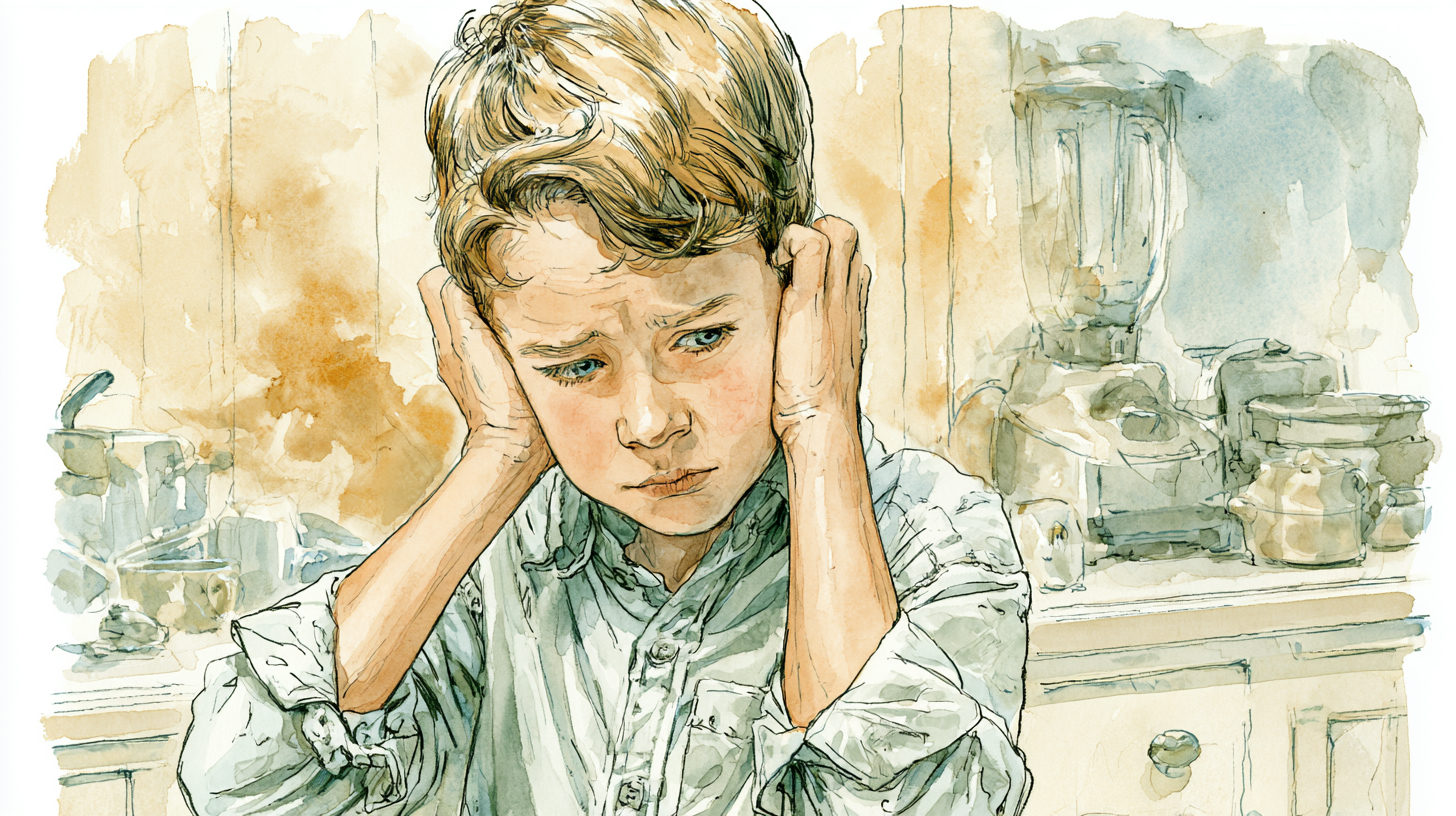
The hand dryer in a public bathroom. The vacuum cleaner. A round of applause. The blender. Sounds that barely register for you can send your child's hands flying to their ears, sometimes with a panic that seems wildly out of proportion to the noise. And it can be baffling — or even a little embarrassing in public — to watch a child react to an ordinary sound as if it were genuinely hurting them.
Here's the thing worth understanding before anything else: for many children, it genuinely is. The ear-covering isn't drama, defiance, or oversensitivity in the dismissive sense. It's a real response to sound that their nervous system processes very differently than yours.
Why Some Sounds Genuinely Hurt
Children who cover their ears are often experiencing something called auditory sensitivity — a difference in how the nervous system processes sound. For these children, certain sounds aren't just louder or more annoying; they can be physically uncomfortable or even painful in a way that's hard for the rest of us to imagine.
A few things tend to be true for a sound-sensitive child. Sudden, unpredictable sounds — a hand dryer kicking on, a dog barking, a balloon popping — can feel almost like a physical jolt. Certain frequencies or pitches can be specifically intolerable, even at moderate volume. And in an environment with a lot of competing sound, like a cafeteria or a party, the inability to filter out background noise means the whole wall of sound comes at them at once, with nothing dampened.
Covering their ears is simply the most direct thing a child can do to protect themselves from input that genuinely hurts. It's not an overreaction to a small thing. It's a reasonable reaction to something that, for them, is not small at all.
The sound that barely registers for you may be genuinely painful for your child. The ear-covering is protection, not performance.
Why It's Easy to Misread
The reason this gets misread so often is that we naturally assume other people experience the world roughly the way we do. If a sound doesn't bother you, it's hard to believe it could be causing your child real distress — so the reaction can look like exaggeration, attention-seeking, or being 'difficult.'
But sensory processing varies enormously from person to person. Your child isn't experiencing the same sound you are and reacting differently. They're having a genuinely different sensory experience — one where the sound really is overwhelming. Once you accept that their experience is real rather than performed, the whole situation shifts from a behavior to manage into a need to accommodate.
What the Ear-Covering Prevents
It also helps to understand what happens if a sound-sensitive child can't escape or dampen the input. Sustained exposure to painful or overwhelming sound doesn't just stay a minor discomfort. It builds. For many children, unrelenting auditory overload is a direct path to a meltdown or a shutdown — the nervous system, pushed past what it can tolerate, finally tips over.
Seen that way, the ear-covering is your child doing exactly the right thing: self-regulating, protecting themselves, trying to keep the input manageable before it becomes unbearable. It's a coping strategy, and a fairly sophisticated one. Punishing it or forcing them to stop removes a tool they're using to stay regulated.
While you're here, take the guide
What's Underneath is free: the three body-state triggers under most meltdowns, what to say in the minute before it tips over, and how to reset afterward.

You'll get the guide instantly, plus five free articles in your inbox every week. Real challenges (meltdowns, school mornings, picky eating, big feelings) and how to actually handle them. Unsubscribe anytime.
What Tends to Help
Believe them. The single most important shift is accepting that the sound genuinely bothers them. Once you're no longer trying to talk them out of their own experience, you can actually help.
Give them tools. Noise-reducing headphones or earplugs can be transformative for a sound-sensitive child, letting them tolerate environments that would otherwise be unbearable. Far from a crutch, they're an accommodation that expands where your child can comfortably go.
Warn before predictable sounds. Much of the distress comes from sounds being sudden. When you can, give a heads-up — 'I'm about to turn on the blender' — so the sound is predictable rather than a jolt. Predictability alone takes a surprising amount of the sting out.
Allow the escape. Let your child cover their ears, leave the room, or step outside when a sound is too much. Honoring their need to protect themselves prevents the slide toward overload and teaches them that their limits are allowed.
Plan around the worst offenders. If you know certain places or events are full of intolerable sound, you can prepare — headphones in the bag, an exit plan, a quieter time of day. Working around the sensitivity is often easier than pushing through it.
Don't force exposure to 'toughen them up.' Repeatedly forcing a child to endure sounds that hurt them doesn't build tolerance; it builds distress and erodes trust. Sensitivity usually eases with development and support, not with forced endurance.
The Shift Worth Making
A child who covers their ears isn't being dramatic or difficult. They're having a real sensory experience in which ordinary sounds are genuinely overwhelming, and they're doing something smart about it — protecting themselves before the input tips them into something worse.
When you can see the ear-covering as the reasonable, self-protective coping strategy it is, your job changes from stopping it to supporting it: believing your child, giving them tools, and helping them move through a world that's often louder, for them, than it is for you.
Every behavior is a clue.
If certain sounds reliably set your child off, LightMap can help you track which ones and what helps them cope — so the pattern beneath it becomes easier to see. Explore LightMap at birchandlight.com/lightmap.
For your child: The Little Porcupine by the Road is about a porcupine whose quills are always up, brought to a noisy place, whose body slowly stops needing to be on alert without the place ever getting quieter.
Sources: Peer-reviewed research on auditory over-responsivity and decreased sound tolerance in children, including pediatric hyperacusis (PMC; Frontiers in Neuroscience); American Academy of Audiology guidance on decreased sound tolerance; research on auditory figure-ground difficulty and filtering in noisy environments (PMC); Dunn's Model of Sensory Processing; STAR Institute for Sensory Processing.
For education and reflection, not medical advice. Our terms
See what's underneath
Find the input before it becomes a meltdown
LightMap reads your hard days together and gives you answers. Start with one moment today.
Start with 3 moments Not sure where to start? Ask me.Message Tara on WhatsApp. It really is me, I read everything and will personally respond.Click here to message Tara →

Part of the award-winning Birch & Light Method, honored with the Mom's Choice Gold Award for excellence in family resources.
A story to read together
Sometimes the easiest way in is a story you read side by side.
 Taste Bud 17
Taste Bud 17 feels everything more — and learns that big sensory feelings deserve the same care as everyone else’s.
Read the story Otto Filled Everything
Otto can't stop filling things with water. His family doesn't understand — until Grandma Willow helps them listen to what his body is actually asking for.
Read the story
If today was one of those days
A few more from the library, free to read.
Researched and drafted with AI assistance, reviewed before publication. Editorial standards