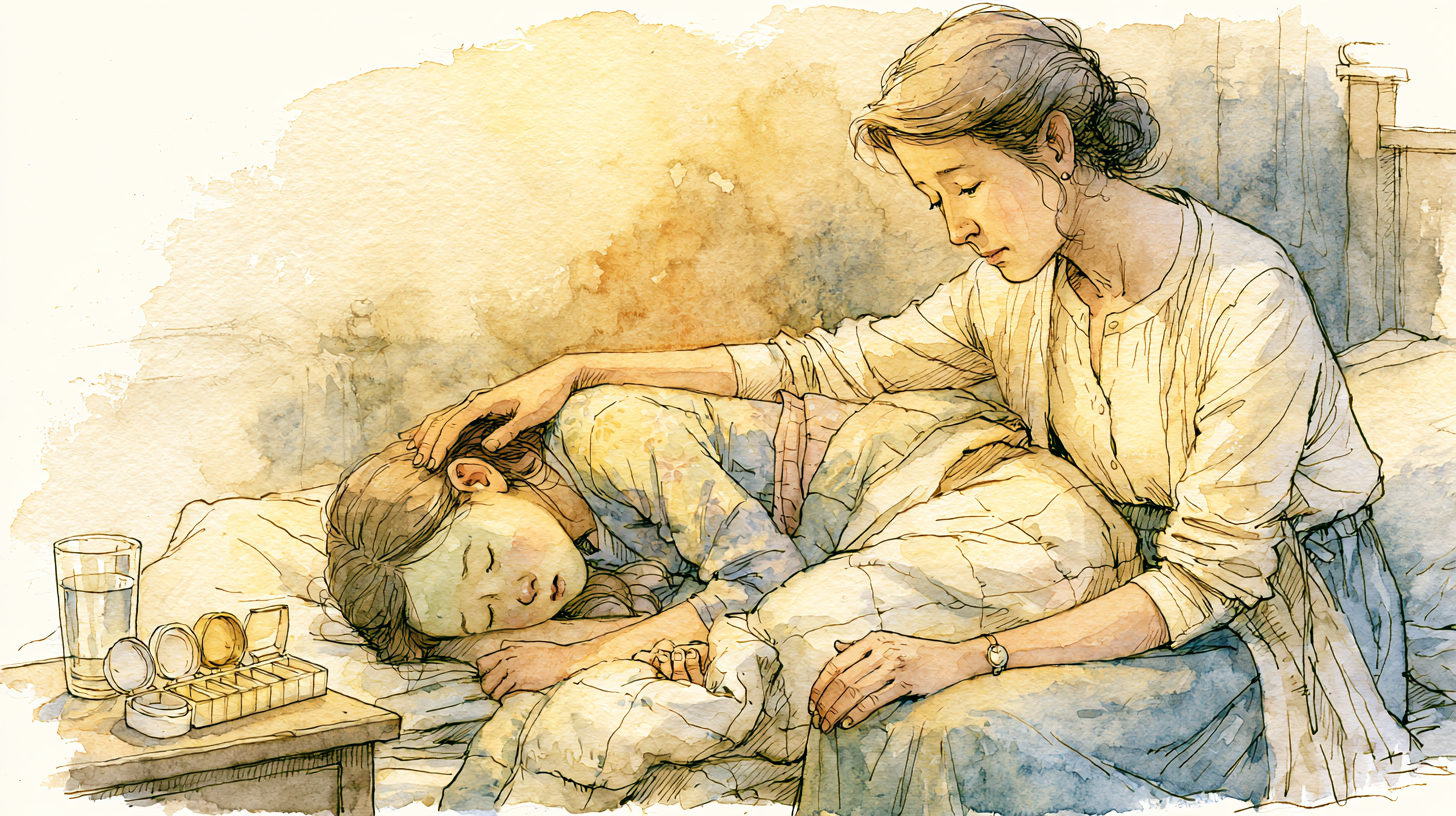
Here is a pattern almost nobody warns parents about: your child has been on a psychiatric medication for two or three years, tolerating it fine. Then new physical symptoms appear. Dizziness. Nausea. Vomiting spells. Headaches. Crushing fatigue. And because the medication has been on board for years, it is the one suspect nobody investigates.
The workup goes everywhere else. GI referrals, bloodwork, imaging, food logs. The medication sits quietly in the corner of every appointment wearing its two-year alibi: she has been on it forever, it cannot be that.
Except sometimes it is.
Late-onset side effects are real
Most parents are told about side effects as a starting-the-med problem: watch the first few weeks, and if she tolerates it, you are in the clear. That is incomplete. Physical side effects from psychiatric medications, including antipsychotics, SSRIs, and alpha agonists, can emerge months or years after starting, and the reasons are not mysterious once you see them.
Kids are moving targets. Puberty changes how the liver processes medications, sometimes dramatically. Bodies grow while doses stay put, or doses climb while bodies change shape underneath them. New medications get added over the years, and each addition changes the chemistry of everything already on board. A medication that fit a nine-year-old's body can sit very differently in a twelve-year-old's. Newly onset dizziness, stomach trouble, vomiting, appetite shifts, or movement changes in a child on long-term psychiatric medication always deserve one direct question at the appointment: could any of her medications be contributing to this?
Our story
I will tell you why I push on this. One of my daughters spent a long stretch on a full medication load. Antibiotics until December of that year, and after those ended, her psychiatric medications continued on their own through the spring. During those months she developed cyclical vomiting syndrome. Real, brutal, recurring vomiting episodes that took over her life, in a kid who had tolerated her medications for years.
We chased it the way every family does. And in the end, with her doctors, the answer was not another specialist or another prescription. It was subtraction. Her team took her off every single thing, deliberately and under supervision, so her body could reset and tell us the truth. She is doing OK right now. I am not going to pretend one family's story is proof of what is happening in your child's body. But I will tell you the question I wish someone had asked us months earlier: what if the medications are the illness now?
While you're here, take the guide
What's Underneath is free: the three body-state triggers under most meltdowns, what to say in the minute before it tips over, and how to reset afterward.

You'll get the guide instantly, plus five free articles in your inbox every week. Real challenges (meltdowns, school mornings, picky eating, big feelings) and how to actually handle them. Unsubscribe anytime.
What a med wash is
What our team did has a name. A medication washout, or med wash, is a planned, supervised period where medications are systematically tapered off so the child's actual baseline becomes visible again. Prescribers consider it when the picture has gotten unreadable: symptoms despite medication, new physical illness without a clear cause, or years of additions with nobody certain anymore what each medication is doing.
Three honest things about med washes. First, they are a legitimate clinical tool, not a fringe idea; the whole point is information. After years of overlapping medications, nobody, including the prescriber, truly knows what your child looks like without them, and sometimes that knowledge is the most valuable thing left to get. Second, they are designed and run by the prescriber, taper by taper, because several psychiatric medications are genuinely unsafe to stop abruptly. A med wash is the opposite of quitting cold turkey. It is the careful, scheduled version of the question you are already asking. Third, a wash is not necessarily forever. Some kids restart one medication that clearly earned its place. Some restart nothing. The wash does not decide the ending; it just turns the lights on.
How to raise it without a fight
You do not need to walk in demanding a washout. Bring the pattern instead. A few weeks of notes on the physical symptoms, when they hit, how long, what was around them, plus the medication list with start dates, tells a story a prescriber can read. Then ask plainly: could any of these medications be contributing to the physical symptoms? Is there a way to simplify, one variable at a time, so we can see what is doing what? If the answer is a shrug, it is fair to ask for a second opinion, ideally from a child psychiatrist if one is not already involved. Bodies have a way of saying enough is enough. When a child on long-term medication starts getting physically sick in new ways, that is not background noise. That is data.
Symptom timing is the whole case here. Logging the physical episodes next to daily patterns in something like LightMap means you walk into the appointment with the timeline in your hand instead of in your memory.
You are allowed to ask whether the treatment has become the problem. It is one of the bravest and most protective questions a parent can bring into that room.
Sources: Journal of the American Academy of Child & Adolescent Psychiatry on endocrine and metabolic effects of psychotropic medications in youth; American Academy of Pediatrics and American Academy of Child and Adolescent Psychiatry guidance on medication holidays.
For education and reflection, not medical advice. Our terms
See what's underneath
Stop guessing what set it off
LightMap reads your hard days together and gives you answers. Start with one moment today.
Start with 3 moments Not sure where to start? Ask me.Message Tara on WhatsApp. It really is me, I read everything and will personally respond.Click here to message Tara →

Part of the award-winning Birch & Light Method, honored with the Mom's Choice Gold Award for excellence in family resources.
A story to read together
Sometimes the easiest way in is a story you read side by side.
 The Tower That Looked Fine
A tower in a quiet clearing tries to stay steady through every small thing nobody else seems to notice — until one tiny breath of wind causes her to fall, and a gentle hand begins to gather the blocks back.
Read the story The Boy at the Edge
A boy finds calm by watching the world move from a window. When his stillness is mistaken for defiance, the moment escalates — and he learns that being calm doesn’t always protect you from being told no.
Read the story
If today was one of those days
A few more from the library, free to read.
Researched and drafted with AI assistance, reviewed before publication. Editorial standards