
There is a kind of exhaustion that does not have a tidy name. It belongs to the families who have done everything: the therapists, the outpatient programs, the specialists, the medications, the supplements, the endless research at midnight. And still the crisis at home does not lift. The child is suffering, the siblings are hiding in their rooms, the parents are in their own therapy just to stay upright, and someone, often a trusted clinician, finally says the words: it may be time for a higher level of care.
If you have arrived at that sentence, this is an orientation to a world most parents are never taught to navigate until they are already lost in it. None of what follows is medical, legal, or insurance advice; every child and plan is different, and your treating clinicians are the ones who know yours. This is a map, not a directive.
The levels of care, briefly
Mental health treatment is not just therapy-or-hospital. There is a whole ladder in between, and knowing the rungs helps you ask for the right one.
Outpatient therapy is the familiar weekly appointment. Intensive outpatient (IOP) adds more hours per week, often several days. Partial hospitalization (PHP) is close to full-day treatment while the child still sleeps at home. Residential treatment is living at a facility for weeks or months, doing daily therapeutic work in a structured setting. And inpatient psychiatric hospitalization is the short-term, acute-safety level, usually measured in days, for stabilizing an immediate crisis.
These are not a straight staircase every child climbs in order. A family might move from outpatient straight to residential, or use PHP to step down after a hospital stay. The point of naming them is so you can say precisely what you are asking for.
What residential treatment actually is, and is not
It helps to be clear-eyed here, because both the fear and the hope around residential tend to run ahead of the reality.
Residential is not a punishment, and it is not abandonment, though a child in crisis may frame it as both, and a parent's own guilt may echo that framing. What it fundamentally offers is not a specific therapy unavailable elsewhere. It is a change of environment. It removes the child from the exact setting where the crisis cycle keeps repeating and places them somewhere structured, consistent, and staffed around the clock, where they can do sustained therapeutic work without the daily triggers of home, and where the family gets a chance to breathe and heal too.
And here is the honest part that the glossy program brochures will not lead with: residential is not a magic fix. Some children come home transformed. Some come home a little better. Some cycle in and out for years. Removing a child from a broken environment creates the conditions for change; it does not guarantee it. Going in with that expectation protects you from a particular heartbreak later.
The medical-necessity question, and the insurance no
Many families hit an early wall: they call insurance, describe the situation, and are told residential is only covered for something like addiction or active suicidality. It is worth understanding what is actually happening in that conversation.
Coverage for higher levels of care generally turns on a concept called medical necessity. That standard is broader than the two things families are often quoted on the phone. Severe, dangerous aggression; a child who cannot be kept safe at home; repeated failure to improve at lower levels of care despite genuine effort, these can all be part of a medical-necessity picture. The specifics depend on the plan, the state, and the documentation, which is exactly why the phone answer is so often incomplete.
A few things parents in this position have found worth knowing. The first no from a phone representative is frequently not the final decision; it is a starting position. What tends to carry weight is documentation from the treating clinicians, the ones who can speak to safety risk and to everything that has already been tried and has not worked. Denials can often be appealed, and there are people whose job is to help: case managers, patient advocates, and in the therapeutic-placement world, educational or therapeutic consultants who navigate this maze for a living. The system is genuinely hard to move, and also more movable than a single discouraging phone call suggests. Your clinicians are your partners in making that case.
The funding routes most parents are never told about
Beyond a straight insurance approval, there are two paths families often discover only by accident, from another parent or a late-night search, that are worth knowing before you conclude residential is out of reach financially.
The school district route. This is the one almost no one is told. If your child has an IEP, and the district cannot provide a free appropriate public education (FAPE) in a less restrictive setting, the district can be legally responsible for funding a residential or therapeutic placement, because in that situation the placement is considered educational, not just medical. This runs through the IEP team, and it is decided based on your child's needs, not on cost. Districts are rarely eager to raise this option, and many parents only learn of it after the fact, so if your child has an IEP and school itself has become impossible, it is a conversation worth starting deliberately with the team, and often with a special-education advocate or attorney who knows how to build the case that the district is not meeting FAPE. Parents have had districts fund placements this way that insurance would not touch.
Insurance-appeal help. There are also companies and independent advocates whose entire job is fighting insurance denials for treatment and pushing for coverage, including for higher levels of care. Some families report real success getting decisions reversed with that kind of help. It is worth researching them carefully, as with anyone you bring into something this important, but a denial letter is not always the end of the road, and you do not necessarily have to fight it alone.
Single case agreements. Here is a specific tool worth knowing by name, because the right facility for a complex child is often out of network. A single case agreement is a one-time contract in which your insurer agrees to cover a particular out-of-network provider at negotiated, close-to-in-network rates, for one child and one episode of care. Insurers will consider one precisely when their network has no provider who can meet your child's needs, which is exactly the case for many specialized residential and therapeutic programs, and it is often the only route to coverage on Medicaid plans that otherwise have no out-of-network benefit. You typically start by calling the number on your insurance card and asking to be assigned a behavioral health case manager, then telling them you need a single case agreement because no in-network facility can provide the level of care your child requires; the treatment center you want and your clinicians then work with that case manager to justify medical necessity and negotiate the rate. It takes documentation and persistence, but it is a real and regularly used path, and most parents have never heard the term.
Neither route is quick or guaranteed, and both can be genuinely draining to pursue in the middle of a crisis. But families do secure funding through them that they were initially told was impossible, which is exactly why they belong on your radar.
While you're here, take the guide
What's Underneath is free: the three body-state triggers under most meltdowns, what to say in the minute before it tips over, and how to reset afterward.

You'll get the guide instantly, plus five free articles in your inbox every week. Real challenges (meltdowns, school mornings, picky eating, big feelings) and how to actually handle them. Unsubscribe anytime.
What an educational consultant is, and how to find a good one
There is a whole profession built around exactly the maze this article describes, and most families have never heard of it until someone mentions it in passing. A therapeutic educational consultant (sometimes called an independent educational consultant, or IEC) is a professional who helps families find and navigate the right treatment placement, wilderness programs, residential treatment, therapeutic boarding schools, young-adult programs, and the levels in between.
What they actually do is more than hand you a list. A good one takes a full history, talks with the clinicians already involved, and helps you figure out what kind of care your child needs and in what order. Because they spend much of their year physically visiting programs across the country, they know these places from the inside, the quality of the staff, the real therapeutic approach behind the glossy website, which program actually fits a child like yours rather than which markets the best. And their job does not end at admission; many stay involved for the length of treatment, sitting in on family calls, monitoring progress, and helping you plan the next step, including the eventual transition home.
Here is the part that matters most, because this field is unregulated and anyone can call themselves a consultant: an ethical educational consultant accepts no fees or compensation from the programs they recommend. They are paid only by you, so their only incentive is the right fit for your child, not a kickback for filling a bed. That single question, do you accept any compensation from programs or facilities, is the one to ask first, and the answer must be no. To find a vetted one, the Independent Educational Consultants Association (IECA) maintains a directory of members who have met education, experience, and ethics requirements and who specialize in therapeutic placement. Look for a consultant with a genuine clinical or counseling background, ask for references, and make sure all fees are stated in writing up front. A strong consultant can be the single most steadying guide a family has through this; a poor or conflicted one can cost you time, money, and a bad placement, so the vetting is worth it.
Educating yourself is the real work now
There is a hard shift that many parents of older teens in crisis eventually make, often after being told some version of it by a professional: at this age and this level of struggle, the daily hands-on parenting that once shaped behavior has limits. What remains within your power, and it is not small, is to become the most informed advocate your child has, and to do your own healing so you can keep showing up.
Two books come up again and again from parents who have walked the residential road. The Parallel Process by Krissy Pozatek speaks to how parents change alongside a child in treatment, so the family the child returns to is not the same one they left. And Crisis Interrupted by Lucy Pritzker is a practical guide through the residential and levels-of-care landscape itself, written for exactly the parent standing where you are standing. Neither is a cure. Both are lanterns.
The reframe to carry
Looking clearly at residential care, getting your family into therapy, considering that home may not currently be the safest or most healing place for your child, none of that is failure or surrender. It is what love looks like when a family is on fire and you are trying to get everyone out. The goal was never to prove you could hold it all at home. The goal is your child's healing and your family's survival, and sometimes those require more hands than one household has. For the moments before it reaches that point, the safety plan for when de-escalation fails may help; and if this crisis is playing out across two parents who see it differently, that piece is here too.
This is a sensitive and heavy topic, and if you are the one carrying it right now, you do not have to carry it alone; a trusted professional or a parent who has walked it can help you find the next step.
If you reach the point of needing to show someone what home has actually been like, a record kept at the time carries weight that memory cannot. LightMap is a place to keep one.
For education and reflection, not medical advice. Our terms
See what's underneath
Stop guessing what set it off
LightMap reads your hard days together and gives you answers. Start with one moment today.
Start with 3 moments Not sure where to start? Ask me.Message Tara on WhatsApp. It really is me, I read everything and will personally respond.Click here to message Tara →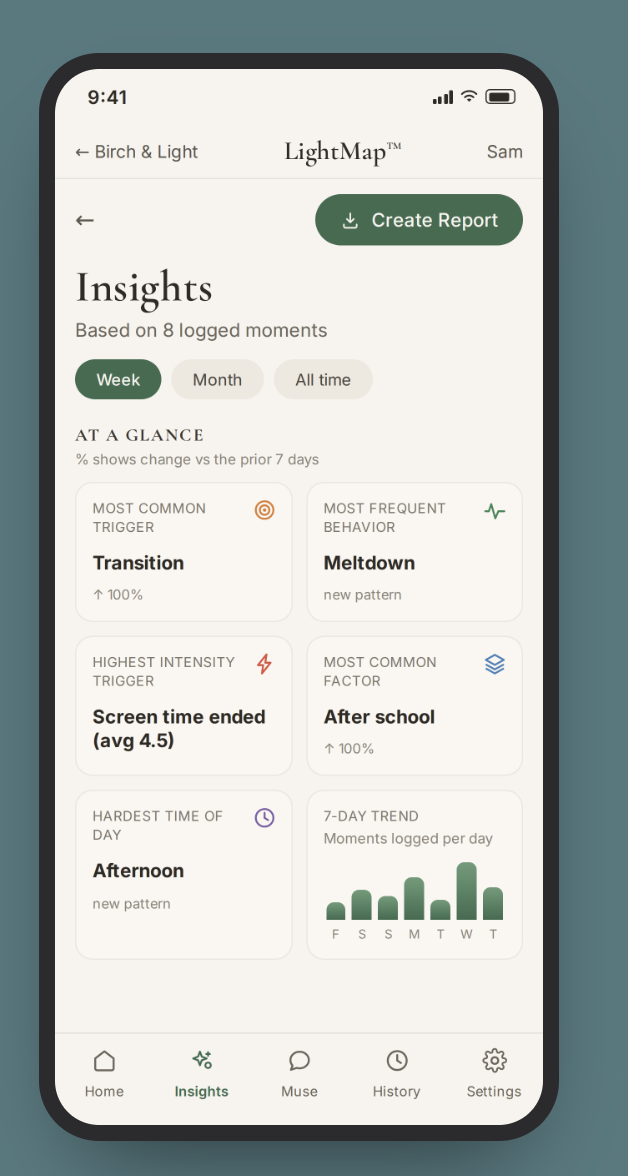

Part of the award-winning Birch & Light Method, honored with the Mom's Choice Gold Award for excellence in family resources.
A story to read together
Sometimes the easiest way in is a story you read side by side.
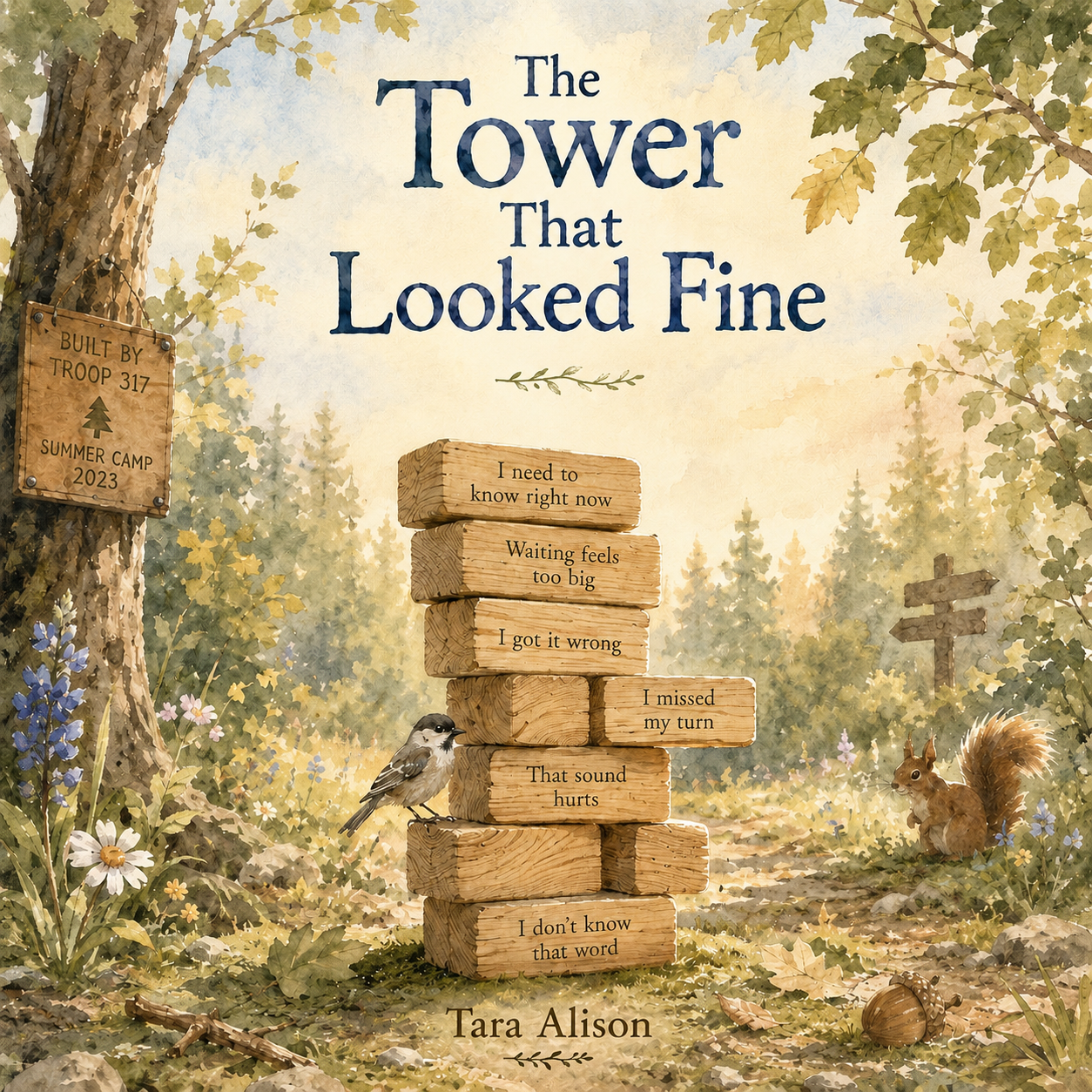 The Tower That Looked Fine
A tower in a quiet clearing tries to stay steady through every small thing nobody else seems to notice — until one tiny breath of wind causes her to fall, and a gentle hand begins to gather the blocks back.
Read the story The Boy at the Edge
A boy finds calm by watching the world move from a window. When his stillness is mistaken for defiance, the moment escalates — and he learns that being calm doesn’t always protect you from being told no.
Read the story
If today was one of those days
A few more from the library, free to read.
Researched and drafted with AI assistance, reviewed before publication. Editorial standards