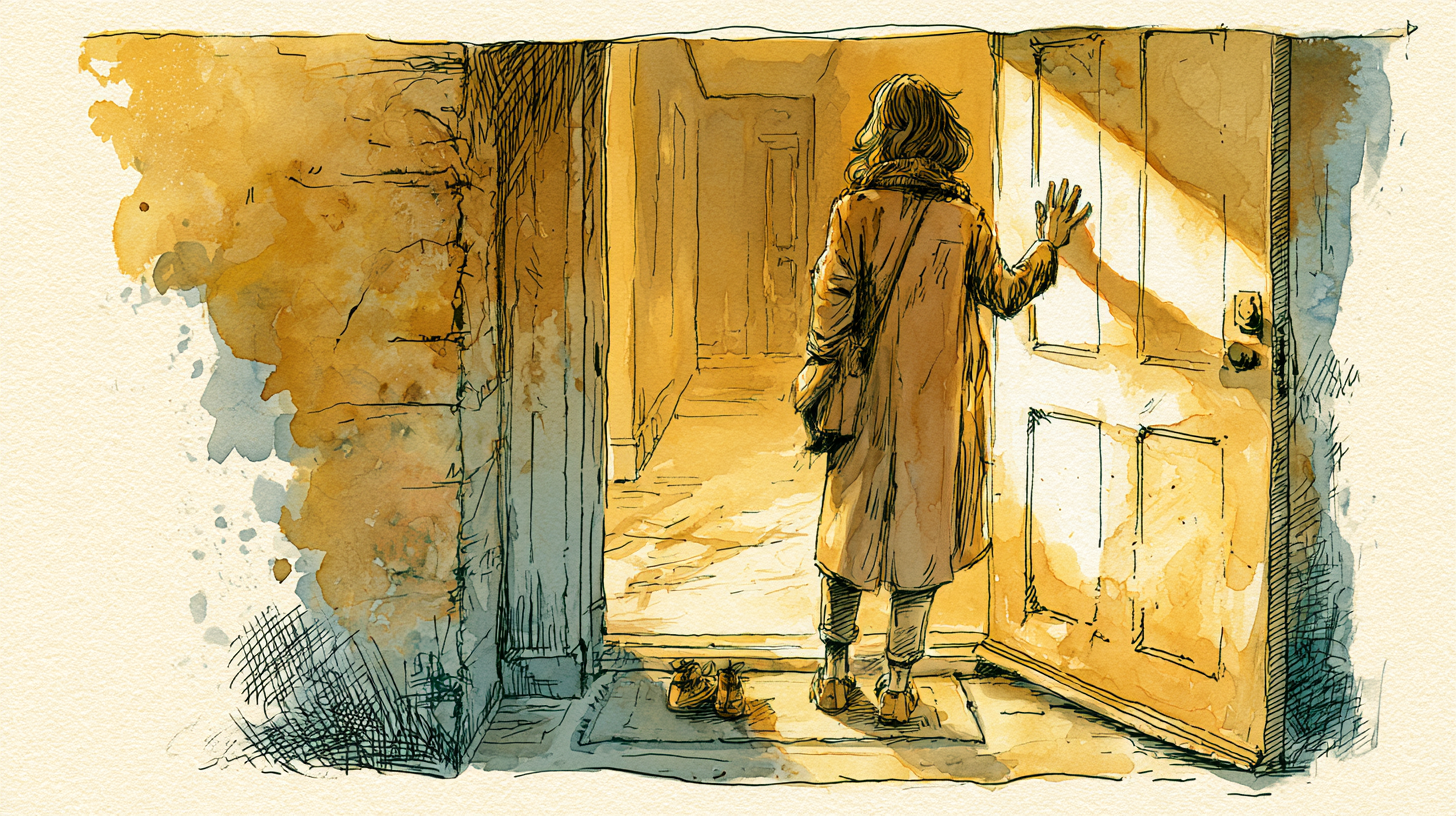
You checked on him at 6:40 and he was asleep. At 7:05 the back door is open and he is in the yard in bare feet, calm as anything, doing something with a stick.
Nothing bad happened. That is the part that makes it hard to explain to anyone, including yourself. Nothing bad happened this time, and you still stood in the kitchen with your heart going sideways, because you understood in that second how thin the margin was.
This has a name. Elopement is the word professionals use for a child leaving a safe place without an adult, and it is far more common in neurodivergent children than most parents are told. The largest study on it found that roughly half of autistic children had attempted to elope at least once after the age of four, and that a quarter of those had been missing long enough to frighten everyone involved. It is also the one behavior where the usual parenting playbook is the wrong tool, because the stakes do not allow for a learning curve.
Why consequences do not work here
Most parents arrive at this the same way. You explained. You explained again. You explained in the calm voice and then in the other voice. You may have taken something away. And the next morning the door was open again.
Here is why that loop keeps running. A consequence works by making a child pause in the moment of decision and weigh what happens next. Elopement rarely involves that moment. The child is moving before deliberation happens, following a pull that is stronger than the memory of a conversation held twelve hours earlier in a different emotional state.
There is a second problem. Punishment after the fact does not reduce the behavior, but it does reliably teach a child to be quieter about it. Parents who lean hard on consequences often find the child stops slamming the door, starts waiting until the shower is running, gets better at putting things back where they were. The leaving continues. The warning signs disappear.
None of this means your child is beyond reach or that you have been too soft. It means the thing you are dealing with sits in the same category as pool fences and car seats. You do not teach a toddler to respect a swimming pool. You put up a fence, and you teach alongside the fence, for years.
What the child is actually doing
Elopement is not one behavior. It is at least four, and they need different responses, so it helps to work out which one you have.
Going toward something. The child has a destination and a reason. Water is the most common one and the most dangerous. Others include a specific person, a park, a neighbor's dog, a road with trucks on it, a particular tree. This kind of leaving is purposeful and often cheerful, and it usually repeats along the same route.
Getting away from something. Noise, a demand, a sibling, a smell, a room that has become unbearable. This is escape rather than exploration, and it tends to happen at predictable pressure points rather than at predictable times.
Running an old pattern. Something used to happen at this hour, in this doorway, and the body kept the habit after the reason ended. A grandparent who used to be in the garage in the mornings. A dog that used to need letting out. The routine outlives the circumstance, and the child is not consciously choosing anything.
Seeking regulation. Outside is quiet, cool, open, and nobody is asking anything. For a child whose nervous system is loaded, stepping outdoors is not an escape from the family, it is the fastest available way to feel okay.
The child who bolts from a shopping center because the lights are too much needs different support from the child who walks calmly to the pond at dawn. Both need the door secured. Only one is telling you the environment has to change.
Secure the exits first
Do this part before anything else, and do it as though the next attempt is tomorrow, because it probably is.
Alarms and chimes on every exterior door. Not just the one being used. Children switch doors. Inexpensive battery-powered contact alarms work, and the point is that you hear it happen in real time rather than discovering it afterward.
Locks above reach, accounting for climbing. A child who has found keys once will look for keys again. Assume chairs, stools, and counters are all available, because they are.
Window locks. Ground floor windows are exits too, and they are often the forgotten ones.
Fence and gate the yard, and treat the yard as the next containment layer rather than as safety. Gate latches go at adult height with a self-closing mechanism.
Water first, always. Pools, ponds, retention basins, drainage ditches, creeks, neighbors' hot tubs. If there is water within walking distance, it belongs at the top of the list, and it needs a fence with a self-latching gate of its own. This is not caution for its own sake. Drowning is the leading cause of death among autistic children who wander, and in the elopement research a quarter of the children who went missing had a close call with water.
Tell the neighbors. A short conversation now means that the person watering their garden at seven in the morning knows to walk your child home rather than assume he is allowed out.
Consider identification. A bracelet, a shoe tag, or a card in a pocket with your phone number. For children who are nonspeaking or who become nonspeaking under stress, this matters enormously, because a lost child who cannot answer questions can stay lost for a long time.
If your child has an IEP or a 504 plan, elopement belongs in it explicitly, along with what staff should do. Schools handle this well when it is written down and inconsistently when it is not.
While you're here, take the guide
What's Underneath is free: the three body-state triggers under most meltdowns, what to say in the minute before it tips over, and how to reset afterward.

You'll get the guide instantly, plus five free articles in your inbox every week. Real challenges (meltdowns, school mornings, picky eating, big feelings) and how to actually handle them. Unsubscribe anytime.
Then replace what the leaving was giving them
Securing the house buys you time. It does not resolve anything by itself, and a child whose need is unmet will keep working on the problem. The second half of this is figuring out what leaving provided and providing it another way.
If the pull is toward something, build it into the day on purpose and on your terms. A child who wants to be outside at dawn can be outside at dawn with an adult. Scheduled access to the thing reduces the drive to obtain it unsupervised far more reliably than prohibition does.
If the pull is away from something, the work is upstream. Find the pressure point, reduce the load before it peaks, and give the child a sanctioned exit that is not the front door. A specific room, a tent, a spot on the stairs, anywhere they can go that counts as leaving without leaving.
If it is an old pattern, name it out loud. Children are often relieved to hear a plain explanation of their own behavior, and a replacement ritual in the same time slot tends to work better than an instruction to stop. Something waiting for them where they wake, in a place that is theirs.
If it is regulation, then outside is doing real work and the answer is more access rather than less, structured so that it is safe.
What to say, and when
Teaching still matters. The timing is what changes. Nothing you say while a child is dysregulated, or in the ten minutes after you have found them outside and your voice is still shaking, will be retained.
Do it later, when everyone is calm, briefly and without heat. Keep it to what is true and concrete. We keep the doors locked because it is my job to know where you are. If you want to go outside, come and get me and I will come with you. Then make sure that offer is honored, every single time, quickly, so that asking works better than going.
Practice the asking when nothing is wrong. A child who has rehearsed coming to find you fifteen times in low-stakes moments has a far better chance of doing it in the moment that counts.
When to bring in help
Raise elopement with your child's pediatrician rather than managing alone, particularly if it is frequent, if it involves roads or water, or if it happens at night.
Consistent very early waking is its own question and sometimes has a medical answer. If your child is up at five most mornings, that needs investigating on its own terms rather than treating only the leaving that follows it.
An occupational therapist can help identify what sensory need is being met. A behavior specialist or psychologist familiar with elopement can help map the pattern and build a plan. If your child is autistic and nonspeaking, ask specifically about local first-responder registries and tracking devices, which many families use and few are told about.
The part nobody says
Living with this is exhausting in a way that is difficult to convey to people whose children stay put. You do not sleep properly. You check the doors more than once. You have run outside barefoot more than once, and the fear does not fully leave afterward.
That vigilance is not anxiety and it is not overreaction. It is a reasonable response to a real risk, and it is costing you something. Build in whatever redundancy you can, so that some of the watching is done by hardware instead of by you. That is what the alarms are genuinely for. Not only to catch your child, but to let you put something down.
Your child is not defying you. Something is pulling, and until you know what it is, the locks hold the line while you find out.
Sources: Anderson C, Law JK, Daniels A, Rice C, Mandell DS, Hagopian L, Law PA, "Occurrence and family impact of elopement in children with autism spectrum disorders," Pediatrics, 2012;130(5):870-877, doi 10.1542/peds.2012-0762; Kiely et al., prevalence and correlates of elopement in a nationally representative sample of children with developmental disabilities (PLOS ONE, 2016); Guan and Li, injury mortality in individuals with autism (American Journal of Public Health, 2017); Interagency Autism Coordinating Committee safety subcommittee materials on wandering.
For education and reflection, not medical advice. Our terms
See what's underneath
Stop guessing what set it off
LightMap reads your hard days together and gives you answers. Start with one moment today.
Start with 3 moments Not sure where to start? Ask me.Message Tara on WhatsApp. It really is me, I read everything and will personally respond.Click here to message Tara →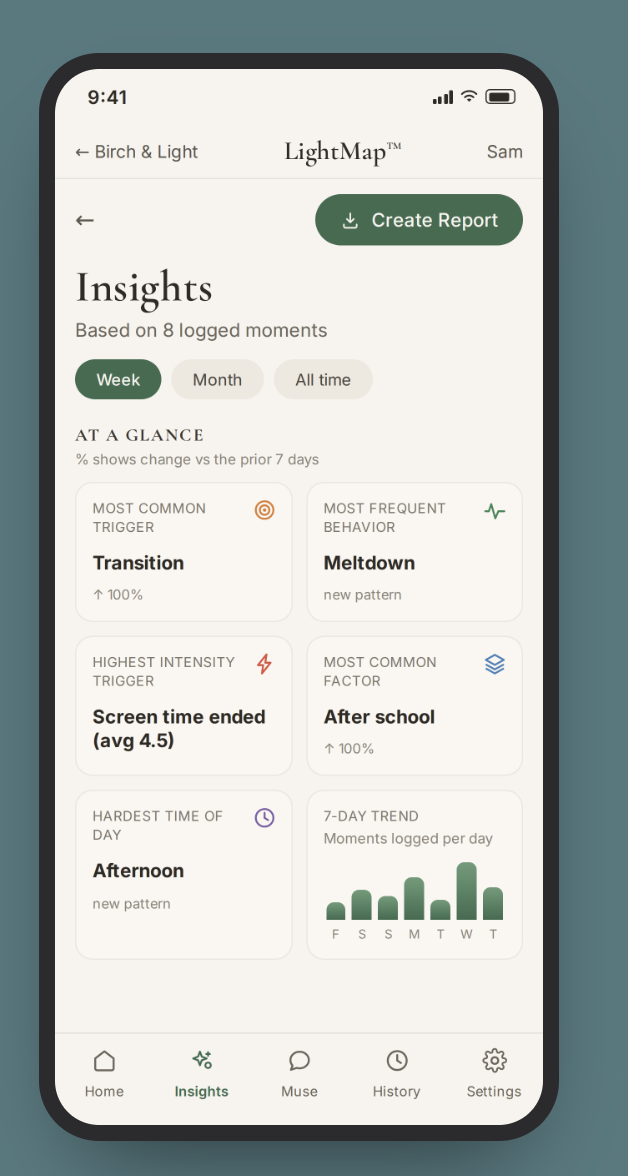

Part of the award-winning Birch & Light Method, honored with the Mom's Choice Gold Award for excellence in family resources.
If today was one of those days
A few more from the library, free to read.
Researched and drafted with AI assistance, reviewed before publication. Editorial standards