
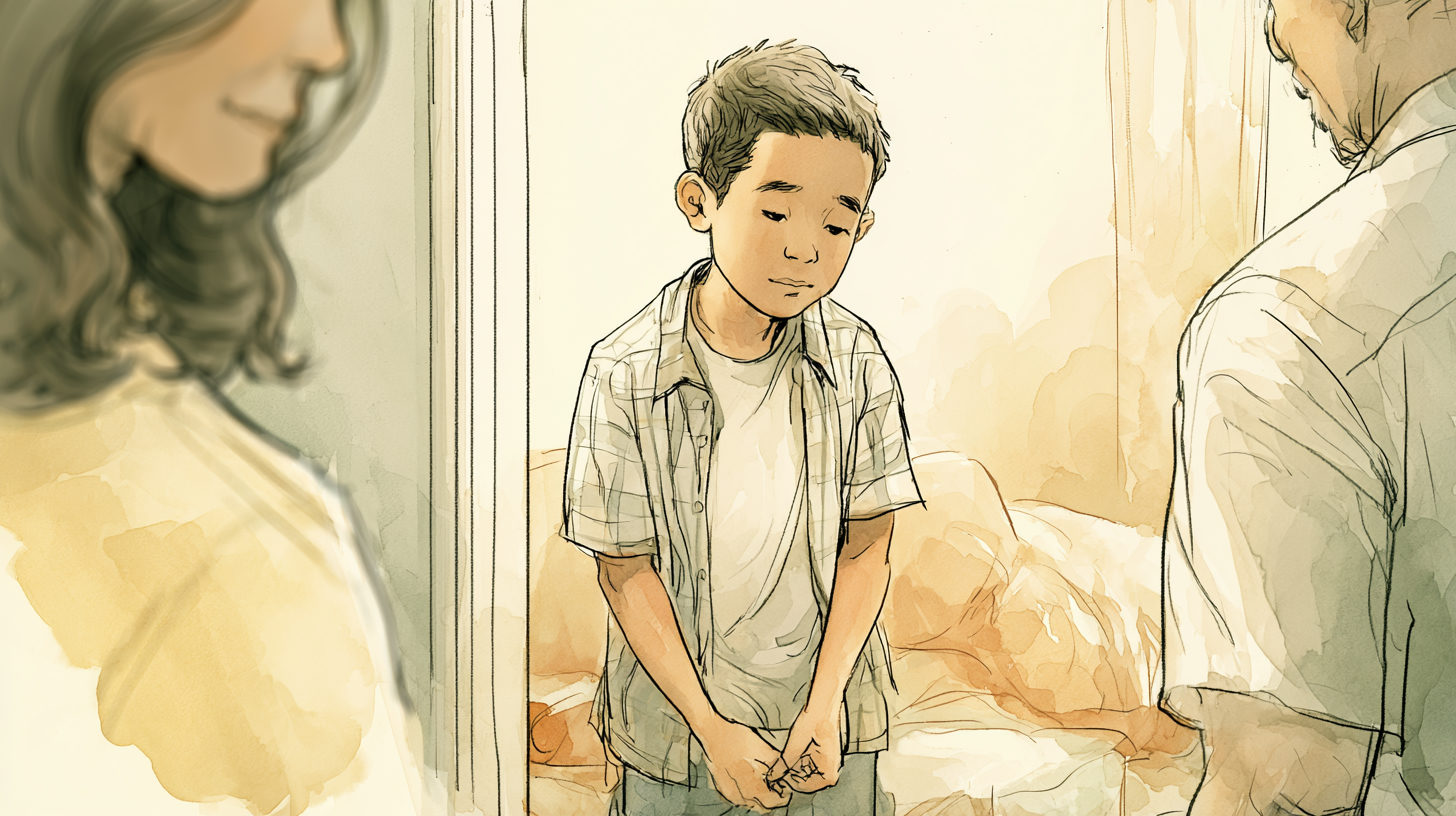
You are standing in the kitchen, describing what just happened, and you can see on your partner's face that they are hearing a completely different story than the one you are telling.
You saw a child who fell apart because they were overwhelmed. They saw a child who fell apart because they didn't get their way. You saw fear. They saw manipulation. You saw a kid who couldn't. They saw a kid who wouldn't.
And now the two of you are not just disagreeing about what to do. You are disagreeing about who your child actually is.
This is one of the loneliest places a parent can stand — not against the world, but across the counter from the one person who is supposed to be on your team. And it is far more common than most families admit out loud, because it feels like a failure to say it: we don't see the same child.
Here is what I want you to consider before this hardens into something that damages your marriage as much as it confuses your kid.
You are probably both seeing something real
The instinct, when you disagree this deeply, is to decide that one of you is right and one of you is wrong. One of you is too soft. One of you is too harsh. One of you "gets it" and one of you doesn't.
But in most families I've watched navigate this, that framing is the problem, not the solution. Because usually, both parents are describing something true. They are just describing different moments, different sides of the same child, seen through different windows.
A child genuinely can be the kid who melts down over a small request and the kid who negotiates like a tiny attorney for an extra hour of screens. A child can be flooded and overwhelmed in one moment and calculating in the next. These aren't contradictions. They are the same nervous system on different days, in different states, under different loads.
When one parent spends more time in the hard moments — the mornings, the homework, the bedtime — they tend to see the overwhelm. When the other parent catches the child more often during recovery, or play, or the negotiation that comes after the storm has passed, they tend to see the capacity. Both are watching the same kid. They are just standing in different parts of the day.
What this often looks like
Disagreement about a child rarely announces itself as disagreement about a child. It shows up sideways.
- One of you quietly undoes what the other just did — lifting a limit, softening a consequence, stepping in — and the other feels undermined in front of the kid.
- You start parenting in secret. One of you handles certain situations alone because it's easier than the argument that follows.
- The child learns, fast, which parent to go to for what. Not because they're scheming — because kids read the temperature of a house and route around the friction.
- Conversations about your child curdle into conversations about each other. "You always coddle." "You always come down too hard."
- One parent carries a private fear they can't say out loud — that the other's approach is hurting the child — and the resentment builds underneath everything.
By the time most couples name this, they've usually been living inside it for a long time.
Why it happens
Some of this is just history. The two of you were raised by different families, with different rules about what behavior meant and what you were allowed to feel. When your child does something difficult, you're not only reacting to your child — you're reacting through the lens of how that same behavior was treated when you were small.
If you grew up in a house where big feelings were met with patience, you may instinctively read your child's meltdown as distress. If you grew up in a house where the same meltdown would have gotten you sent to your room, you may instinctively read it as something that needs a firmer hand. Neither of you is choosing your lens on purpose. You inherited it.
There's also a simpler, less visible reason: you genuinely have different data. The parent who does the school pickup sees the child fall apart the moment they get in the car. The parent who comes home at six sees a kid who seems basically fine. They are not disagreeing about the child. They are each telling the truth about the slice of the day they witnessed — and neither has the whole picture.
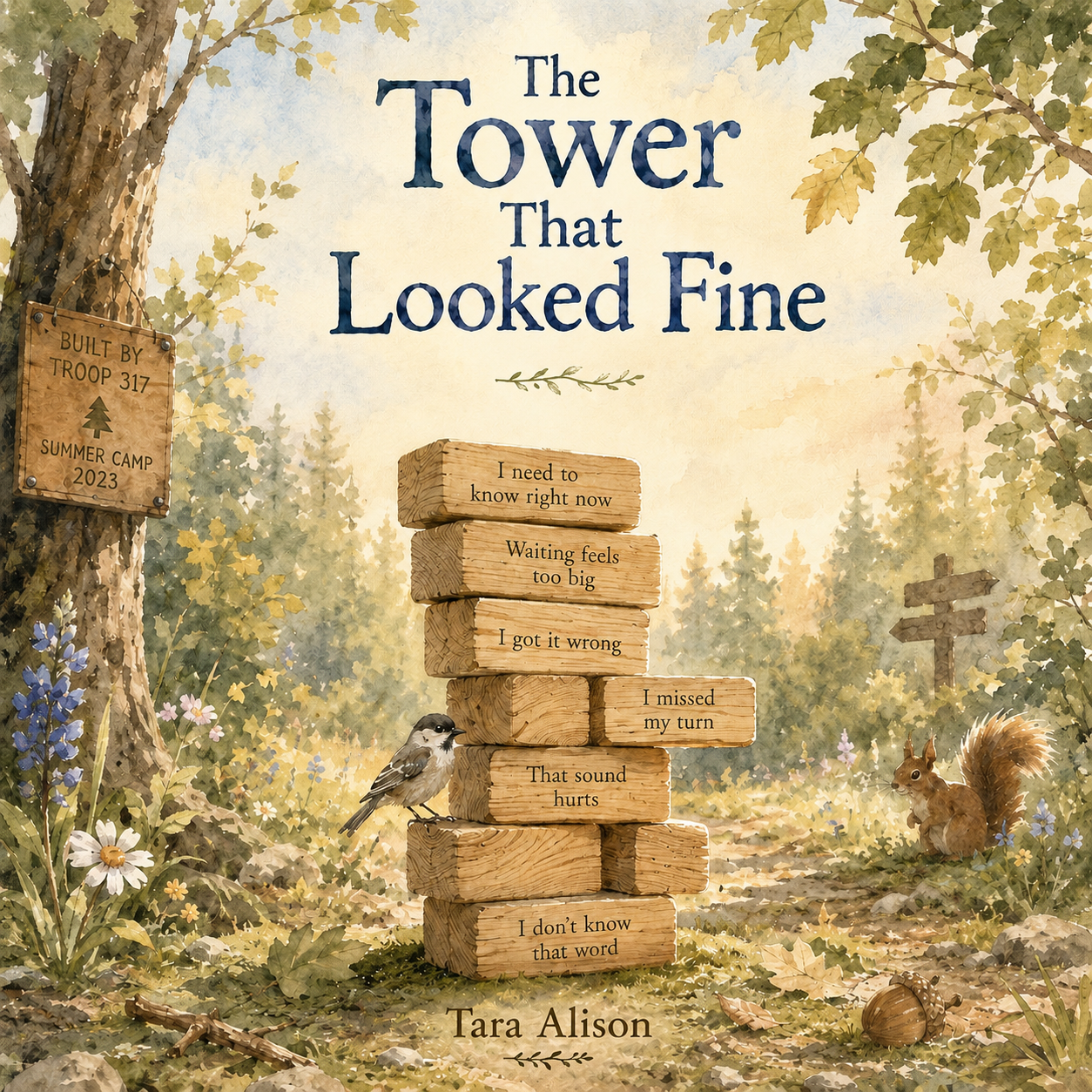
There's a story for this exact struggle
The Tower That Looked Fine
A tower in a quiet clearing tries to stay steady through every small thing nobody else seems to notice — until one tiny breath of wind causes her to fall, and a gentle hand begins to gather the blocks back.
Free to read. You'll also get five free articles a week. Unsubscribe anytime.
What tends to help
The goal is not to get your partner to admit you were right. The goal is to get the two of you looking at the same child instead of defending two different versions of them.
- Trade observations before conclusions. Instead of "he was manipulating you," try "here's what I saw right before it started." Describe the moment, not the motive. You can usually agree on what happened even when you can't yet agree on why.
- Assume your partner is seeing something you're missing. If they describe a child you don't recognize, the most useful question isn't "how can you think that?" It's "when does it look like that for you?" You may be missing an entire half of the day.
- Pick the next hard moment to watch together. Not to intervene — just to both witness the same event with the same eyes. It is remarkable how much disagreement dissolves when both parents finally see the same meltdown from the same angle.
- Separate the child question from the marriage question. "What is going on with our kid" and "do you respect how I parent" are two different conversations. They feel like one. Pull them apart, and each gets easier.
- Find the one thing you both already agree on — usually that you both love this child and you're both exhausted — and start every hard conversation from there.
Before you go, grab the free guide
The 3 body-state triggers under most meltdowns, a script for the 30 seconds before it tips over, and a reset for after. Free.

You'll get the guide instantly, plus five free articles in your inbox every week. Real challenges (meltdowns, school mornings, picky eating, big feelings) and how to actually handle them. Unsubscribe anytime.
What tends not to help
Trying to win. The moment one parent "wins" the argument about who the child is, the other parent doesn't actually change their mind — they just stop saying it out loud. The disagreement goes underground, where it does more damage, not less.
Parenting in front of the child as a way of proving a point also backfires. When a kid watches one parent override the other, they don't learn who's right. They learn that the adults aren't steady, and a child who senses that the ground is unstable underneath the grown-ups tends to get more dysregulated, not less.
And reading the same parenting book at each other rarely works. Advice handed across a divide tends to land as an accusation: see, this proves you've been doing it wrong. The book may even be right. It still won't change anything if it arrives as ammunition.
When additional support may be needed
Sometimes the disagreement isn't really about interpretation — it's about a genuine difference in values or risk tolerance that the two of you can't bridge alone, especially around big decisions like medication, school changes, or whether a behavior needs evaluation. There is no shame in bringing a third person into that. A family therapist or a clinician who knows your child can give you a shared, neutral picture to react to, instead of two competing ones.
It's also worth getting support when the conflict about your child has started to erode the relationship itself — when you're fighting more than you're partnering, when one of you has stopped bringing things up because it isn't worth it. The disagreement about your kid is usually a solvable problem. The slow loss of being a team is the one that does lasting harm, and it's worth protecting.
Where LightMap helps
A lot of this conflict comes from each parent holding a different fragment of the week and assuming their fragment is the whole. The morning parent and the evening parent are, in a real sense, looking at two different children — because they're looking at two different parts of the day.
Sometimes the disagreement only resolves when you can both see the same several weeks at once — when the scattered moments each of you witnessed turn out to be points on a single pattern. It's much harder to argue about whether it's "won't" or "can't" when you can both see that the hard moments cluster on the days after a poor night's sleep, or always in the same transition, regardless of which parent was standing there.
Every behavior is a clue.
When two parents log what they see, the shared pattern often settles an argument that words alone couldn't. Explore LightMap at birchandlight.com/lightmap.
Frequently asked questions
What if I really do think my partner's approach is harming our child?
That's a serious concern and worth taking seriously — but it's more likely to change anything if you raise it as something you've noticed rather than a verdict you've reached. Describe the specific moments that worry you and what you see happen afterward. If the concern is significant and the conversation keeps stalling, a neutral professional who knows your child can help you both look at it without it becoming a fight about who's the better parent.
How do we stop the kids from playing us against each other?
Most kids aren't scheming — they're reading which parent offers the easier path in a given moment and taking it, which is ordinary and human. It eases when the two of you get more aligned, not when you crack down harder. The more your child senses the adults are steady and on the same page, the less incentive there is to route around one of you.
Do we have to agree on everything?
No. You have to be on the same team, which is different. Kids do fine with two parents who handle things somewhat differently, as long as both feel safe and neither one is constantly undoing the other. Aim for a shared understanding of who your child is and what they need. The day-to-day style can vary more than you'd think.
For education and reflection, not medical advice. Our terms
See what's underneath
Stop guessing what set it off
LightMap turns scattered hard days into a pattern you can see. Start by logging one moment tonight.
Log today's hard moment, no account needed

Part of the award-winning Birch & Light Method, honored with the Mom's Choice Gold Award for excellence in family resources.
A story to read together
Sometimes the easiest way in is a story you read side by side.
- The Tower That Looked Fine
A tower in a quiet clearing tries to stay steady through every small thing nobody else seems to notice — until one tiny breath of wind causes her to fall, and a gentle hand begins to gather the blocks back.
Read the story  The Boy at the Edge
A boy finds calm by watching the world move from a window. When his stillness is mistaken for defiance, the moment escalates — and he learns that being calm doesn’t always protect you from being told no.
Read the story
Researched and drafted with AI assistance, reviewed before publication. Editorial standards