
If a pool day once ended in a flare, the next water outing carries a low hum of dread. You want your child to have the ordinary joy of a beach day, and you also cannot un-know what came after the last time. So you start asking the practical questions: is the ocean different from the pool, does sunscreen help or hurt, what should I be watching for. Sensible questions, all of them, and worth answering honestly, with the same caveat that governs everything in this territory: your child's own clinician knows your child, and none of this replaces a conversation with them.
Why the ocean is often easier than the pool
The good news first. Many parents find the ocean genuinely gentler than a chlorinated pool, and there is a plausible reason. Whatever role pool chemistry plays for a sensitive child, whether it is the chlorine itself or the disinfection byproducts that build up in enclosed treated water, the open ocean simply does not have. Saltwater is not chlorinated, and the sheer volume dilutes what is in it. A lot of families quietly discover their child tolerates ocean swimming far better than the pool that seemed to set them off.
Lakes are the genuine wild card, and the disagreement among parents about them is not a contradiction, it is the truth. Freshwater lakes vary enormously: some are pristine, others carry bacteria, algae, or in warm shallow water the organisms that cause swimmer's itch and occasionally worse. For a child whose system reacts to immune challenges, a lake can be the best day of summer or the trigger for a rough week, and which one it is depends heavily on the specific lake. If you try one, treat the first visit as a cautious experiment, not a season pass.
The sunscreen question
This is worth asking, because for a chemically sensitive child the sunscreen can matter as much as the water. The broad consensus among parents in this world, and it aligns with how these products differ, is to favor mineral sunscreens, the ones whose active ingredient is zinc oxide or titanium dioxide, over chemical ones. Mineral formulas sit on top of the skin and physically block UV rather than being absorbed, and they tend to have shorter, simpler ingredient lists with fewer fragrances and additives, which is what you want on a reactive kid.
Skipping sunscreen entirely is the answer that helps no one. A sunburn is itself a physical stressor and an inflammatory event, precisely the kind of bodily stress that parents in this community work hard to avoid. Sun protection still matters; the move is to choose the gentlest effective option. A practical tip many parents use: test any new sunscreen on a small patch a day or two before the trip, so the beach is not where you discover a reaction.
While you're here, take the guide
What's Underneath is free: the three body-state triggers under most meltdowns, what to say in the minute before it tips over, and how to reset afterward.

You'll get the guide instantly, plus five free articles in your inbox every week. Real challenges (meltdowns, school mornings, picky eating, big feelings) and how to actually handle them. Unsubscribe anytime.
What to actually keep in mind on the day
A few things that make the difference between a good outing and a hard lesson:
- Rinse and change promptly after. Whatever was in the water, salt, sand, lake microbes, spends less time against the skin if you rinse off and get into dry clothes soon after swimming. This is one of the few universally sensible steps.
- Watch the whole-body load, not just the water. Beach days stack up stressors that have nothing to do with what's in the water: heat, sun, a skipped meal, dehydration, a wildly off nap and bedtime, overstimulation. For a child prone to flares or dysregulation, any of these alone can produce a rough evening, and a beach day delivers all of them at once. Pacing, shade, water, and food may matter more than the swim itself.
- Go shorter the first time. A brief first outing tells you how your specific child does with this specific water, with far less at stake than a full day.
- Keep a simple note of what happened. If a flare or hard patch follows, having a record of where you swam, for how long, what sunscreen, and what else was unusual that day helps you and your clinician tell a real pattern from a coincidence, instead of banning the beach on a single bad night.
The bigger picture
It is worth holding onto the thing that is easy to lose in the vigilance: the goal is not a childhood with the water removed from it. The goal is finding the version of these ordinary joys that your child's body can handle, which very often exists once you find the right water, the right sun protection, and the right pacing. For the pool side of this question and what the evidence actually says about chlorine, we went deep in chlorine, pools, and PANDAS. And because a beach day is really a whole-body stress-load question, why summer can be harder than school is a useful companion.
Whether a beach day costs you one hard evening or three is worth knowing before next summer. Log the outing and the days after it in LightMap.
Sources: American Academy of Dermatology, Cleveland Clinic, CDC Healthy Swimming program.
For education and reflection, not medical advice. Our terms
Before the next flare
Bring your doctor a timeline, not a memory
LightMap reads your hard days together and gives you answers. Start with one moment today.
Start with 3 moments Not sure where to start? Ask me.Message Tara on WhatsApp. It really is me, I read everything and will personally respond.Click here to message Tara →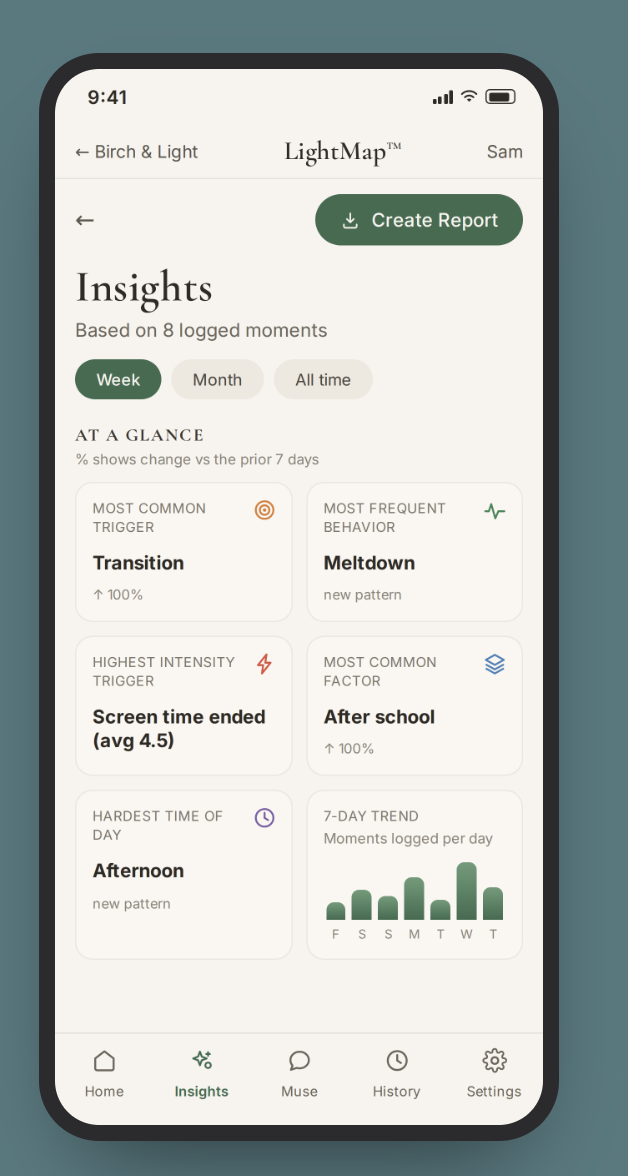

Part of the award-winning Birch & Light Method, honored with the Mom's Choice Gold Award for excellence in family resources.
A story to read together
Sometimes the easiest way in is a story you read side by side.
 The Princess and the Witch Inside
Esme is loved, but a fast protective part keeps rushing in before she gets a turn. A quiet visitor helps her meet the witch inside — not as an enemy, but as a worried protector — and find her way back to the people she wanted to be with all along.
Read the story The Tower That Looked Fine
A tower in a quiet clearing tries to stay steady through every small thing nobody else seems to notice — until one tiny breath of wind causes her to fall, and a gentle hand begins to gather the blocks back.
Read the story
If today was one of those days
A few more from the library, free to read.
Researched and drafted with AI assistance, reviewed before publication. Editorial standards