
It usually happens the same way. Your child is at the pool every day, happy, tired in the good way, and then you read a post in a PANDAS group: chlorine causes flares. Someone else agrees. Someone shares a protocol. And suddenly the place your kid loves most is recast as a hazard, and you are lying awake doing math on every cranky evening that followed a swim.
So let us do what we did with mold and detox: separate what parents report, what science has documented, and what is likely actually going on, so you can make a decision based on your child instead of a comment thread.
What parents report
The chlorine worry is not new and not fringe within the community. Parent forum threads about tics and symptoms worsening after pool time go back more than fifteen years, and the accounts are often specific: anxiety, irritability, sensory overwhelm, or tics ramping up within hours of swimming. Community resources circulate precautions, rinse before and after, goggles, probiotics, on the theory that chlorine exposure sets off flares or disrupts the gut. When this many families notice the same pattern, the pattern deserves respect. But a repeated observation is a starting point for questions, not an answer to them.
What is actually documented
Here is the honest state of the evidence: there are no studies showing that chlorine triggers PANS or PANDAS flares. No trials, no case series, no established mechanism. The claim lives entirely in anecdote and inference. That does not prove it is false, absence of research is not absence of effect, but it means anyone stating it as settled fact is ahead of the science.
What is documented is more mundane. When chlorine reacts with sweat, urine, and other organic material, it forms irritant byproducts called chloramines, and those genuinely do irritate eyes and airways, sometimes dramatically. Public health investigations of indoor pools with poor ventilation have recorded large proportions of swimmers developing eye and respiratory symptoms. So a child who comes home from an indoor pool with red eyes, a cough, and a short fuse may truly be reacting to the pool, as an irritant exposure, the way anyone might, which is a very different claim than chlorine reaching the brain and reigniting an autoimmune process.
The likelier culprits hiding inside the stories
The germs, not the chemical. This one matters most for this community. Public pools in summer are children exchanging microbes at close range, and for a condition where flares are triggered by infections, strep above all, a crowded pool is a genuinely plausible exposure route. At least one longtime forum parent who originally blamed chlorine came around to exactly this view after a pediatrician suggested a child likely picked up strep at the pool. If swimming is followed by a flare a week or two later, an infection acquired at the pool explains it better than the chlorine does, and it changes what you do about it: you do not need to avoid water, you need your usual infection vigilance.
Exhaustion and sensory load. Swimming is heavy exercise wrapped in noise, crowds, cold water, bright sun, and transitions, a full sensory invoice that comes due at dinnertime. Plenty of neurotypical kids fall apart after a pool day. For a PANS/PANDAS child whose baseline regulation is already spending extra, a post-swim rough evening may just be a tired, over-stimulated kid, not a neuroimmune event.
Confirmation bias, which comes for all of us. Once you have read that chlorine causes flares, every post-swim wobble becomes evidence, and the many swims followed by nothing quietly disappear. This is not a flaw in worried parents; it is how human pattern-detection works, which is exactly why it helps to write things down instead of trusting the feeling.
While you're here, take the guide
What's Underneath is free: the three body-state triggers under most meltdowns, what to say in the minute before it tips over, and how to reset afterward.

You'll get the guide instantly, plus five free articles in your inbox every week. Real challenges (meltdowns, school mornings, picky eating, big feelings) and how to actually handle them. Unsubscribe anytime.
What to actually do
Do not pull your child from the pool over a comment thread. Daily swimming is exercise, regulation, sleep pressure, friendship, and joy, all things that measurably help these kids. Removing it has a real cost, and that cost should only be paid for a real, demonstrated benefit.
Track before concluding. If you are worried, run the honest experiment: note each swim, the venue, and the following 48 hours for a few weeks, in a notebook or a tracker like LightMap. If a pattern is real it will show up on paper, and it will usually point at a specific variable, one particular indoor pool, long tournament days, the week a stomach bug went around, rather than at chlorine in general.
Take the cheap precautions, skip the expensive conclusions. Rinsing before and after swimming, goggles, teaching kids not to swallow pool water, and favoring outdoor or well-ventilated pools are all reasonable, low-cost, and sensible for any swimmer. They cost you nothing. Quitting swimming, or buying a protocol, costs a lot.
If one venue reliably precedes trouble, test the variable. Try a different pool, a lake, the ocean. If symptoms follow one poorly ventilated indoor pool and not open water, you have learned something useful about irritants and ventilation, not about your child needing a chlorine-free life.
Loop in your practitioner with data, not dread. A tracked pattern is something a PANS-literate clinician can actually work with, and they can also rule the boring things in or out, seasonal allergies, swimmer's ear brewing, a strep exposure making the rounds.
The bottom line
A child who is at the pool every day and doing well is not in danger from a stack of anecdotes. The documented pool risks for a PANDAS family are the ordinary ones, infections from other kids and irritating air in badly ventilated indoor pools, and both have ordinary answers that do not involve giving up the water. Watch your child, write down what you see, and let their pattern, not the group's, decide.
Letting your child's pattern decide means writing the pattern down. LightMap gives you somewhere to log swim days against symptom days and settle it for your family rather than the group.
Sources: CDC Healthy Swimming program, CDC Morbidity and Mortality Weekly Report (indoor waterpark investigation).
For education and reflection, not medical advice. Our terms
Before the next flare
Bring your doctor a timeline, not a memory
LightMap reads your hard days together and gives you answers. Start with one moment today.
Start with 3 moments Not sure where to start? Ask me.Message Tara on WhatsApp. It really is me, I read everything and will personally respond.Click here to message Tara →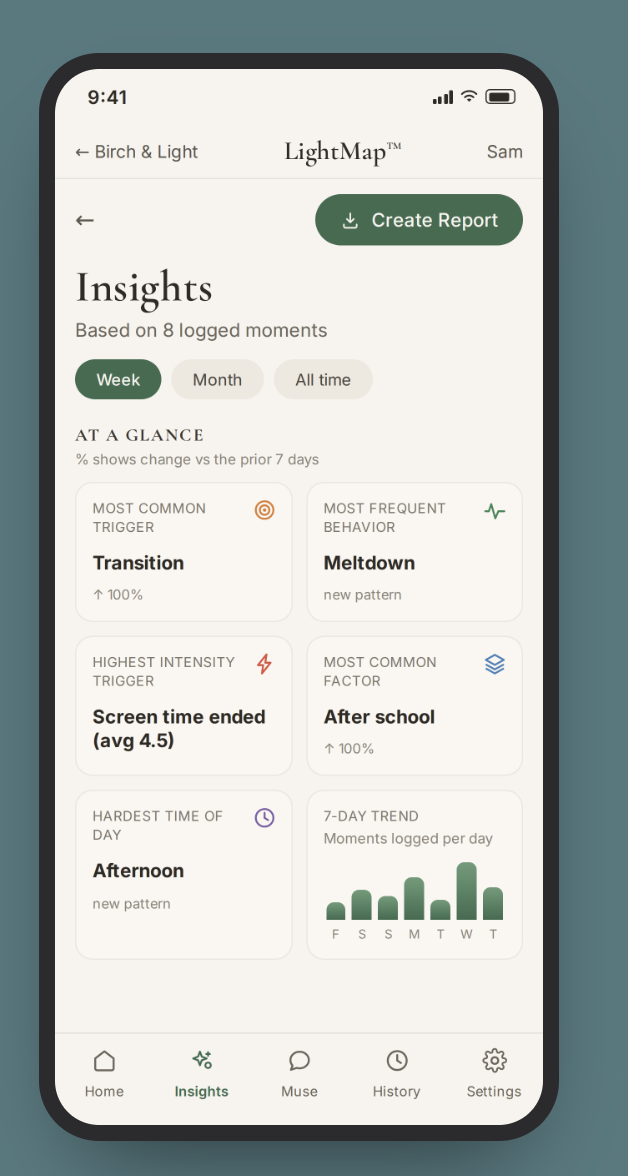

Part of the award-winning Birch & Light Method, honored with the Mom's Choice Gold Award for excellence in family resources.
A story to read together
Sometimes the easiest way in is a story you read side by side.
 The Princess and the Witch Inside
Esme is loved, but a fast protective part keeps rushing in before she gets a turn. A quiet visitor helps her meet the witch inside — not as an enemy, but as a worried protector — and find her way back to the people she wanted to be with all along.
Read the story The Tower That Looked Fine
A tower in a quiet clearing tries to stay steady through every small thing nobody else seems to notice — until one tiny breath of wind causes her to fall, and a gentle hand begins to gather the blocks back.
Read the story
If today was one of those days
A few more from the library, free to read.
Researched and drafted with AI assistance, reviewed before publication. Editorial standards