

A mom in a PANDAS group asked this week what happens when a kid who flares gets a palate expander for six to eight months. She'd read it could set off a flare. The replies were about holistic dentists, metal versus plastic, and antibiotics for the duration. Nobody answered the question she asked, which was how to get through it.
I asked it too, before one of mine got an expander and then braces. Here is what I'd have wanted someone to tell me.
Where the fear comes from
The fear is not silly. In PANS and PANDAS, flares follow immune triggers, and the consensus treatment guidelines list dental infection among the infections associated with onset or worsening of symptoms (Cooperstock et al., 2017). If your child has flared after strep, after a sinus infection, after a stomach bug, then an appliance living in their mouth for most of a year sounds like a trigger you're choosing on purpose.
But an expander is not an infection. It's a piece of hardware and a slow mechanical push. The things that could plausibly matter are the ones around it: the mouth being harder to keep clean, the gum irritation that comes with any appliance, the pain of adjustments, the sensory load of something new in the mouth, and the stress of dental visits themselves. Those are real, and they're manageable, and they're a different category from an infection.
In our house, the expander and the braces that followed were less trouble than I'd braced for. No flare that we could tie to either one. I'm one family, and one family is not evidence. But if you're standing where I stood, I want you to know that the story you're afraid of is not the only story.
What to line up before the appliance goes in
Tell the orthodontist about PANS or PANDAS in plain words. Most have never heard of it. What they need to know is simple: this child has an immune condition where infections and inflammation can trigger sudden behavioral and neurological symptoms, so you want the cleanest mouth possible and the fewest surprises. Ask what they recommend for hygiene with the appliance, and ask whether anything about your child's plan involves procedures that could introduce infection.
Loop in the PANS clinician too. If your child is on prophylactic antibiotics, the prescriber should know about the dental plan. If they're not, ask directly whether this plan changes anything. Get an answer from the person managing the immune side, not from a comment thread.
Time it if you can. Nobody controls when a flare hits, but if your child is in a rough stretch right now, ask whether the start can wait a few weeks. Starting during a calm window gives you a clean baseline, so if something does change you can see it.
Plan for the pain of adjustments. Orthodontic pain is well documented: it typically starts within hours of an adjustment, peaks over the first day or so, and eases over the following week (Krishnan, 2007). For a kid who is already easily overwhelmed, that's a predictable rough patch you can prepare for with soft food, whatever pain relief your pediatrician approves, and lower demands on adjustment days. Predictable is the key word. A kid who knows the ache is coming and knows it will pass does better than one ambushed by it.
Do the sensory prep. An expander changes how the tongue sits, how swallowing feels, how words come out for the first few days. For a sensory-sensitive child, that's the part that may actually cause the meltdown, not the immune system. Let them see and touch a model. Practice the turns on a dummy if there's a key. Name in advance that talking and eating will feel weird for about a week.
Hygiene is the real job
If the fear is inflammation, the thing you can actually control is the mouth. Food packs into an expander and around brackets, gums get puffy, and that low-grade irritation is the last thing you want in a kid whose immune system overreacts. A water flosser, a good brush after every meal, and a rinse the orthodontist approves are not overkill here. This is the one place where being the intense parent is correct.
Watch, but watch fairly
Keep a simple record through the whole course: adjustments, illnesses, sleep, mood, any tics or fears or bathroom changes, and what happened at school. Not because you expect a flare, but because if one comes you want to know whether it followed the appliance or followed the cold that went through the house the same week. Memory will tell you it was the expander. A log might tell you something different. Any flare with the classic sudden-onset shape, new obsessive fears, a personality shift over days, still belongs to the PANS clinician regardless of what's in the mouth (American Academy of Pediatrics, 2025).
The part nobody warned me about
Here's the one I didn't see coming. The appliances going in were fine. The braces coming off were not.
My kid had a weeklong meltdown when the braces came off. She wanted them back. She wasn't used to seeing her own teeth, and the face in the mirror wasn't the face she'd gotten used to. Nobody at the orthodontist's office thought to mention that a child who struggles with change might struggle with this change, because for most kids it's the happy day.
If your child has a hard time with anything new, treat the removal like you treated the installation. Talk about it weeks ahead. Show them photos of their teeth before the braces. Tell them their mouth will feel slippery and strange and their teeth will look bigger for a while. Let them be sad about it instead of confused that they're sad. It passes. It passed for us in about a week. It would have been an easier week if I'd known it was coming.
Sources: Cooperstock MS, Swedo SE, Pasternack MS, Murphy TK, for the PANS PANDAS Consortium. Clinical Management of Pediatric Acute-Onset Neuropsychiatric Syndrome: Part III, Treatment and Prevention of Infections. Journal of Child and Adolescent Psychopharmacology. 2017;27(7):594-606. Krishnan V. Orthodontic pain: from causes to management, a review. European Journal of Orthodontics. 2007;29(2):170-179. American Academy of Pediatrics. Pediatric Acute-Onset Neuropsychiatric Syndrome (PANS): Clinical Report. Pediatrics. 2025;155(3):e2024070334.
For education and reflection, not medical advice. Our terms
Before the next flare
Stop guessing which trigger it was
LightMap turns scattered hard days into a pattern you can see. Start by logging one moment tonight.
Find out why it keeps happening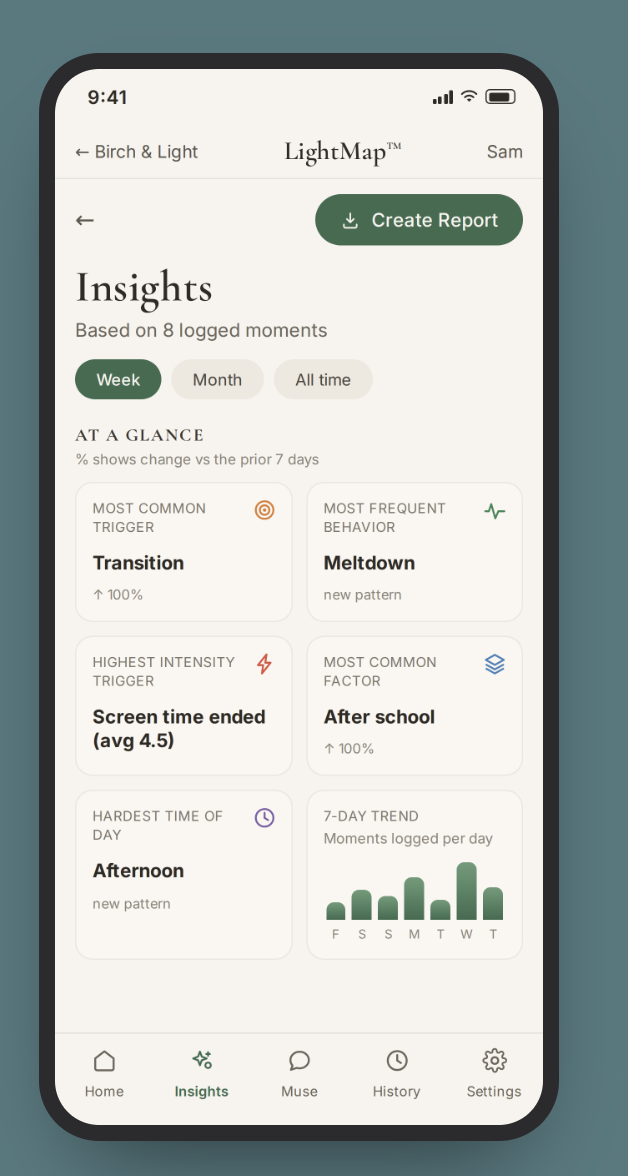

Part of the award-winning Birch & Light Method, honored with the Mom's Choice Gold Award for excellence in family resources.
Before you go, grab the free guide
The 3 body-state triggers under most meltdowns, a script for the 30 seconds before it tips over, and a reset for after. Free.

You'll get the guide instantly, plus five free articles in your inbox every week. Real challenges (meltdowns, school mornings, picky eating, big feelings) and how to actually handle them. Unsubscribe anytime.
Researched and drafted with AI assistance, reviewed before publication. Editorial standards