
It is the middle of summer and your kid is at his worst. Not after a bad night, not after a fight with a sibling, but on an ordinary hot afternoon when nothing else is wrong. Water is fine. He can swim for hours. But hang around outside without it, get his face red and his hair wet with sweat, and something flips. The rages come faster, land harder, and will not resolve until he cools down, sometimes not even then.
If you are watching this happen every single day right now, you are not imagining a pattern that is not there. Heat is a real trigger, and it deserves to be taken seriously on its own, separate from the water question and separate from detox theories that circulate in this community.
What parents report
Ask around any PANS or PANDAS group in July and you will hear a version of this story more than once: fine in the pool, fine in the air conditioning, falling apart the moment core temperature climbs and stays up. Beet red face, soaked hair, a rage that will not de-escalate with the usual tools. Some parents describe a clear temperature threshold, others just know the look on their kid's face means it is time to get inside.
What is actually known
There is no PANDAS-specific research on heat as a flare trigger. But heat sensitivity worsening neurological symptoms is well documented in other conditions where the immune system is involved. In multiple sclerosis, a rise in body temperature of even a fraction of a degree can temporarily worsen nerve signaling, a phenomenon well known enough to have a name, Uhthoff's phenomenon. The mechanism is that heat slows conduction along nerves that are already inflamed or under strain, so a system running close to its limit loses margin fast when it warms up.
PANDAS and PANS are not multiple sclerosis, and nobody has proven the same mechanism is at work. But the underlying idea, an already taxed neuroimmune system having less tolerance for an added physical stressor, is not a stretch. It fits the general pattern seen across this community: kids whose baseline regulation is already spending extra fall apart faster when anything else is added to the load, whether that is an infection, a bad night of sleep, or, very plausibly, heat itself.
The ordinary explanations worth ruling in first
Dehydration. Heat plus outdoor activity plus a kid who is not reliably drinking water is a fast path to mild dehydration, which on its own causes irritability, headache, and a shortened fuse in any child, PANDAS or not.
Sleep and appetite disruption. Heat wrecks sleep quality even when a child does not fully wake up, and hot weather often means less appetite and more skipped or picked-at meals. Both are known regulation-eroders on their own.
Sensory load. Sweat-soaked clothes, sun glare, the physical discomfort of being overheated, these are sensory inputs an already-sensitive nervous system has to process on top of everything else. For a lot of these kids, discomfort they cannot easily name comes out as behavior instead.
While you're here, take the guide
What's Underneath is free: the three body-state triggers under most meltdowns, what to say in the minute before it tips over, and how to reset afterward.

You'll get the guide instantly, plus five free articles in your inbox every week. Real challenges (meltdowns, school mornings, picky eating, big feelings) and how to actually handle them. Unsubscribe anytime.
What tends to help
Get ahead of the temperature, not just the behavior. Waiting until he is beet red to intervene means you are already behind. Cooling breaks on a schedule, not just when things start to go sideways, tend to work better than reactive ones.
Make cooling down easier to accept, not harder. If he refuses a shower once he is dysregulated, that is a demand landing on a kid with no bandwidth left to comply with anything. A cool washcloth on the neck, a fan directly on him, an ice pack he can hold himself, these are lower-demand ways to bring core temperature down without requiring cooperation with a whole routine.
Treat hydration as non-negotiable, not optional. Water within reach at all times, offered on a schedule rather than only when he asks, since thirst cues are often the first thing to go when a kid is already dysregulated.
Protect sleep and food rhythms even when the heat is loosening everything else. The physical margin these provide matters more, not less, in summer.
Track it before you fight about it. If the pattern is real, and it sounds like it is, writing down the day, the temperature, what he was doing, and how the evening went will tell you faster than any group thread whether it is heat specifically, exertion, hydration, or some combination, and which lever actually moves the needle for your kid.
On the gym accommodation
Having his doctor sign off on skipping gym once school starts is a reasonable, evidence-aligned move, not an overreaction. If heat and exertion are genuinely driving rages this reliably in summer, there is no reason to assume a hot gym in September behaves differently.
The bottom line
You do not need a mold panel or a detox protocol to explain what is happening here. An already taxed system losing tolerance when it heats up is a plausible, physiologically grounded explanation on its own, and it points toward something you can actually act on this week: get ahead of the heat instead of reacting to the rage.
Every behavior is a clue.
If you want to know for certain whether it is the heat, the exertion, or something else entirely, LightMap lets you log the day, the temperature, and what followed, so the pattern shows itself instead of staying a guess.
Sources: Peer-reviewed research on Uhthoff's phenomenon and heat-related worsening of neurological symptoms in multiple sclerosis (Multiple Sclerosis Journal; PMC); American Academy of Pediatrics guidance on heat illness and hydration in children; research on mild dehydration and its effects on mood, irritability, and cognitive performance (Journal of Nutrition; PMC); research on ambient heat, sleep quality, and next-day regulation (PMC); PANS Research Consortium clinical guidelines on flare triggers and symptom exacerbation.
For education and reflection, not medical advice. Our terms
Before the next flare
Bring your doctor a timeline, not a memory
LightMap turns scattered hard days into a pattern you can see. Start by logging one moment tonight.
Start with 3 moments Not sure where to start? Ask me.Message Tara on WhatsApp. It really is me, I read everything and will personally respond.Click here to message Tara →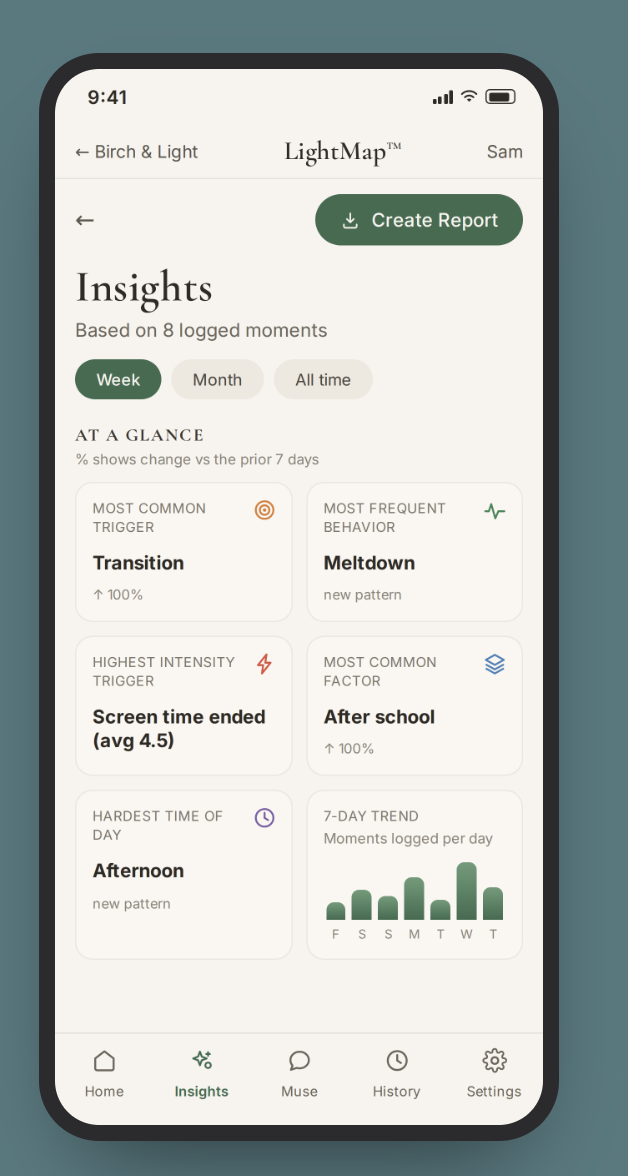

Part of the award-winning Birch & Light Method, honored with the Mom's Choice Gold Award for excellence in family resources.
A story to read together
Sometimes the easiest way in is a story you read side by side.
 Taste Bud 17
Taste Bud 17 feels everything more — and learns that big sensory feelings deserve the same care as everyone else’s.
Read the story Otto Filled Everything
Otto can't stop filling things with water. His family doesn't understand — until Grandma Willow helps them listen to what his body is actually asking for.
Read the story
Researched and drafted with AI assistance, reviewed before publication. Editorial standards