A provoked metal test, collected after your child takes a chelating agent, will show high metals in almost anyone, so an alarming number on it cannot tell you whether your child carries too much. The American College of Medical Toxicology calls this testing unvalidated, and no good trial evidence shows chelation helps children who are not poisoned.
You ran a functional panel and the numbers came back frightening. Mercury, lead, arsenic, all elevated, some of them far outside the range printed on the report. Your child has been sick for years. Someone in a group tells you they finally found the thing. A consult is booked.
Before that appointment, there is one question that changes how you read the whole page, and almost nobody is told to ask it.
Was the sample collected before or after a chelating agent
This is the difference between two completely different tests that produce reports looking nearly identical.
An unprovoked sample is collected normally. It is compared against reference ranges built from the general population, and it can tell you something real.
A provoked sample, also called a challenge or post-chelator test, is collected in the hours after your child is given a chelating agent such as DMSA or DMPS. That agent works by pulling metals out of tissue and into urine. That is its entire purpose. So the sample collected afterward has more metal in it, in essentially everyone, whether or not the child has any excess in their body.
Then that number is compared against reference ranges built from unprovoked samples. Higher-than-normal results are not a finding. They are the expected outcome of the procedure, in a healthy adult as much as in a chronically ill child.
The American College of Medical Toxicology issued a formal position statement on this. Their conclusion was that post-challenge urinary metal testing has not been scientifically validated, has no demonstrated benefit, and may be harmful when used to assess and treat patients. They also specifically disapproved of using such results as a reason to give more chelation. The Pediatric Environmental Health Specialty Units and the American Academy of Clinical Toxicology do not recommend it either.
If your report came from a provoked sample, the alarming number on it is close to uninterpretable. That does not mean your child is fine. It means this particular test cannot tell you.
What should you ask the lab or the clinician?
Four questions, and you can send them by email before the consult.
Was a chelating agent given before this sample was collected. If yes, which one and at what dose. Are the reference ranges on this report derived from provoked or unprovoked samples. And what would an unprovoked blood lead level and unprovoked urine or blood mercury show.
Unprovoked testing exists, is standard, and is usually inexpensive. If there is genuine concern about lead in particular, a blood lead level is the accepted measure and your pediatrician can order it. If the clinician resists unprovoked testing, that is information.
What the evidence on chelation for neuropsychiatric symptoms shows
There is no good trial evidence that chelation improves neurodevelopmental or neuropsychiatric symptoms in children who are not actually poisoned.
A Cochrane review examined chelation for autism and found only one trial to include, and that trial compared one round of oral DMSA against multiple rounds rather than against placebo. It found no effect on symptoms. The reviewers concluded there was no clinical trial evidence that chelation is an effective intervention, and took the unusual step of saying that given reported harms and no proven benefit, the risks currently outweigh the benefits. Cochrane reviews normally avoid making recommendations at all.
For PANS and PANDAS specifically the picture is simpler. Chelation does not appear in the PANS Research Consortium treatment guidelines. Those guidelines describe a three-part approach: treating the infection, addressing the immune response, and supporting the psychiatric symptoms. Heavy metal removal is not part of any of them.
The safety part, which is not theoretical
Chelating agents do not selectively remove the metals you want gone. They bind minerals your child needs, including calcium, zinc, copper, and iron.
Between 2003 and 2005, three deaths from chelation-related hypocalcemia causing cardiac arrest were reported to the CDC. Two were children. One was a five-year-old autistic boy who went into cardiac arrest during his third treatment in a physician's office in Pennsylvania in 2005. He had been given edetate disodium rather than edetate calcium disodium, two agents whose names differ by one word. The CDC had recommended against giving edetate disodium to children since 1991.
Beyond the acute risk, animal research found that chelation given in the absence of lead exposure produced lasting cognitive impairment. A planned National Institutes of Health trial of chelation in autism was cancelled partly on the strength of that finding. Chelating a child who does not need it is not a neutral experiment.
Reported adverse effects also include kidney impairment and mineral depletion. None of this means chelation is never appropriate. For a child with confirmed, significant lead poisoning it is established medical treatment, delivered under specialist supervision with monitoring. That situation is diagnosed by unprovoked testing, not by a provoked panel.
While you're here, take the guide
What's Underneath is free: the three body-state triggers under most meltdowns, what to say in the minute before it tips over, and how to reset afterward.

You'll get the guide instantly, plus five free articles in your inbox every week. Real challenges (meltdowns, school mornings, picky eating, big feelings) and how to actually handle them. Unsubscribe anytime.
Why does this land so hard in PANDAS families specifically?
None of this is about parents being credulous. It is about a condition whose structure makes this reasoning almost irresistible.
PANS and PANDAS flare and remit, often without a visible cause. Ten years into a chronic course, you have watched your child improve and slide back many times, and you have run out of explanations that account for it. A test that produces a concrete, physical, fixable answer is enormously compelling when everything else has been a shrug.
The same structure makes any intervention look effective. Start something during a bad stretch and improvement follows, because bad stretches end. That is the illness, not the protocol. It is the reason this field needs controlled trials more than most, and the reason testimonials in groups are so consistently positive for so many contradictory treatments at once.
Using the same four questions
The test we apply to every protocol in this community works here too. What is the evidence in children. What does it cost. What would it displace. How will we know if it worked.
On the last one, decide in advance what improvement would look like in behavior you could describe to someone else, and set a time limit. Log what you see as it happens rather than reconstructing it later, because memory keeps the worst day and the best day and loses the shape between them.
On displacement, be honest about the months. A protocol that occupies a year of attention and budget has a cost even if it does nothing at all.
What should you do with the consult you already booked?
Keep it. Go with the four questions above written down. Ask whether the recommendation would change if unprovoked testing came back normal. Ask what monitoring would happen during treatment and how mineral levels would be tracked. Ask what the plan is if symptoms worsen.
You can also take the report to your child's pediatrician or to a medical toxicologist and ask them to read it. Most regions have a poison control center staffed by toxicologists who will discuss a result over the phone at no cost. They are the people who actually treat metal poisoning, and they have no financial relationship to the panel you were sold.
Ten years of a chronic illness earns you the right to try things. It also earns you the right to know which test you were given before anyone acts on it.
Sources: American College of Medical Toxicology, "Position Statement on Post-Chelator Challenge Urinary Metal Testing," Journal of Medical Toxicology, 2010;6(1):74-75, doi 10.1007/s13181-010-0039-0. James S, Stevenson SW, Silove N, Williams K, "Chelation for autism spectrum disorder (ASD)," Cochrane Database of Systematic Reviews, 2015;(5):CD010766, doi 10.1002/14651858.CD010766.pub2. Centers for Disease Control and Prevention, "Deaths Associated with Hypocalcemia from Chelation Therapy: Texas, Pennsylvania, and Oregon, 2003-2005," MMWR Morbidity and Mortality Weekly Report, 2006;55(8):204-207. Baxter AJ, Krenzelok EP, "Pediatric fatality secondary to EDTA chelation," Clinical Toxicology, 2008;46(10):1083-1084. Brown MJ, Willis T, Omalu B, Leiker R, "Deaths resulting from hypocalcemia after administration of edetate disodium: 2003-2005," Pediatrics, 2006;118(2):e534-e536, doi 10.1542/peds.2006-0858. Risher JF, Amler SN, "Mercury exposure: evaluation and intervention. The inappropriate use of chelating agents in the diagnosis and treatment of putative mercury poisoning," NeuroToxicology, 2005;26(4):691-699, doi 10.1016/j.neuro.2005.05.004. Stangle DE, Smith DR, Beaudin SA, Strawderman MS, Levitsky DA, Strupp BJ, "Succimer chelation improves learning, attention, and arousal regulation in lead-exposed rats but produces lasting cognitive impairment in the absence of lead exposure," Environmental Health Perspectives, 2007;115(2):201-209, doi 10.1289/ehp.9263. Swedo SE, Frankovich J, Murphy TK, "Overview of Treatment of Pediatric Acute-Onset Neuropsychiatric Syndrome," Journal of Child and Adolescent Psychopharmacology, 2017;27(7):562-565, doi 10.1089/cap.2017.0042, introducing the three-part PANS Research Consortium treatment guidelines published in the same issue. This article is general information and not medical advice. Decisions about testing and treatment belong with your child's clinicians. In the United States, Poison Control can be reached at 1-800-222-1222.
For education and reflection, not medical advice. Our terms
Before the next flare
Bring your doctor a timeline, not a memory
LightMap logs what you see as it happens, so a protocol trial produces answers instead of an impression.
Start with 3 moments Not sure where to start? Ask me.Message Tara on WhatsApp. It really is me, I read everything and will personally respond.Click here to message Tara →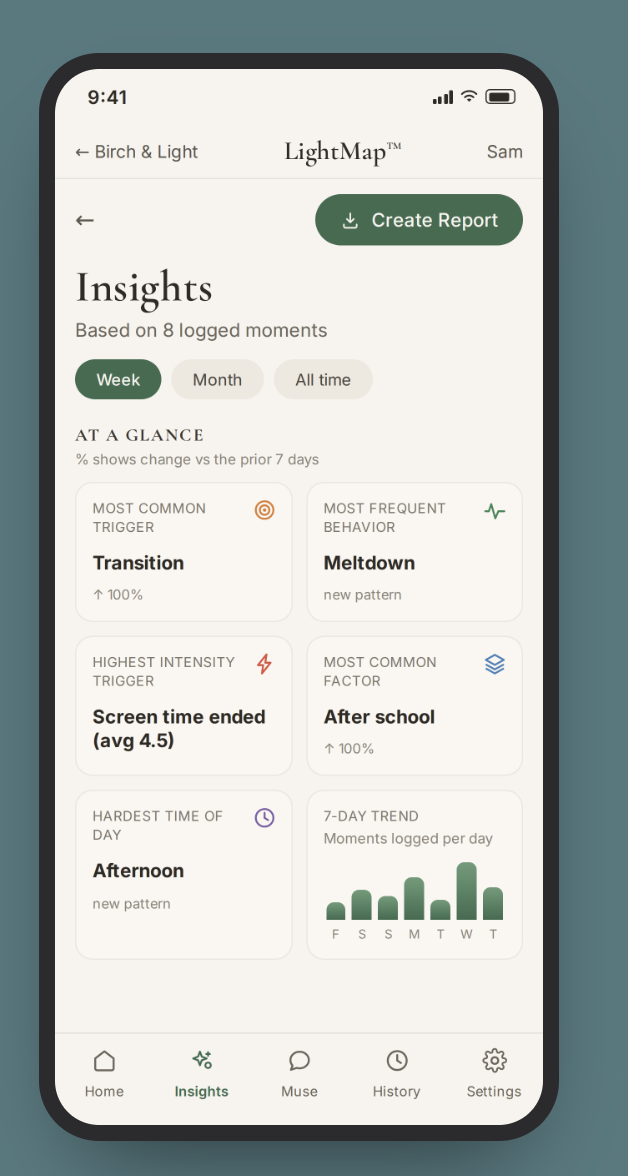

Part of the award-winning Birch & Light Method, honored with the Mom's Choice Gold Award for excellence in family resources.
If today was one of those days
A few more from the library, free to read.
Researched and drafted with AI assistance, reviewed before publication. Editorial standards