

One of you has been reading about it for months. The other one shuts down the moment it comes up.
Maybe you're the parent who has watched your child struggle long enough that medication has started to feel like the thing that might finally give them some relief — and you can't understand why your partner won't even seriously discuss it. Or maybe you're the parent who hears "medication" and feels something tighten in your chest, a fear you can't quite put into words, and you can't understand why your partner is so ready to medicate a child who is still so young.
Either way, you've probably had this conversation more than once, and it probably hasn't gone well. Few disagreements in parenting a complex child are as loaded as this one.
Here is what I want you to consider before the next round.
What this often looks like
The medication conversation rarely stays about medication. It tends to become a stand-in for everything else the two of you haven't resolved.
- One parent does mountains of research and arrives with articles, dosages, and a plan. The other feels ambushed and digs in.
- The conversation keeps ending the same way — one person frustrated, one person quietly resolved, nothing decided.
- It stops being a real discussion and becomes a series of comments. A sigh when a hard day happens. A pointed "well, if we'd done something about this..."
- One parent starts to feel like they're fighting alone for the child's relief. The other starts to feel like they're the only thing standing between their kid and a decision they'll regret.
Both of you think you're protecting your child. That's the part that gets lost.
Why it happens
The parent who wants to try medication is usually the one carrying the daily weight of the child's struggle — the one in the hard moments, watching their kid suffer, and increasingly unwilling to withhold something that might help. For them, waiting feels like letting their child stay in pain when relief might be available.
The parent who resists is rarely resisting out of denial, even though it can look that way. Underneath, there's often a real fear — that medicating means admitting something is "wrong" with their child, that they'll lose the kid they know, that they're taking a shortcut instead of solving the real problem, or simply that this is permanent and they're not ready. Those fears deserve to be heard, not argued out of existence.
And both of you may be carrying old stories — a relative who was overmedicated, or one who went undiagnosed for years and suffered for it. You're not only deciding about your child. You're deciding against the backdrop of everything you've absorbed about what medication means.
What tends to help
- Name the fear under the position. "I'm scared we'll medicate too fast" and "I'm scared we're making him white-knuckle through something we could ease" are both real. You can't address a fear that stays disguised as a debate.
- Agree on what you're both trying to protect. Usually it's the same thing — a child who can function and feel like themselves. Starting from the shared goal makes the disagreement feel less like a battle.
- Treat it as one experiment, not a life sentence. Much of the fear comes from a sense of permanence. A time-limited trial, with agreed-upon things to watch for and a real check-in date, lowers the stakes for the hesitant parent without asking them to commit forever.
- Get information from someone who knows your child, together, in the same room — a prescribing clinician you both trust — rather than trading articles across the kitchen. A neutral expert answering both parents' questions at once moves things further than months of home debate.
- Let the resistant parent set some of the terms. What would they need to see to feel okay trying? What would make them want to stop? Giving the hesitant parent real authority over the guardrails often unlocks a yes.
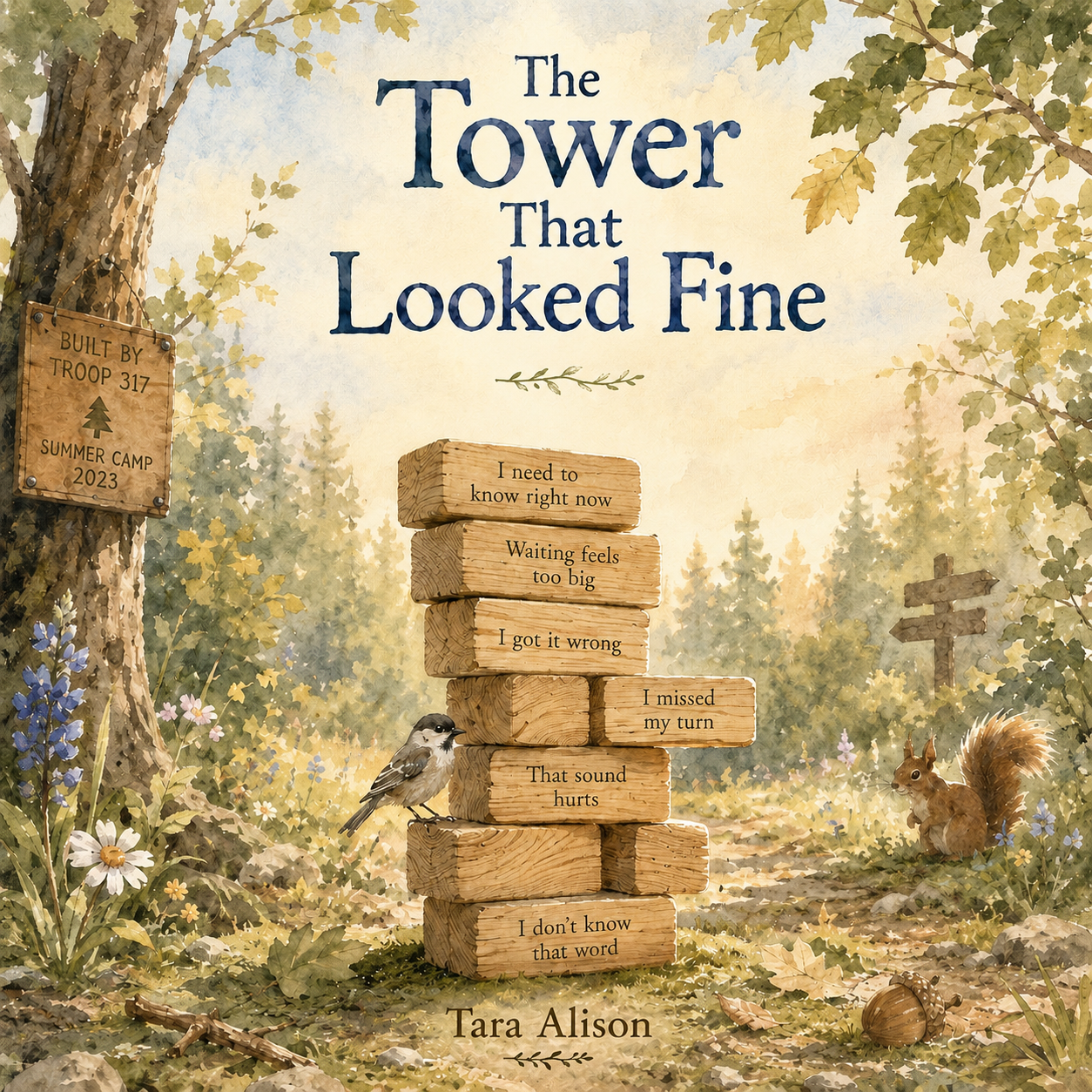
There's a story for this exact struggle
The Tower That Looked Fine
A tower in a quiet clearing tries to stay steady through every small thing nobody else seems to notice — until one tiny breath of wind causes her to fall, and a gentle hand begins to gather the blocks back.
Free to read. You'll also get five free articles a week. Unsubscribe anytime.
What tends not to help
Pressure and repetition. Bringing it up after every hard day doesn't move the hesitant parent toward yes — it moves them toward bracing. The more it feels like being worn down, the harder they hold.
Research as a weapon also backfires. A stack of studies handed to a frightened partner doesn't feel like information; it feels like being told their fear is stupid. The fear doesn't go away. It just stops being spoken, and goes to work underground.
And going around your partner — starting a medication conversation with the pediatrician without them, or making the decision unilaterally — may end the argument, but it ends the partnership too. A choice this big needs both of you inside it, even if you get there slowly.
Before you go, grab the free guide
The 3 body-state triggers under most meltdowns, a script for the 30 seconds before it tips over, and a reset for after. Free.

You'll get the guide instantly, plus five free articles in your inbox every week. Real challenges (meltdowns, school mornings, picky eating, big feelings) and how to actually handle them. Unsubscribe anytime.
When additional support may be needed
If the two of you are genuinely stuck — not just disagreeing, but unable to have the conversation at all without it collapsing — it's worth sitting down with a professional whose whole job is helping families weigh exactly this. A clinician who knows your child can lay out what they're actually seeing and what the realistic options are, which gives you both something concrete and shared to respond to instead of your own competing fears.
It's also reasonable to get support when the medication standoff has become the thing your whole relationship now orbits — when it's leaked into everything and you can't talk about your kid at all without it surfacing. At that point the medication question and the marriage question have fused, and untangling them usually takes a hand from outside.
Where LightMap helps
One of the hardest parts of this decision is that it often gets made out of two different sets of memories. One parent remembers the worst days vividly; the other remembers the good stretches and wonders what all the worry is about. You're deciding from impressions, and impressions are shaped by which moments stuck.
Seeing several weeks at once can give you both the same footing. When you can look at how often the hard moments actually happen, how long recovery actually takes, and whether things are slowly improving or slowly getting heavier, the conversation shifts from "how bad is it, really" — where you'll never agree — to a shared picture you're both looking at together.
Every behavior is a clue.
Sometimes a few weeks of logged patterns tell you more about whether something is working than any single hard day can. Explore LightMap at birchandlight.com/lightmap.
Frequently asked questions
How do we decide if we can't agree?
Start by getting both of your real fears on the table, then bring them to a clinician who knows your child and can answer you both at once. A lot of stuck couples find that a time-limited trial with clear, agreed-upon things to watch for is something both can live with — it gives the eager parent a real attempt and the hesitant parent a real off-ramp.
Is it bad that one of us is so hesitant?
No. Hesitation about medicating a child is healthy, not a flaw — it usually means that parent is taking the decision seriously. The goal isn't to overcome their caution but to understand what's underneath it, because that fear often points at exactly the guardrails that will make any trial safer and more workable.
What if we try it and only one of us thinks it's working?
This is common, which is why it helps to agree in advance on what you're both watching for — specific, observable things, not just a general sense of "better." When you've named the markers beforehand and can look at them together over several weeks, you're far less likely to end up in two different stories about whether it helped.
Sources: American Academy of Child and Adolescent Psychiatry on family accommodation and shared decision-making; resilience research on protective adult relationships (Werner & Smith, Kauai Longitudinal Study).
For education and reflection, not medical advice. Our terms
See what's underneath
Stop guessing what set it off
LightMap turns scattered hard days into a pattern you can see. Start by logging one moment tonight.
Log today's hard moment, no account needed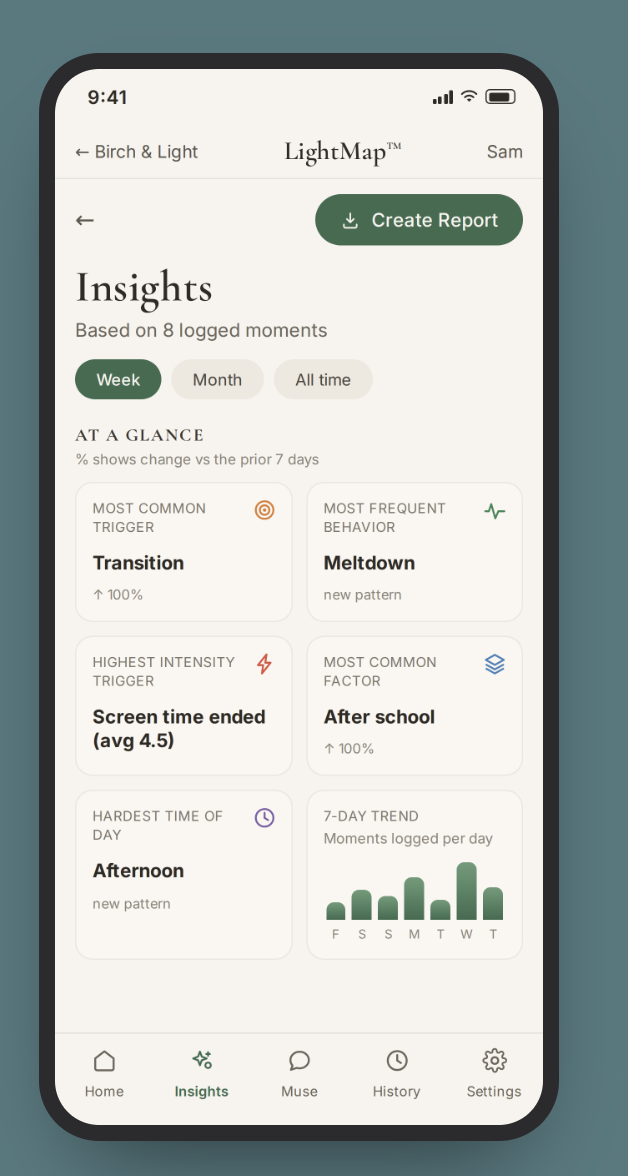

Part of the award-winning Birch & Light Method, honored with the Mom's Choice Gold Award for excellence in family resources.
A story to read together
Sometimes the easiest way in is a story you read side by side.
- The Tower That Looked Fine
A tower in a quiet clearing tries to stay steady through every small thing nobody else seems to notice — until one tiny breath of wind causes her to fall, and a gentle hand begins to gather the blocks back.
Read the story  The Boy at the Edge
A boy finds calm by watching the world move from a window. When his stillness is mistaken for defiance, the moment escalates — and he learns that being calm doesn’t always protect you from being told no.
Read the story
Researched and drafted with AI assistance, reviewed before publication. Editorial standards