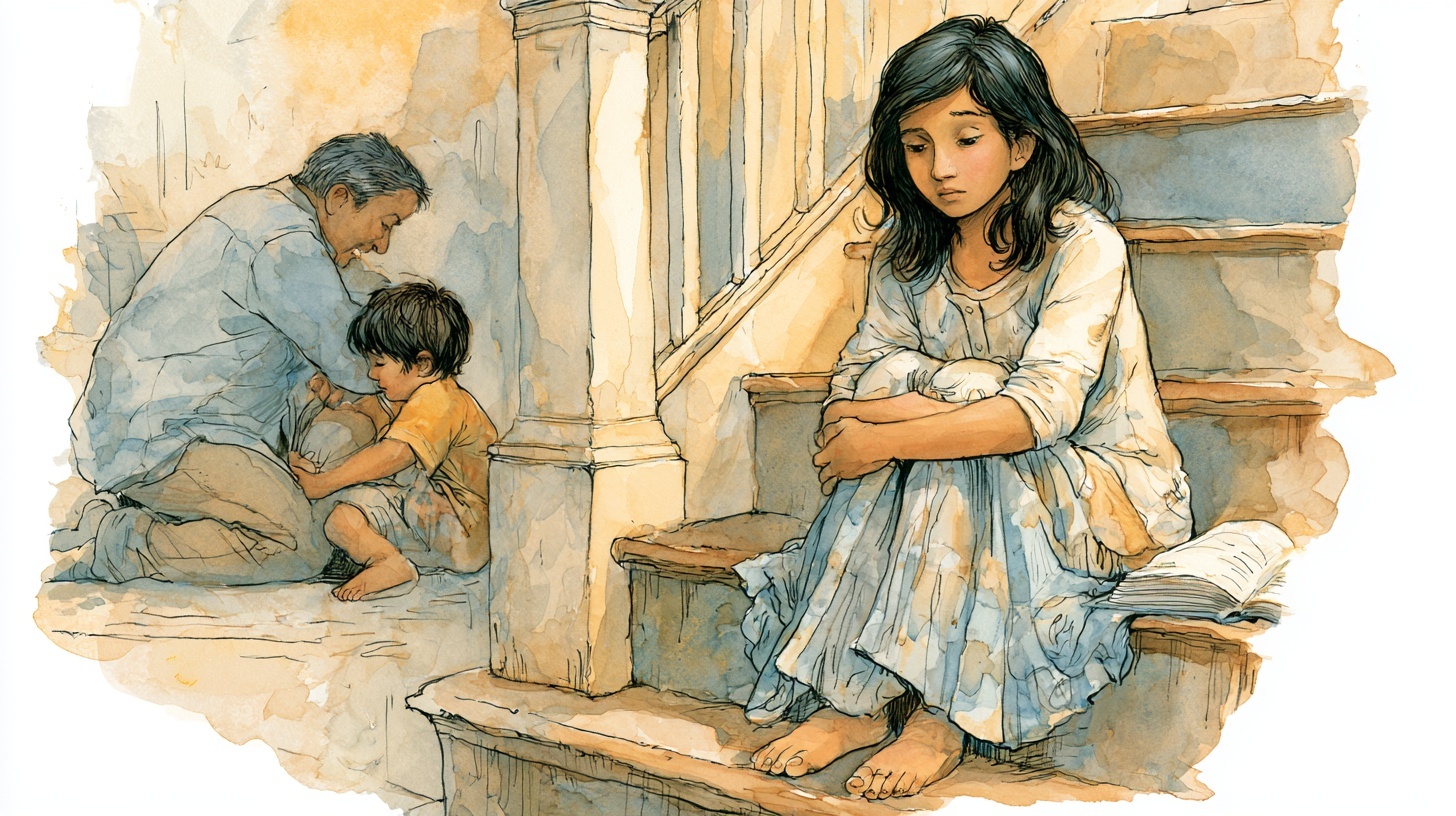
Your son is having his third meltdown of the day and your daughter, the one who has not needed anything from you since breakfast, is sitting on the stairs reading the same page for the tenth time because she has learned nobody is coming.
She is not being difficult. She is being easy, and that is the problem.
There is a name for this now. Therapist Alicia Maples coined it: the glass child, a sibling of a child with significant needs who becomes so easy to see through that their own wants and struggles stop registering as things that need attention. Not because anyone loves them less. Because crisis always wins the room, and a child who is not in crisis quietly learns to stop competing for it.
What this often looks like
- They stop asking. Not because they do not want things, but because they have learned the answer is usually not right now, so eventually they stop bringing it up at all.
- They become the helper. Fetching, distracting, translating a meltdown to a confused stranger at the store. It looks like maturity. It is often a child doing unpaid labor to keep the house calm.
- Their wins get smaller responses. A meltdown gets the whole family's attention for an hour. A spelling test does not, simply because there is less bandwidth left by the time it comes up.
- They apologize for having needs. "It's fine, I don't need anything" becomes a reflex, sometimes said before anyone has even had the chance to say no.
Why it happens
None of this happens because a parent loves one child more. It happens because attention is finite and crisis is loud. A meltdown produces an immediate, visible emergency that has to be addressed right now, while a quiet child's unmet need produces nothing that demands a response in the moment. The math of the household ends up rewarding the child who does not ask.
There is also a version of the competence trap at play here. A sibling who is calm, capable, and low maintenance becomes genuinely useful to a family running on empty, and once a child proves they can hold themselves together and help hold the house together, that role tends to stick. The child who was praised for being so grown up at seven can still be playing that part at fifteen, and by then it does not feel optional to stop.
What tends to help
- Make the time protected, not leftover. A specific slot on the calendar that survives a bad week is worth more than an open promise of something special soon that keeps losing to whatever is on fire. Fifteen minutes that reliably happens beats two hours that gets cancelled twice a month.
- Let them set the agenda. The point of the time is that they get to choose, with no discussion of their sibling unless they bring it up first. A glass child spends most of the day organized around someone else's needs. This slot should not be.
- Notice the small stuff out loud, on its own. Not "you're such a good helper," which rewards the role you are trying to lighten, but "I saw how hard you worked on that project," said with the same weight you would give any other kid's effort.
- Give them permission to be upset about this specifically. Not just a general "everything is hard for our family," but the direct version: "It is fair that you are frustrated your birthday got interrupted. That is a real thing to be mad about, and it does not make you selfish."
While you're here, take the guide
What's Underneath is free: the three body-state triggers under most meltdowns, what to say in the minute before it tips over, and how to reset afterward.

You'll get the guide instantly, plus five free articles in your inbox every week. Real challenges (meltdowns, school mornings, picky eating, big feelings) and how to actually handle them. Unsubscribe anytime.
What tends not to help
Waiting until the guilt catches up to you is the most common trap, because by the time a parent notices the imbalance clearly enough to act, the sibling has often already adjusted their own expectations downward to match what they have been getting. A sudden overcorrection, a big trip, a flood of gifts, can feel more confusing than comforting to a kid who has learned not to trust that attention sticks.
Leaning on them as a co-parent is another one worth naming directly. Asking a sibling to translate, supervise, or de-escalate in a genuine crisis sometimes cannot be avoided, but making it their standing job, the one who is always on call, teaches them that their role in the family is to manage someone else's needs rather than have their own.
And treating the special time as optional the moment something else comes up erodes trust faster than skipping it would have in the first place. A child who has been told we'll reschedule enough times stops believing the reschedule is coming, and stops asking for it back.
When additional support may be needed
If a sibling has started actively avoiding their brother or sister, expressing that they wish they were not part of this family, or showing signs of anxiety or depression that go beyond ordinary frustration, it is worth getting them their own space to talk, separate from you and separate from anything framed around their sibling's diagnosis. Sibshops, a peer support model built specifically for siblings of kids with disabilities, exist in many areas and give kids a room full of other children who understand this without having to explain it first. An individual therapist can also help a sibling untangle their own feelings from the responsibility they may have quietly taken on for the whole family's stability.
Where LightMap helps
A lot of what pulls a parent's attention entirely toward one child is unpredictability. When a meltdown can happen at any moment for reasons that are not yet clear, everyone else in the house ends up on standby, including the sibling who just wanted to finish telling you about their day.
Tracking what actually precedes a hard moment, the time of day, the trigger, the pattern, turns some of that unpredictability into something you can plan around instead of react to. A family with more warning has more room to protect the fifteen minutes that belongs to someone else.
Every behavior is a clue.
When the patterns are written down instead of held in your head alone, there is more room left for the child who is not in crisis. Explore LightMap at birchandlight.com/lightmap.
Frequently asked questions
What does glass child mean?
A glass child is a term for the sibling of a child with significant medical, developmental, or behavioral needs, one who becomes so easy to see through that their own struggles and needs stop getting noticed. It is not a clinical diagnosis. It is a description of a family dynamic, and naming it is often the first step toward changing it.
My other child says they are fine. Should I still worry?
I'm fine is often the most practiced sentence in a glass child's vocabulary, said before anyone has a chance to ask a second time. It is worth gently pushing past the first answer every so often, not to force a confession, but to signal that you are genuinely available if the real answer is different.
How do I find time for this when the house already feels like it is on fire?
Start smaller than feels meaningful. Ten or fifteen minutes, protected on the calendar, done consistently, changes a child's sense of where they stand far more than one long outing that happens once and then does not repeat. Consistency is what rebuilds the trust, not duration.
Is it okay to ask my other child to help during a meltdown sometimes?
In a genuine emergency, safety comes first, and that can mean asking any family member for help, including a sibling. What to watch for is whether that becomes their default role rather than an occasional ask. If they are the one who is always sent to handle it, that is worth stepping back from, even if they seem capable and even if they never complain.
For education and reflection, not medical advice. Our terms
See what's underneath
Stop guessing what set it off
LightMap turns scattered hard days into a pattern you can see. Start by logging one moment tonight.
Log today's hard moment, no account needed Not sure where to start? Ask me.Message Tara on WhatsApp. It really is me, I read everything and will personally respond.

Part of the award-winning Birch & Light Method, honored with the Mom's Choice Gold Award for excellence in family resources.
A story to read together
Sometimes the easiest way in is a story you read side by side.
 The Tower That Looked Fine
A tower in a quiet clearing tries to stay steady through every small thing nobody else seems to notice — until one tiny breath of wind causes her to fall, and a gentle hand begins to gather the blocks back.
Read the story The Boy at the Edge
A boy finds calm by watching the world move from a window. When his stillness is mistaken for defiance, the moment escalates — and he learns that being calm doesn’t always protect you from being told no.
Read the story
Researched and drafted with AI assistance, reviewed before publication. Editorial standards