Somewhere around your child's seventeenth birthday, people start using the word guardianship at you. The school transition coordinator raises it. An attorney at a parent night says you need it before the eighteenth birthday. Another parent says her lawyer told her not to wait.
Almost nobody tells you that guardianship is one option among several, that it is the most restrictive of them, or that it is legally supposed to be a last resort.
Note before you read on: guardianship is state law, and the rules, the terminology, and the available alternatives vary enormously. Some states call it conservatorship. What follows is the shape of the decision and how to find your own state's answer, not a substitute for advice about your state.
What actually happens at eighteen
Your child becomes a legal adult. That means medical providers stop talking to you without permission, schools stop sharing records without consent, and financial and legal decisions become theirs.
Under federal special education law, educational rights transfer to the student at the age of majority in most states, and the school is required to notify both you and your child that this is coming, at least a year in advance. If you have not received that notice by the time your child is seventeen, ask for it in writing.
None of that means you disappear from your child's life. It means the paperwork changes and the legal defaults change.
The ladder, from least restrictive to most
The reason this decision gets made badly is that most families are shown only the top and bottom rungs. Here is the whole ladder.
Supported decision-making. Your child keeps every legal right and chooses trusted people to help them understand information, weigh options, and communicate decisions. It can be an informal arrangement or a written agreement, and a growing number of states now recognize these agreements in statute. This is how most adults actually make decisions. We consult people. Nobody takes our rights away for it.
Release forms and consent. A signed release lets a doctor talk to you. A FERPA consent lets a college share records. Enormously underused, and it solves a great deal of what families think they need guardianship for.
Health care proxy or advance directive. Your child names who makes medical decisions if they cannot.
Power of attorney. Your child delegates financial or legal decision-making to a person they choose, and can revoke it.
Representative payee. If Social Security benefits are involved, this handles benefit money specifically without touching anything else.
Special needs trust and ABLE account. For money and benefits eligibility. Neither one requires removing decision-making rights.
Limited guardianship. A court removes decision-making authority only in the specific areas where it finds your child cannot decide, and only for as long as it finds necessary. Everything else stays with them.
Full guardianship. A court finds your child legally incapacitated and transfers nearly all decision-making to somebody else.
Most families are told the ladder has two rungs. It has eight.
While you're here, take the guide
What's Underneath is free: the three body-state triggers under most meltdowns, what to say in the minute before it tips over, and how to reset afterward.

You'll get the guide instantly, plus five free articles in your inbox every week. Real challenges (meltdowns, school mornings, picky eating, big feelings) and how to actually handle them. Unsubscribe anytime.
Why the default answer is so often wrong
A disability is not the same thing as an incapacity. Courts routinely appoint guardians for people who could have continued making their own decisions with the right support, because that was the only option anyone put in front of them.
Full guardianship is difficult to undo. It affects voting in some states, marriage, contracts, where a person lives, and what happens to their money. Federal disability policy, the American Bar Association, and the Department of Justice all treat it as a last resort to be used when nothing less restrictive will work.
The question is not whether your child needs help. Almost certainly they do. The question is the narrowest arrangement that provides that help.
Start at sixteen, not at seventeen and eleven months
Raise it at the IEP meeting when your child is sixteen. Transition planning is already required by then, and this belongs in it.
Ask the team directly what supports your child would need to make decisions rather than whether they can make them. That single reframe changes the conversation, and it is the question the law actually wants answered.
If the school is unfamiliar with supported decision-making, bring material from your state's disability rights organization. Many are.
Where to find your state's answer
Every state and territory has a federally funded Protection and Advocacy agency. They are free, they are independent of the state agencies they hold to account, and guardianship alternatives are core work for them. Search for disability rights followed by your state name.
Your state chapter of The Arc has templates and worksheets for supported decision-making agreements, and the Center for Public Representation maintains practical tools on it.
The Administration for Community Living publishes an overview of alternatives to guardianship, and the American Bar Association maintains a chart of which states recognize supported decision-making in statute.
If you do use an attorney, ask them one question first: what less restrictive alternatives would you consider before guardianship. An attorney who has no answer is telling you something.
What to bring into the room
Your own record does more here than almost anywhere else. Where does your child manage well. Where do they need somebody to explain something. Where do they need somebody to decide.
Those three categories are not the same, and a family that walks in able to distinguish them ends up with a much narrower arrangement than a family that walks in with a general sense that their child needs help.
The part to hold onto
You have spent years fighting for your child to be seen as capable. The eighteenth birthday is not the moment to hand that argument to the other side because a form was easier.
Some young people do need a guardian, and choosing that is not a failure. Choosing it without ever being shown the other seven options is.
Our research says these are the options and roughly how they rank. It is not legal advice, and guardianship is state law, so the names, the procedures and which alternatives are recognised all change at the state line. Check it directly. The Administration for Community Living publishes an overview of alternatives to guardianship, and your state's Protection and Advocacy agency will tell you what is actually available where you live, free.
Sources: Administration for Community Living, Alternatives to Guardianship; US Department of Justice Elder Justice Initiative; American Bar Association Commission on Law and Aging; 34 CFR 300.520; 34 CFR 300.320(c).
For education and reflection, not medical advice. Our terms
See what's underneath
Walk in able to show the difference
LightMap reads your hard days together and gives you answers. Start with one moment today.
Start with 3 moments Not sure where to start? Ask me.Message Tara on WhatsApp. It really is me, I read everything and will personally respond.Click here to message Tara →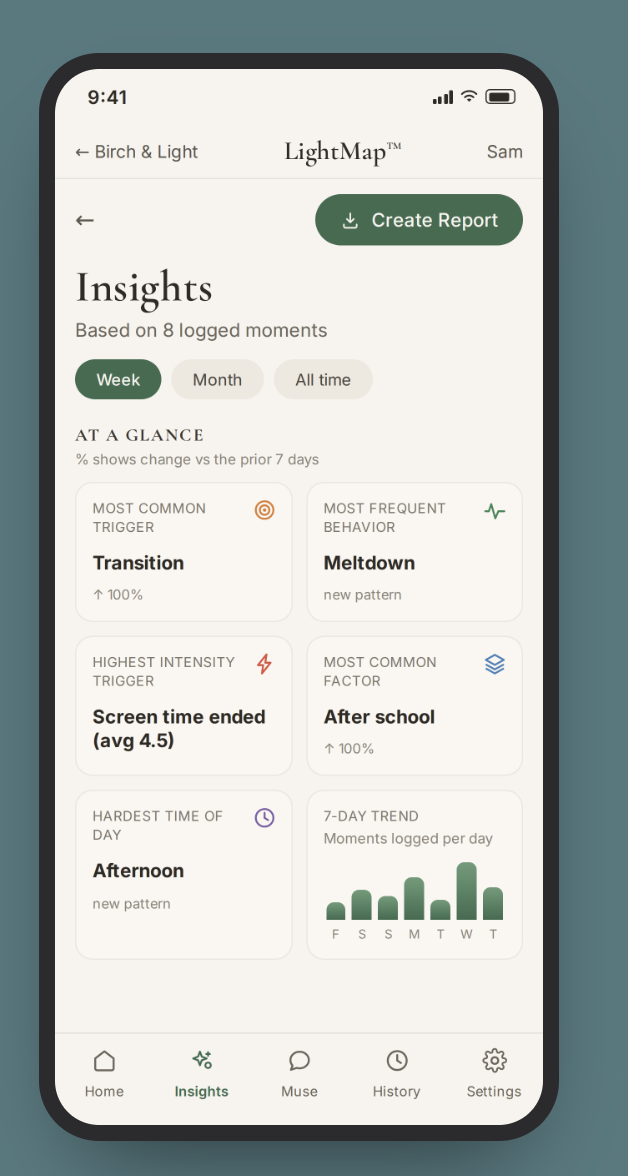

Part of the award-winning Birch & Light Method, honored with the Mom's Choice Gold Award for excellence in family resources.
If today was one of those days
A few more from the library, free to read.
Researched and drafted with AI assistance, reviewed before publication. Editorial standards