
You already know how your child sleeps. You know which nights are bad, you know roughly what time the arguing starts, and you know what the next morning costs.
What you probably cannot do is say it out loud in a way a clinician can use. Ask most parents at an appointment how their child sleeps and the honest answer is some version of "badly, I think, most of the time." That sentence is true and it goes almost nowhere. Two weeks of a filled-in grid goes somewhere, because a clinician can see the shape of the week instead of taking your word for the average.
This is a guide to filling in that grid. It comes with a printable diary, and it takes about a minute a day.
This is information, not medical advice. It reflects our best reading of the guidance and research at the time of writing and is not guaranteed. A sleep diary cannot diagnose anything, and anything involving medication or supplements belongs with your child's prescriber.
Download Your Child's Two-Week Sleep Diary (PDF, 6 pages, prints on US Letter)
What a sleep diary actually is
A sleep diary is a record of when your child was in bed and when you think they were asleep, kept day by day rather than remembered afterward. That is the whole of it. The standard version was published by Carney and colleagues in 2012 for insomnia research, and its core is nine items: when you got into bed, when you started trying to sleep, how long it took to fall asleep, how many times you woke, how long those wakings lasted altogether, when you woke for the last time, when you got up for the day, how you would rate the night, and a space for anything else. Naps and daytime questions sit in a longer optional version of the same diary. The one in this guide adds a short daytime section, because in children the daytime is often where the problem actually shows.
What makes it useful is not precision. It is that the record is made close to the event, across enough days to show a pattern, by the person who was actually there.
It is also a completely ordinary thing to bring to an appointment. You are not diagnosing anything, and neither is the paper. You are collecting the information a clinician would otherwise have to reconstruct from memory in a fifteen-minute visit.
Why two weeks and not two nights
Two weeks is not an arbitrary round number. When clinicians assess a body-clock problem, the diagnostic criteria in the International Classification of Sleep Disorders call for sleep logs, with actigraphy where possible, kept for at least seven days and preferably fourteen, and they specify that the record should include both school or work days and free days.
That last part is the reason short records mislead. Plenty of children look fine on a school night and completely different on a Saturday, or the reverse. One week can miss a whole side of that. Fourteen days catches two weekends, a sick day if one turns up, and the ordinary drift that nobody notices while it is happening.
Fourteen days is also long enough that a few blank rows do not ruin it. If you miss three nights you still have eleven, and eleven real nights is a great deal more than most clinicians get.
Three things that are not the same
Most of the value in a sleep diary comes from separating three things that get collapsed into one word at home.
Getting into bed. The time your child is physically in bed with the lights going out. This is the part you have the most control over and the one most families can state confidently.
Falling asleep. The time your child is actually asleep. Nobody knows this precisely, including sleep clinics, which is why the standard diaries ask for an estimate. The gap between the first and the second is the number that matters most, and it is invisible unless you record both. A child in bed at 8pm who is asleep at 8.15 and a child in bed at 8pm who is asleep at 10.30 are having very different nights, and both get described at home as "goes to bed at eight."
Staying asleep. Whether your child wakes in the night, how often, and whether they come to find you or settle alone. Some wakings you will know about. Some you will not. Record the ones you know about and leave the rest.
There is a fourth thing that gets discussed less: the final waking, and whether it happens on its own or only after three attempts and a light switch. A child who cannot surface in the morning is telling you something about the other end of the night.
How to fill it in when you do not know
The most common reason a sleep diary never gets started is a parent deciding they do not have good enough information. You do not need good information. You need honest information.
Fill it in in the morning, not the night before. You will remember last night better than you can predict tonight, and the morning version is closer to what happened.
Use the house as your clock. If the noise stopped around nine and you did not hear anything after that, shade from nine. If your child came down twice and the second time was during the ten o'clock news, you know more than you think you do.
Where you truly do not know, write a question mark and move on. A diary with question marks in it is honest and readable. A diary that was never filled in because the information was not perfect enough is neither.
And leave the two weeks ordinary. Do not move bedtime, drop a nap, or change anything your child takes because you are now paying attention to it. The diary's job is to describe the weeks you were already having.
What to write down about the next day
A night on its own is only half the picture. The reason clinicians ask about daytime function is that sleep problems announce themselves in the daytime, and in children they frequently announce themselves as behavior rather than as sleepiness.
The printable diary asks you to rate four things on a one-to-five scale, which takes about ten seconds:
- Tiredness. Not just yawning. Being hard to rouse, falling asleep in the car, needing to be carried through the morning.
- Irritability. How close to the surface the upset was, and how quickly small things became big ones.
- Attention. Whether the day held together, or whether everything took four reminders.
- Usual activities. Whether the day went ahead as planned, or whether school, practice, homework or plans with friends came apart.
Rate them against your own child on a normal day, not against anyone else's child and not against an ideal. The scale is there so a clinician can see which nights sat next to the hard days, and whether they line up at all. Sometimes they do not, and that is also an answer.
How much sleep is usual, by age
Parents ask this constantly and the number is genuinely useful, so here it is. The American Academy of Sleep Medicine published consensus recommendations in 2016 after a panel reviewed 864 studies. These are totals per 24 hours, including naps where naps are still normal:
- 4 to 12 months: 12 to 16 hours, including naps
- 1 to 2 years: 11 to 14 hours, including naps
- 3 to 5 years: 10 to 13 hours, including naps
- 6 to 12 years: 9 to 12 hours
- 13 to 18 years: 8 to 10 hours
Read those as ranges for healthy children as a group, not as a target your child has to hit every night. A child at the bottom of the range who wakes rested and gets through the day is not in trouble because of a number. A child in the middle of the range who is exhausted, miserable and coming apart by Wednesday is still telling you something, and the number does not cancel that out.
What the recommendations do say is that regularly sleeping less than the recommended amount is associated with problems with attention, behavior and learning. That is an association across populations, not a verdict on any one child's week.
The part about ADHD, kept honest
If you are here because of an ADHD assessment, or because someone at school raised attention, a few things are fair to say and a few are not.
A 2025 narrative review by Malhi, Weiss, Waxmonsky and Baweja describes the relationship between ADHD and sleep as bidirectional: too little sleep is linked to more inattention and more emotional dysregulation, while hyperactivity and impulsivity in the evening can make falling asleep harder. Those two run in a loop, which is part of why sorting out which came first is a job for a clinician with real data rather than a job for a parent at 11pm.
The same review notes that stimulant medications remain first-line treatment for ADHD symptoms and that insomnia can be a common side effect. That is one concrete reason the diary asks you to write down what your child takes and when, copied straight from the label rather than from memory.
What is not fair to say is that every child with ADHD has a sleep disorder, and here it helps to look at what the research actually measured. A 2025 systematic review and meta-analysis by Xian and colleagues pooled 44 studies covering 2,239 children with ADHD against 57,181 typically developing children. It did find differences on every measure it examined: less total sleep, longer to fall asleep, more waking in the night, lower sleep efficiency. Then look at the size of them. The average difference in total sleep time was about seven minutes a night. The authors themselves graded the quality of the underlying evidence as low or very low and warned that the studies were inconsistent with each other.
That is what a group difference looks like. It is real, and it is close to useless for predicting one particular child. Some children with ADHD sleep like anyone else. Some have a delayed body clock, some have a separate sleep disorder, and some have a sleep problem that has nothing to do with the ADHD at all. The diary exists to find out which, not to confirm a story you already have.
If a delayed body clock is the thing you keep circling back to, we go into it in more depth in Your ADHD Child Cannot Sleep. It Is Not a Bedtime Problem.
While you're here, take the guide
What's Underneath is free: the three body-state triggers under most meltdowns, what to say in the minute before it tips over, and how to reset afterward.

You'll get the guide instantly, plus five free articles in your inbox every week. Real challenges (meltdowns, school mornings, picky eating, big feelings) and how to actually handle them. Unsubscribe anytime.
When to raise it with a clinician sooner
Some things are not a two-week-and-see situation. Guidance for pediatricians is to ask every child about snoring at routine visits, and where a child snores regularly and has other symptoms, to arrange a sleep study or refer to a sleep specialist or an ENT. Estimates of how common childhood obstructive sleep apnea is vary widely. The AAP's own technical report, which reviewed the studies behind the guideline, found prevalence ranging from 0 to 5.7 percent depending on the population studied and how it was measured.
Say something at the next appointment, or sooner, if you are seeing:
- Snoring on most nights
- Gasping, snorting, choking or pauses in breathing during sleep
- Persistent mouth breathing, or a very restless, sweaty sleeper
- Morning headaches, or a child who cannot be woken
- Falling asleep during the day, at school or in the car
- An urge to move the legs at bedtime, or legs that ache at night
- Bedwetting that has restarted after a dry stretch
- Sleep that got noticeably worse after a medication change
None of these means something is definitely wrong. All of them mean sleep deserves to be named out loud rather than left in the background of the appointment.
A diary is not a sleep study
This matters, because families sometimes arrive at a clinic having done two careful weeks and expecting it to stand in for testing.
A sleep diary records a schedule. A sleep study, or polysomnography, records physiology: breathing, oxygen, heart rhythm, brain activity, movement. It is done overnight with equipment, it is ordered by a clinician, and it is the test that identifies sleep apnea. A diary cannot do any of that, and no wearable you buy can either.
A diary also cannot measure melatonin. Body-clock timing is assessed in research and specialist settings by sampling melatonin under controlled lighting, not by watching bedtime. What a diary can do is show that the pattern looks delayed, which is often what prompts the conversation in the first place.
So the honest framing is this. The diary does not replace testing. It is the thing that helps a clinician decide whether testing is needed, and which kind.
A short word on melatonin
Melatonin comes up in every conversation about children and sleep, so it is better addressed than avoided.
In the United States melatonin is sold as a dietary supplement, which means it is regulated less strictly than a prescription or over-the-counter medicine. In several other countries it is a prescription drug. The National Center for Complementary and Integrative Health notes that a 2023 study of 25 over-the-counter melatonin gummy products found 22 of them inaccurately labeled, with melatonin content ranging from 74 percent to 347 percent of what the label claimed, and one product containing no detectable melatonin at all. An earlier analysis of 31 supplements found most did not match their labels and that 26 percent contained serotonin.
Two more things from the same source. Because melatonin is a hormone, there is real uncertainty about long-term use in children and about effects on hormonal development including puberty, and that uncertainty has not been resolved. And the CDC estimated roughly 11,000 emergency department visits between 2019 and 2022 for unsupervised melatonin ingestion by children five and under, many of them involving flavored products, which is a storage problem as much as a dosing one.
One distinction gets blurred in parent groups. The prolonged-release pediatric melatonin studied in the autism and ADHD trials people cite is a prescription medicine, authorized in the European Union since 2018 under the name Slenyto for insomnia in children with autism spectrum disorder or certain neurogenetic conditions, and for children aged 6 to 17 with ADHD, in both cases where sleep hygiene measures have not been enough. A supplement on a US shelf labeled "extended release" is not that product and has not been through that assessment.
None of which is a recommendation either way. Dose, timing, formulation and whether to use melatonin at all are decisions for your child's clinician, and they are much easier to make with two weeks of diary in front of them.
Melatonin is also not the only thing that ends up in a bedtime routine. Over-the-counter antihistamines get used for sleep, and plenty of children are on a prescription for something else that affects it. Whatever is in your house, write it on the medicines page of the diary with the strength copied off the label. What a night already has in it is information the clinician needs, and it is the kind of thing that goes unmentioned in an appointment because nobody thinks to ask.
What to do with it when it is done
Take the whole thing. Do not summarize it into a sentence on the way in, and do not tidy it up. The messy rows are the informative ones.
The last page of the printable diary is a short summary you fill in yourself: usual asleep time on school nights and free nights, how many nights had a waking, how many days had a nap, the shortest and longest nights, and the questions you want to ask. It is there so you are not trying to read fourteen rows upside down while someone waits.
Then let the clinician interpret it. You did the hard part, which was noticing on purpose, for fourteen days, while also living the fourteen days.
Download Your Child's Two-Week Sleep Diary (PDF)
This article is for information only. It reflects our best reading of the guidance and research at the time of writing and is offered without any guarantee of accuracy or outcome. It is not medical advice and it is not a diagnosis. A sleep diary cannot diagnose ADHD, autism, insomnia, sleep apnea or a delayed sleep-wake phase disorder, and it does not measure melatonin. Anything involving medication or supplements belongs with your child's prescriber.
Sources, tied to the claims they support. The nine core items of the standard sleep diary, and the placement of naps and daytime questions in its expanded version: Carney CE, Buysse DJ, Ancoli-Israel S, Edinger JD, Krystal AD, Lichstein KL, Morin CM, "The Consensus Sleep Diary: Standardizing Prospective Sleep Self-Monitoring," Sleep, 2012;35(2):287-302. Sleep logs kept for at least seven days and preferably fourteen, including both school or work days and free days, as a diagnostic requirement for intrinsic circadian rhythm sleep-wake disorders: American Academy of Sleep Medicine, International Classification of Sleep Disorders, third edition, text revision, diagnostic criteria for delayed sleep-wake phase disorder; see also Auger RR, Burgess HJ, Emens JS, Deriy LV, Thomas SM, Sharkey KM, "Clinical Practice Guideline for the Treatment of Intrinsic Circadian Rhythm Sleep-Wake Disorders," Journal of Clinical Sleep Medicine, 2015;11(10):1199-1236. Recommended sleep durations by age, and the association between regularly sleeping less than recommended and problems with attention, behavior and learning: Paruthi S, Brooks LJ, D'Ambrosio C, Hall WA, Kotagal S, Lloyd RM, Malow BA, Maski K, Nichols C, Quan SF, Rosen CL, Troester MM, Wise MS, "Recommended Amount of Sleep for Pediatric Populations: A Consensus Statement of the American Academy of Sleep Medicine," Journal of Clinical Sleep Medicine, 2016;12(6):785-786. Screening every child for snoring, referring or testing when a child snores regularly with other symptoms, and polysomnography as the diagnostic standard: Marcus CL, Brooks LJ, Draper KA, Gozal D, Halbower AC, Jones J, Schechter MS, Sheldon SH, Spruyt K, Ward SD, Lehmann C, Shiffman RN, "Diagnosis and Management of Childhood Obstructive Sleep Apnea Syndrome," Pediatrics, 2012;130(3):576-584. The 0 to 5.7 percent prevalence range comes from the accompanying AAP technical report of the same name, Pediatrics, 2012;130(3):e714-e755. The bidirectional relationship between ADHD and sleep, and insomnia as a common side effect of first-line stimulant treatment: Malhi N, Weiss M, Waxmonsky J, Baweja R, "Sleep disturbances in children and adolescents with attention-deficit/hyperactivity disorder: A narrative review," World Journal of Clinical Pediatrics, 2025;14(4):110612. The pooled sleep differences between children with ADHD and typically developing children, the sample sizes, the roughly seven-minute average difference in total sleep time (518.9 against 525.9 minutes), and the authors' own low to very low GRADE rating of the evidence: Xian P, Sheng X, Liu S, Liu Z, Guo X, "Sleep dysregulation in ADHD children: a systematic review and meta-analysis," Psychological Medicine, 2025;55:e321. Melatonin's regulation as a dietary supplement in the United States, mislabeling of gummy products, the presence of serotonin in supplements, the unresolved questions about long-term use and hormonal development, and the emergency department estimate: National Center for Complementary and Integrative Health, National Institutes of Health, "Melatonin: What You Need To Know," last updated May 2024, drawing on Cohen PA, Avula B, Wang Y-H, et al., JAMA, 2023;329(16):1401-1402; Erland LAE, Saxena PK, Journal of Clinical Sleep Medicine, 2017;13(2):275-281; and Freeman DI, Lind JN, Weidle NJ, et al., MMWR Morbidity and Mortality Weekly Report, 2024;73(9):215-217. Slenyto's European authorization, its prolonged-release formulation and its approved indications: European Medicines Agency, Slenyto European Public Assessment Report, marketing authorization issued 20 September 2018.
For education and reflection, not medical advice. Our terms
See what's underneath
Walk into the next appointment with something to show
LightMap turns your logged moments into something a clinician can read. Start with one moment today.
Start with 3 moments Not sure where to start? Ask me.Message Tara on WhatsApp. It really is me, I read everything and will personally respond.Click here to message Tara →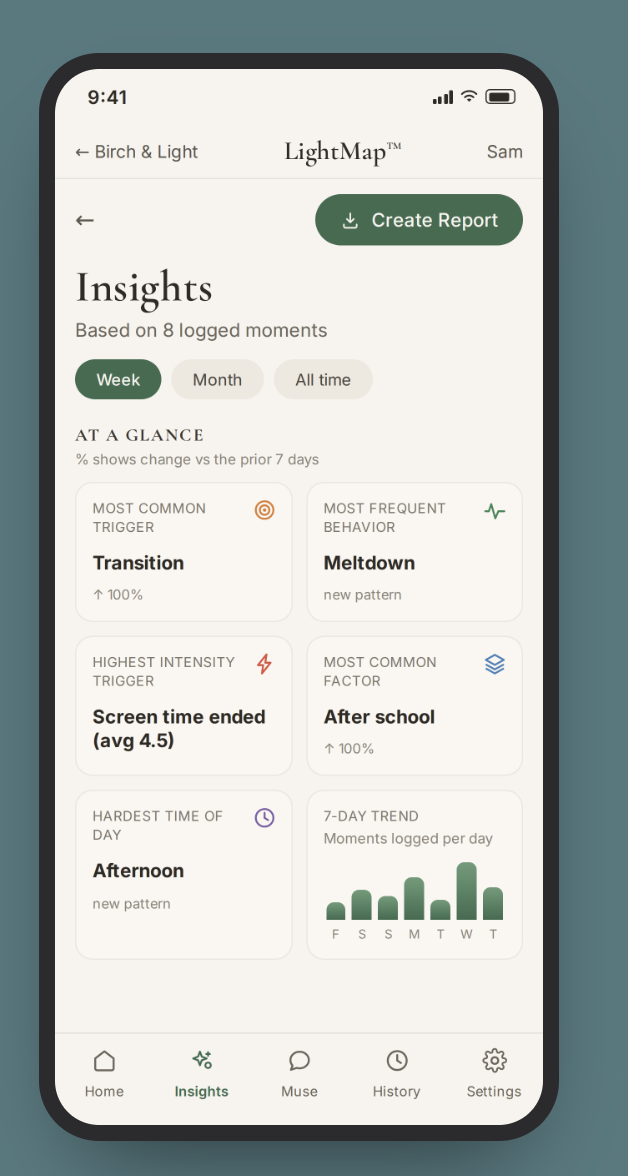

Part of the award-winning Birch & Light Method, honored with the Mom's Choice Gold Award for excellence in family resources.
A story to read together
Sometimes the easiest way in is a story you read side by side.
 When Axel's Engine Stayed On
After a big, exciting day, Axel's body is tired but his engine won't quiet down. A gentle story about overstimulated kids who can't settle — and the calm grown-ups who help them.
Read the story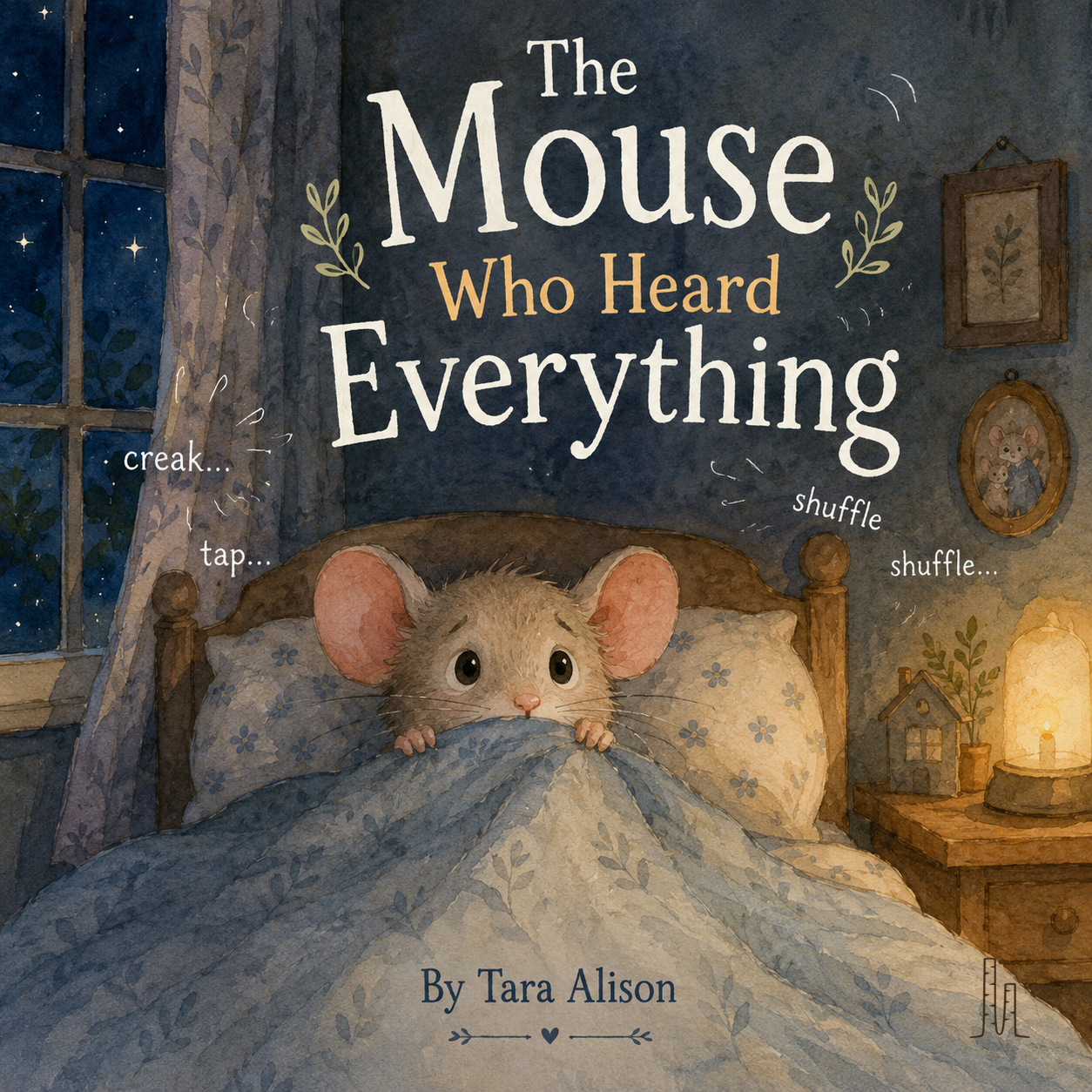 The Mouse Who Heard Everything
Mina Mouse hears every creak the old house makes at night. The story gently shows that her brain isn’t broken — it’s working overtime to keep her safe — and what changes when someone sits beside her in the dark.
Read the story
Researched and drafted with AI assistance, reviewed before publication. Editorial standards