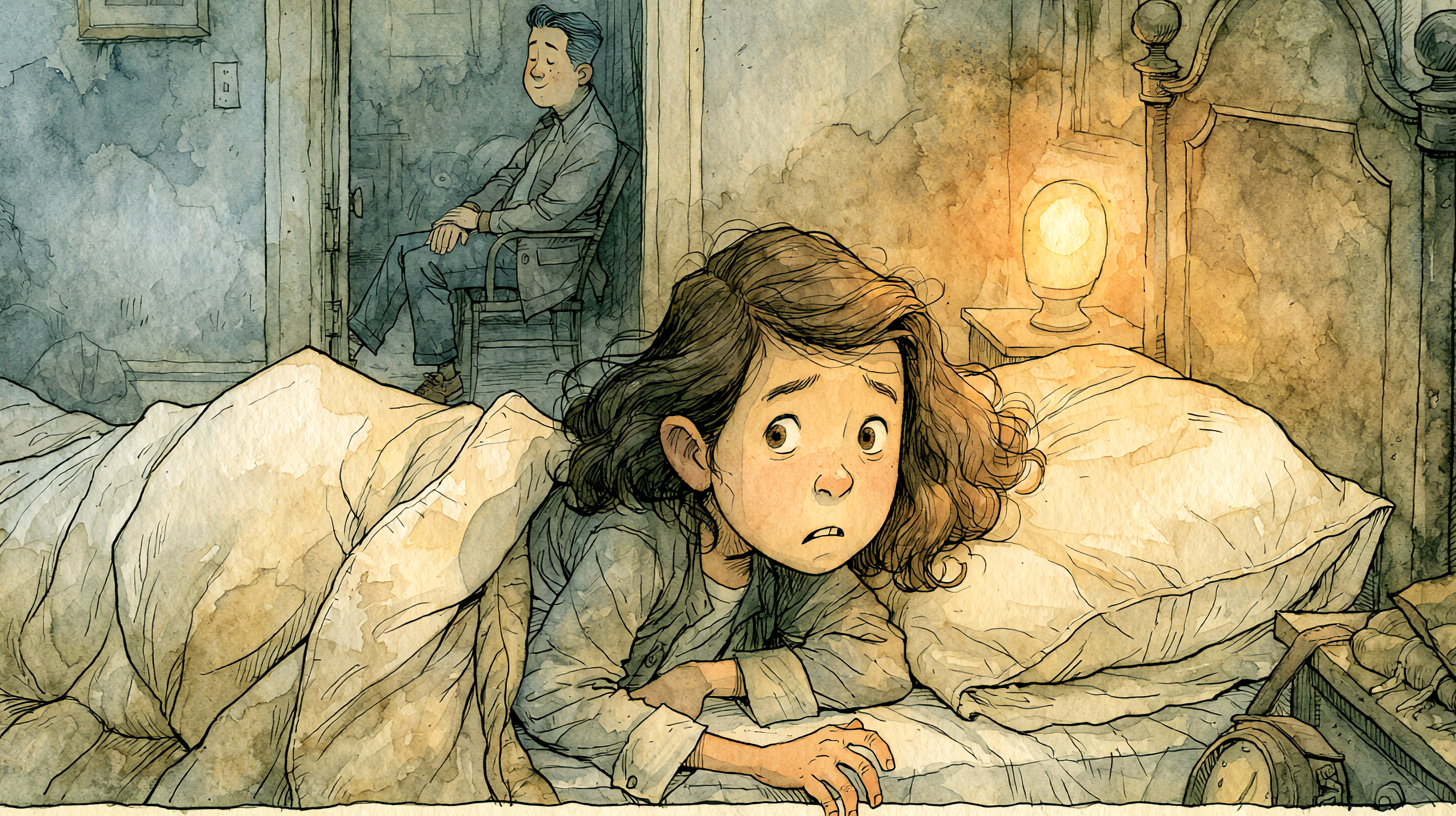
A child with ADHD who lies awake for hours and cannot be woken for school usually has a body clock that runs late, not a bedtime behavior problem. Delayed sleep and wake timing affects up to 78% of children with ADHD, per a 2025 Frontiers in Psychiatry review. Standard bedtime advice targets behavior, so more of it has not worked.
You have done the bath. You have done the dim lights and the story and the no screens after seven. You have done the reward chart, the lavender spray, the weighted blanket, the thing one professional suggested and the thing your mother suggested. And your child is still awake at midnight, or at two, or later, night after night, and by now you are running on a level of sleep deprivation that makes it hard to think about the problem at all.
Here is the thing almost nobody says out loud in that situation. If your child cannot fall asleep for hours and then cannot be woken in the morning, the problem is probably not bedtime behavior. It is timing. And the entire standard advice list is aimed at the wrong target, which is why running it harder has not worked.
This is a map, not medical advice. It reflects our best reading of the research at the time of writing and is not guaranteed. Anything involving medication or supplements belongs with your child's prescriber.
How common is this?
Sleep problems in children with ADHD are close to the norm rather than the exception. A 2025 review in Frontiers in Psychiatry, gathering the evidence on ADHD as a circadian condition, reports that insomnia and sleep disturbance affect up to 82% of children with ADHD, and that delayed sleep and wake timing specifically occurs in up to 78%.
So if you have been carrying the sense that other families manage this and you do not, put that down. You are in the majority, and the reason it feels solitary is that the advice you get assumes a different problem.
The body clock runs late
Every person has an internal clock that decides when the body starts preparing for sleep. Its most reliable marker is something called dim light melatonin onset, the point in the evening when the brain begins releasing melatonin. In a typical pattern, that release starts roughly two to three hours before a person actually falls asleep. It is the opening move, not the finish line.
In children with ADHD, that release starts later. The same 2025 review puts the average delay at around 45 minutes in children and about 90 minutes in adults.
Forty-five minutes may not sound like the difference between a normal bedtime and 2am, and on its own it is not. What matters is what happens when a delay meets a household schedule. If the body has not begun the process at the time a child is put to bed, the child lies there awake. Lying there awake in the dark with nothing to do is, for an ADHD nervous system, an invitation for the mind to start running. Now the child is both awake and activated, which pushes sleep further out, and the next morning they are woken for school before the sleep they eventually got has finished. Sleep debt accumulates, the weekend becomes a catch-up marathon that shifts the clock later still, and by a few weeks in, the gap between the body's schedule and the house's schedule is enormous.
The evidence that this is a clock problem rather than a behavior problem is fairly direct. A 2005 study of 120 medication-naive children with ADHD, aged six to twelve, compared those who had chronic difficulty falling asleep against those who did not. Melatonin onset in the group with sleep-onset problems averaged 20:32, against 19:47 in the children with ADHD who slept fine, a difference of about three quarters of an hour that held up statistically. Same diagnosis, same country, same clinics, and the thing that separated the two groups was the biological clock rather than anything about the households.
Why does the standard advice backfire?
Almost every sleep hygiene list ends with some version of moving bedtime earlier and being consistent about it. For a child whose clock is set late, that instruction does something specific and unhelpful.
It adds more time lying in bed not sleeping.
Beds get their power from association. A bed that reliably means sleep makes a person sleepy on contact. A bed that means an hour of frustration, an hour of a racing mind, an hour of a parent coming in and out with increasing tension, stops producing drowsiness and starts producing dread. Clinicians call the result conditioned arousal, and once it sets in you have two problems where you had one: a late clock, and a child whose body now treats the bedroom as a place where something difficult happens.
This is why so many parents report that the harder they enforce bedtime the worse it gets, and then conclude they are being inconsistent. They usually are not. They are applying a correct tool to the wrong mechanism.
What actually shifts a clock
Body clocks are not set by bedtime. They are set mainly by light, and secondarily by the regularity of everything else, meals, activity, and above all when the day begins.
The pathway that emerges from the circadian research is fairly consistent, and it is behavioral first.
Fix the wake time before you touch the bedtime. The same wake time every day, weekends included. This is the least popular sentence in this article and the most important one. Sleeping in on Saturday and Sunday hands back the ground gained during the week, because those two mornings tell the clock to stay late. A consistent wake time is the anchor everything else is pulled toward.
Light in the morning, as early as possible. Morning light is the strongest signal for pulling a clock earlier. Outdoors is better than any indoor lighting, even on an overcast day, because outdoor light is many times brighter than a lit room. Curtains open the moment they wake, breakfast near a window, the walk to school rather than the drive if that is possible. Bright light therapy has been used in ADHD populations specifically to advance the clock, and it worked.
Take light away in the evening. Not only screens. Overhead lighting counts. Dim the house in the last hour or two, use lamps rather than ceiling lights, and accept that this is about the light itself and not only about what the screen is showing.
Set bedtime where the sleep actually is, then move it. This is the counterintuitive one and it is standard practice in behavioral sleep work. For a week or two, put bedtime close to the time your child genuinely falls asleep now rather than the time you want. Yes, that means a later bedtime at first. The purpose is to rebuild the association between bed and sleep, so falling asleep quickly becomes normal again. Once that is reliable, move bedtime earlier in small steps of about fifteen minutes at a time, holding each step for several nights before the next one.
All of this works over weeks, not nights. That is genuinely hard to hear when you are this tired, and it is the honest timeline.
Melatonin, and the thing about timing
Melatonin comes up in every conversation like this, and the most useful fact about it is one that rarely gets passed along.
Melatonin is not primarily a sedative. It is a timing signal. Used as a chronobiotic, meaning a substance that shifts the clock, the guidance from research on delayed sleep-wake phase disorder in children is that it needs to be given some hours before the body's own melatonin release begins, and at the smallest dose that works. Given at bedtime as a knock-out drug, at a large dose, it is being used as the wrong tool, and that is how most families end up using it.
The evidence in this specific population is reasonable. In a randomized placebo-controlled trial of medication-free children who had ADHD and chronic difficulty falling asleep, melatonin over four weeks moved the body's own melatonin onset earlier by about 44 minutes, while the control group drifted later. Total sleep time improved by around 20 minutes in the treatment group, and dropped by about 14 minutes in the control group.
One important limit on that result. The trial that produced it measured sleep, and sleep is what improved. It did not find improvements in problem behavior, cognitive performance or quality of life over its four weeks. So melatonin, used correctly, is a tool for moving a clock. It is not a treatment for ADHD, and anyone selling it to you as one is overreaching.
Two cautions from the same literature. The reviewers who conclude melatonin is effective and safe for this condition in children attach a condition to it, which is that it has to be given at the right time and the right minimal dose. And they recommend stopping it periodically, at least once a year, to see whether the clock still needs it.
How melatonin is regulated varies enormously by country. In some places it sits on a supermarket shelf and in others it is a prescription that only a specialist can start. That is a conversation with your prescriber rather than something to work out alone, and the useful question to bring is not whether melatonin will help but what time it should be given.
While you're here, take the guide
What's Underneath is free: the three body-state triggers under most meltdowns, what to say in the minute before it tips over, and how to reset afterward.

You'll get the guide instantly, plus five free articles in your inbox every week. Real challenges (meltdowns, school mornings, picky eating, big feelings) and how to actually handle them. Unsubscribe anytime.
The things to rule out before you settle on a diagnosis of a late clock
A delayed clock is the most likely explanation. It is not the only one, and a few of the alternatives are treatable in completely different ways.
Breathing. Snoring, mouth breathing, restless thrashing, pauses in breathing, or a child who is somehow both exhausted and wired. Enlarged tonsils and adenoids are common at these ages, and fragmented sleep from disrupted breathing shows up in the daytime as more hyperactivity rather than as a sleepy child.
Restless legs. The overlap here is substantial. A review of pediatric restless legs syndrome puts the proportion of children with ADHD who meet criteria for it at somewhere between 12 and 35 percent, and roughly a quarter of people with restless legs meet criteria for ADHD. The tell is legs that feel strange or need to move, worse in the evening, better with movement, and a child who cannot keep them still while trying to fall asleep. Young children rarely have words for the sensation and instead simply look like they will not settle.
Iron stores. Restless legs is closely tied to iron, and this is where it becomes concrete. International guidelines on iron treatment for restless legs treat a serum ferritin at or above 50 as the target in children, and recommend oral iron below that. Ferritin measures stored iron and can sit low while a standard blood count reads as normal, so a previous test showing no anemia has not answered this question. One study also found mean ferritin significantly lower in children with ADHD than in controls, and its authors recommended that clinicians assess children with ADHD for restless legs, a family history of it, and iron deficiency. Ask for ferritin by name, ask for the number rather than being told it is fine, and do not start iron on your own, because supplementing without knowing the level is its own risk.
Medication timing. Stimulants can delay sleep onset, and that is a dose and timing conversation with the prescriber rather than a reason to abandon treatment. It is also not the whole story, since children with ADHD who take no medication at all still have far higher rates of sleep problems than children without ADHD.
Why this is not just about sleep
The best argument for putting effort into this comes from a randomized controlled trial published in the BMJ in 2015, which tested a brief behavioral sleep intervention with families of children with ADHD.
The children who got the sleep intervention showed a greater reduction in ADHD symptoms than the control group at three months and again at six months. The trial also looked at behavior, quality of life, daily functioning, working memory, and parent mental health.
Read that again if you are on your fourth broken night, because it is saying something specific. Improving the sleep improved the ADHD picture. The exhaustion is not a side story running alongside the main problem. For a large number of children it is part of the main problem.
What if you are told there is nothing available?
Plenty of parents are told, in one form or another, that sleep support is not something the service offers. Sometimes that is accurate for one particular route and it is almost never accurate for every route.
The thing that changes those conversations is documentation. Start a sleep diary tonight and keep it for two to four weeks. For each night: what time they got into bed, roughly what time they actually fell asleep, any wakings, what time they woke, what time they got up, and a line about the next day. If you have a smartwatch or a tracker, add it, though a paper record is enough.
Two to four weeks of that is a different object than a parent describing a bad night. It shows a pattern, it shows severity, and it demonstrates that this is chronic rather than a rough patch. It is the single most useful thing you can do while waiting, it costs nothing, and it is frequently what moves a request from declined to accepted. Ask specifically what the criteria are and what evidence is needed, because "no" and "not yet, and here is what would change that" often sound identical when they are delivered.
Ask about the rule-outs above by name too. Breathing, restless legs, ferritin. Naming a specific concern tends to open doors that a general request for help with sleep does not.
The part to hold on to
Nothing about this means you have been doing it wrong. Most of the advice handed to parents is written for a child whose clock runs on schedule and who is resisting bedtime by choice. It is reasonable advice for that child and it was never aimed at yours.
Clocks can be moved. It takes weeks of dull consistency in the least appealing places, mornings and light, rather than anything clever at bedtime. And the effort tends to pay in more than sleep.
Researched and written in 2026. This reflects our best reading of the research at that time and is offered without any guarantee of accuracy or outcome. It is not medical advice and it is not a diagnosis. Anything involving medication or supplements belongs with your child's prescriber.
Sources, tied to the claims they support. Sleep disturbance affecting up to 82% of children with ADHD, delayed sleep-wake timing in up to 78%, melatonin onset delayed by around 45 minutes in children and 90 minutes in adults, and the behavioral-first pathway of fixed wake times, morning bright light and evening light restriction with selective low-dose melatonin: "ADHD as a circadian rhythm disorder: evidence and implications for chronotherapy," Frontiers in Psychiatry, 2025. The randomized placebo-controlled trial in medication-free children with ADHD and chronic sleep-onset insomnia, advancing melatonin onset by about 44 minutes with total sleep time improving by roughly 20 minutes against a loss of 14 minutes in controls, as reported in the Frontiers review above. Melatonin as an effective and safe chronobiotic for delayed sleep-wake phase disorder in children provided it is given at the correct time and minimal effective dose, with the recommendation to pause treatment at least annually: "Efficacy and safety of supplemental melatonin for delayed sleep-wake phase disorder in children: an overview." Bright light therapy advancing melatonin onset in an ADHD population: "Correcting delayed circadian phase with bright light therapy predicts improvement in ADHD symptoms," Journal of Psychiatric Research. Greater reduction in ADHD symptoms at three and six months following a brief behavioral sleep intervention: Hiscock et al., "Impact of a behavioural sleep intervention on symptoms and sleep in children with attention deficit hyperactivity disorder, and parental mental health: randomised controlled trial," BMJ, 2015. The 2005 comparison finding melatonin onset at 20:32 in children with ADHD and sleep-onset insomnia against 19:47 in children with ADHD and no sleep problems, in 120 medication-naive children aged six to twelve: Van der Heijden, Smits, Van Someren and Gunning, Chronobiology International, 2005, volume 22, pages 559 to 570. The melatonin trial improving sleep onset and duration without improving problem behavior, cognitive performance or quality of life: Van der Heijden et al., "Effect of melatonin on sleep, behavior, and cognition in ADHD and chronic sleep-onset insomnia," Journal of the American Academy of Child and Adolescent Psychiatry, 2007. Between 12 and 35 percent of children with ADHD meeting criteria for restless legs syndrome, and roughly a quarter of people with restless legs meeting criteria for ADHD: Picchietti and Picchietti, "Advances in pediatric restless legs syndrome: iron, genetics, diagnosis and treatment," Sleep Medicine. A serum ferritin at or above 50 as the therapeutic target in children and oral iron recommended below it: International Restless Legs Syndrome Study Group task force report, "Evidence-based and consensus clinical practice guidelines for the iron treatment of restless legs syndrome/Willis-Ekbom disease in adults and children," Sleep Medicine, 2018. Mean serum ferritin significantly lower in children with ADHD than controls, with the recommendation that clinicians assess children with ADHD for restless legs, family history and iron deficiency: Konofal et al., "Impact of restless legs syndrome and iron deficiency on attention-deficit/hyperactivity disorder in children," Sleep Medicine, 2007. Insomnia as a possible stimulant side effect alongside elevated rates of sleep problems in unmedicated children with ADHD, and the role of breathing disorders and restless legs: Sciberras et al., BMJ Open, 2017, and Cortese et al., "Assessment and management of sleep problems in youths with attention-deficit/hyperactivity disorder," Journal of the American Academy of Child and Adolescent Psychiatry, 2013.
For education and reflection, not medical advice. Our terms
See what's underneath
Walk into the next appointment with answers
LightMap reads your hard days together and gives you answers. Start with one moment today.
Start with 3 moments Not sure where to start? Ask me.Message Tara on WhatsApp. It really is me, I read everything and will personally respond.Click here to message Tara →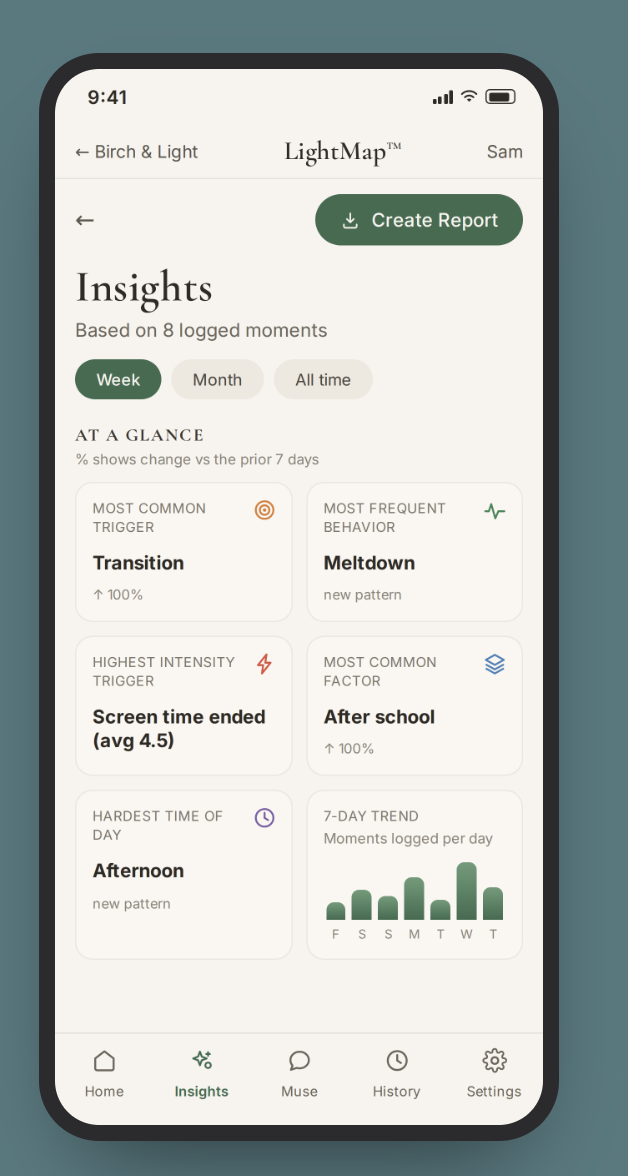

Part of the award-winning Birch & Light Method, honored with the Mom's Choice Gold Award for excellence in family resources.
If today was one of those days
A few more from the library, free to read.
Researched and drafted with AI assistance, reviewed before publication. Editorial standards