
The first fifteen minutes problem
If your child sees a therapist, you know how sessions start. The recap. What happened this week, roughly when, how bad it got, what you tried. You reconstruct it from memory, which means you reconstruct it from whatever is loudest in your memory: the worst moment, the most recent moment, or the moment you are still upset about. Fifteen minutes gone, and the therapist is working from a story filtered through your exhaustion.
Memory is not a neutral reporter. It compresses a week of mixed days into "it was a bad week," drops the quiet wins entirely, and cannot tell a therapist whether this week's hard moments were actually more frequent than last week's or just landed harder on you.
What the session looks like with data
Now imagine the therapist starts the session already holding a one-page brief: seven moments logged this week, average intensity, which part of the day carried most of the load, the most frequent trigger, what showed up underneath it, and which repair actually worked. Plus what rose since last week, what fell, and what disappeared entirely.
The recap evaporates. The session starts at the real starting line: not "what happened," but "why is this happening and what do we do about it."
What data catches that memory misses
- Direction of change. More moments this week but lower average intensity is a completely different clinical picture than fewer, hotter ones. Memory cannot make that distinction. A log makes it automatically.
- The trigger behind the trigger. The surface trigger might be a demand. The pattern underneath, showing up again and again as a contributing factor, might be feeling unheard or out of control. That layered view is nearly impossible to see from inside individual moments.
- Time-of-day clustering. When most hard moments land in the same stretch of day, that is not random. It is depleted capacity, and it points the intervention at the routine around that stretch rather than at each individual blowup.
- What quietly stopped. A behavior that dominated last month and has vanished is huge clinical information, and it is exactly the kind of thing nobody remembers to report, because absence does not announce itself.
While you're here, take the guide
What's Underneath is free: the three body-state triggers under most meltdowns, what to say in the minute before it tips over, and how to reset afterward.

You'll get the guide instantly, plus five free articles in your inbox every week. Real challenges (meltdowns, school mornings, picky eating, big feelings) and how to actually handle them. Unsubscribe anytime.
Predictable is good news
Here is the reframe that surprised me most: when the data shows the same trigger setting off the same window of the day, week after week, that is not discouraging. It is the best possible news, because predictable means addressable. You stop firefighting individual moments and start redesigning the conditions that keep producing them.
Your therapist wants this
Clinicians make decisions on the information they get, and most of what they get is recollection. A structured brief does not replace their judgment. It feeds it. If you are already tracking, ask your child's therapist if they want a summary before sessions. Most will say yes before you finish the sentence.
LightMap generates a pre-session therapist brief from your logged moments automatically. Walk in with the week already mapped.
For education and reflection, not medical advice. Our terms
See what's underneath
Stop guessing what set it off
LightMap reads your hard days together and gives you answers. Start with one moment today.
Start with 3 moments Not sure where to start? Ask me.Message Tara on WhatsApp. It really is me, I read everything and will personally respond.Click here to message Tara →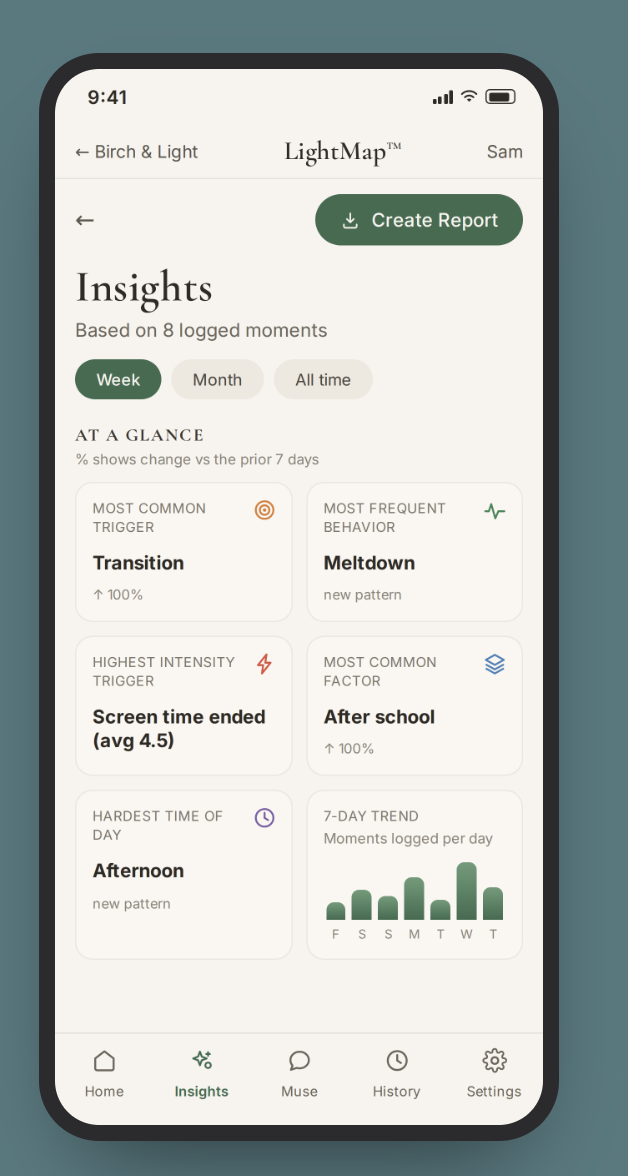

Part of the award-winning Birch & Light Method, honored with the Mom's Choice Gold Award for excellence in family resources.
A story to read together
Sometimes the easiest way in is a story you read side by side.
 The Tower That Looked Fine
A tower in a quiet clearing tries to stay steady through every small thing nobody else seems to notice — until one tiny breath of wind causes her to fall, and a gentle hand begins to gather the blocks back.
Read the story The Boy at the Edge
A boy finds calm by watching the world move from a window. When his stillness is mistaken for defiance, the moment escalates — and he learns that being calm doesn’t always protect you from being told no.
Read the story
If today was one of those days
A few more from the library, free to read.
Researched and drafted with AI assistance, reviewed before publication. Editorial standards