Yes. The habit of tracing a behavior back to what came before it, which you build for a child whose behavior does not explain itself, works on your other children, your partner, and most people you talk to. You stop answering the eye roll and start answering what caused it.
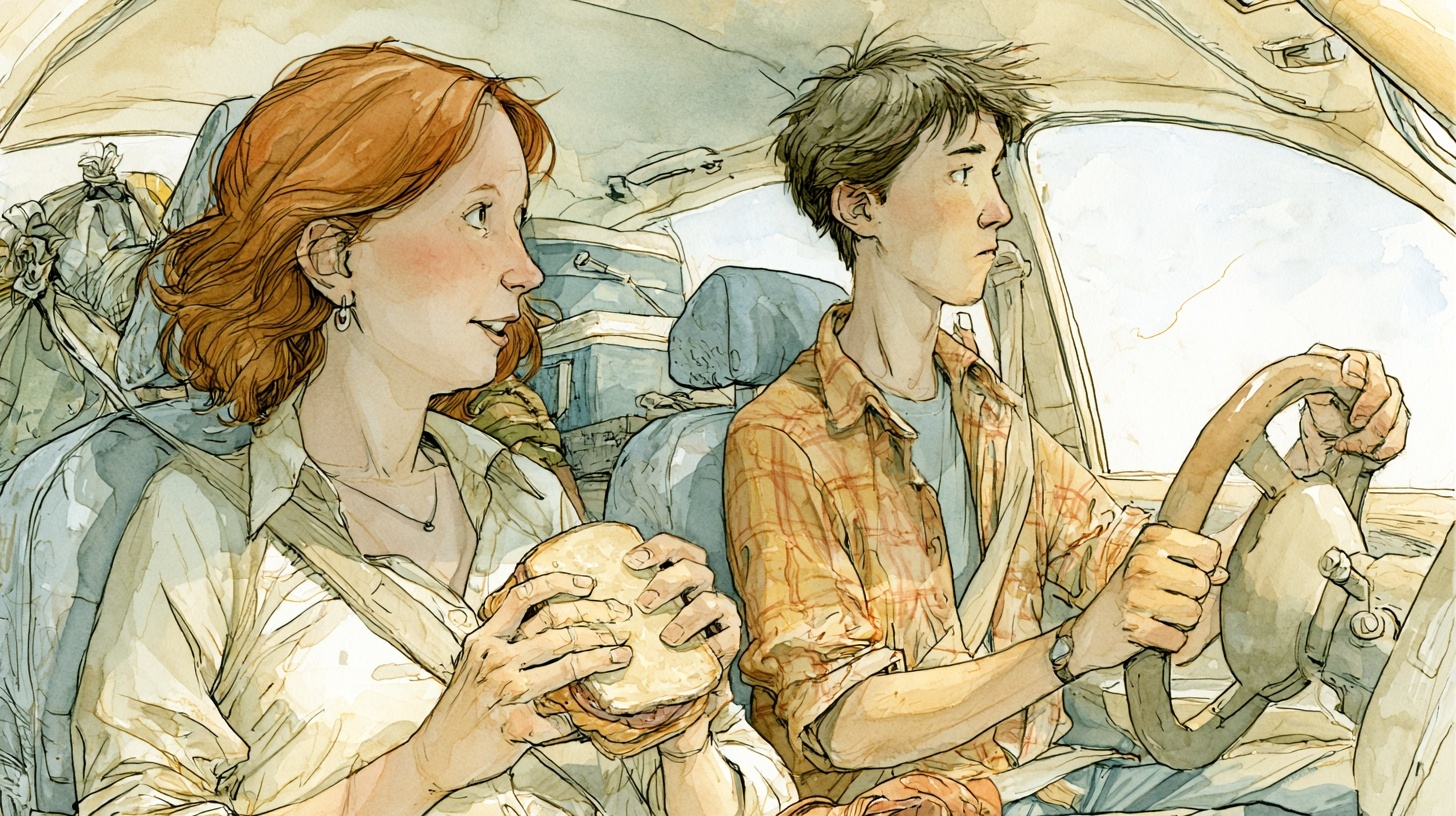
Before a road trip I packed myself a peanut butter and jelly sandwich. I tried to talk him into making one too, and he said no. Two hours into the drive, with him behind the wheel, I unwrapped mine and said something cheerful about how glad I was that I had made it.
He rolled his eyes.
And the old version of me would have stopped right there, at the eye roll, and felt the judgment in it. Who rolls their eyes at a person enjoying a sandwich. There is a whole conversation available at that point, about respect, about what exactly that look was for, and two hours of highway left to have it in, and none of it would have gone anywhere good.
Instead I did the thing I have spent two years training myself to do for a different child entirely. I went backward.
The habit is not logging. It is looking backward.
When you have a child whose behavior does not explain itself, you are forced to become a certain kind of observer. You cannot work from the behavior alone, because the behavior is the end of a chain, not the start of one. So you learn to ask what came before. Sometimes that is the sixty seconds before. Sometimes it is a setup laid hours earlier that gives this moment its charge, and the trigger is just the match.
That is the actual skill. The logging is just the scaffolding that builds it. What you are really practicing, over and over, is the belief that the visible thing is downstream of something you did not see, and the discipline of going to look for it, however far back it sits.
And a habit practiced that many times does not stay in its lane.
What was actually happening in the car?
Here is the chain, once I looked for it.
I said a cheerful thing about my sandwich. But this was not just any sandwich. It was the sandwich I had tried to talk him into making that morning, and he had said no, and now it was unwrapped next to him with hours of driving still ahead. In the space of about a second, my pleasure became, to him, the closing argument in a two-hour-old case. See how sensible I was and how you were not.
He felt judged. And the eye roll was not him judging me. It was him defending himself against something he thought I had just done to him.
Psychologists have a name for the first half of that: hostile attribution, the tendency to read neutral or ambiguous behavior as carrying hostile intent. It is well documented, and it is not a character flaw. Everyone does it under the right conditions, and children and teenagers do it more, particularly when they are tired, already a bit down on themselves, or braced for criticism from somewhere.
So the sequence was: neutral comment, misread as accusation, injury, defense. Four steps. And here is the thing: this is my easiest kid, the one who almost never pushes back on anything. Which is exactly why a single eye roll was worth tracing instead of correcting. From a child who bristles daily, an eye roll is weather. From this one, it was information.
Why the neurodivergent child teaches you this and the others benefit
This is the part I did not expect.
Every child has conflict to work through and communication to grow into. Neurotypical does not mean finished, and it does not mean easy. It mostly means their reactions stay close enough to their causes that you can respond on the surface and get away with it most days.
Which is the trap. Nobody forces you to trace backward for a child whose behavior almost adds up. So that child quietly gets the version of your attention that stops at the behavior, and you can go years without noticing what you are missing. Not because you love them less. Because their behavior never broke your model badly enough to make you rebuild it.
Meanwhile the child whose behavior does not make sense drags you into a completely different way of paying attention. You learn to look for antecedents. You learn that intensity is information about capacity, not about character. You learn to hold a hypothesis loosely and test it across a week.
Then one day you use it on the kid who was never the reason you learned it, and you see something you would have missed for another decade.
There is a quiet piece of justice in that. Siblings of children with high needs often absorb a great deal of family attention going elsewhere. This is one of the few things that flows the other direction: the sibling gets a parent who has been trained, at some cost, to look underneath.
While you're here, take the guide
What's Underneath is free: the three body-state triggers under most meltdowns, what to say in the minute before it tips over, and how to reset afterward.

You'll get the guide instantly, plus five free articles in your inbox every week. Real challenges (meltdowns, school mornings, picky eating, big feelings) and how to actually handle them. Unsubscribe anytime.
The three things to look for
Defensive moments from this particular kid are rare, which makes them easy to study. The handful of times one has appeared, the pattern underneath turned out to be narrow. Each time, one of three things had happened in the moments before.
He felt dismissed. Something he offered got a short answer, or got absorbed into a logistics conversation, or landed while I was clearly thinking about something else.
He felt accused. A neutral question landed as an interrogation. "Did you eat?" heard as "you did not eat again."
He felt judged. A comment about me got heard as a comparison to him. The sandwich.
Three antecedents, one visible behavior. Once I had the list, I stopped guessing. When something defensive comes back at me now, I run the list before I respond to the tone.
What do you do with it in the moment?
Respond to the injury, not the defense. If you answer the eye roll, you are having an argument about manners. If you answer the thing that came before it, you are having the actual conversation.
Say your intent out loud, plainly, without any weight on it. I was not saying anything about you, I was just happy about my sandwich. Short, unbothered, no lecture attached. He does not need an apology, because nothing wrong was done. He needs the misread corrected before it hardens.
Then let it go. A repaired misread does not need a debrief.
The advantage you have with this child
Here is where the neurotypical sibling differs, and it is a real gift. You can check your hypothesis out loud.
With a child who cannot report their internal state, you infer, and you wait for the pattern to confirm or deny it over weeks. With a child who can, you get to ask. Did that land as me having a go at you? And they will tell you, sometimes immediately, sometimes an hour later, but they will tell you.
Which means the loop that takes a month with one child can take ninety seconds with another. The lens is the same. The feedback is faster.
It does not stop at the children
Once you have the four step chain in your hands, you start seeing it everywhere, because it was never a childhood mechanism. Neutral remark, misread as accusation, injury, defense. That is most of the bad evenings in a marriage.
A partner says the dishwasher is full. You hear a comment about who does not empty it. You answer the comment you heard rather than the sentence that was said, and now there are two people defending themselves against things neither of them did.
The same move works. Do not answer the tone, answer what came before it. Name what you actually meant, without weight. Ask whether it landed as a dig, since adults can report too, though we are often worse at it than teenagers.
It works at the office, with your own parents, with a friend who went cool on you for no reason you can identify. You learned it under hard conditions for one child. It generalizes to nearly everyone you speak to.
The trace only works if you can see the sequence, and memory rewrites the order of things almost immediately. Log the moments as they happen in LightMap, including the ones for the kid who supposedly does not need tracking, and the antecedents stop being something you reconstruct and start being something you can read.
I am not suggesting your neurotypical child needs to be managed like a case. I am suggesting that the attention you were forced to develop is simply good attention, and it was never specific to the child who required it. You built it under difficult conditions, for one person, at real cost. It works on everyone in the house, and on most of the people outside it.
Sources: Dodge's research on hostile attribution bias in children and adolescents (Child Development; PMC); peer-reviewed research on antecedent-behavior-consequence analysis and functional assessment (PMC); Tronick's still face research and subsequent work on rupture and repair in parent-child interaction; peer-reviewed research on the experiences and attention needs of siblings of children with disabilities or chronic illness (PMC; Journal of Child and Family Studies); Gottman's research on repair attempts in close relationships.
For education and reflection, not medical advice. Our terms
See what's underneath
Stop guessing what set it off
LightMap reads your hard days together and gives you answers. Start with one moment today.
Start with 3 moments Not sure where to start? Ask me.Message Tara on WhatsApp. It really is me, I read everything and will personally respond.Click here to message Tara →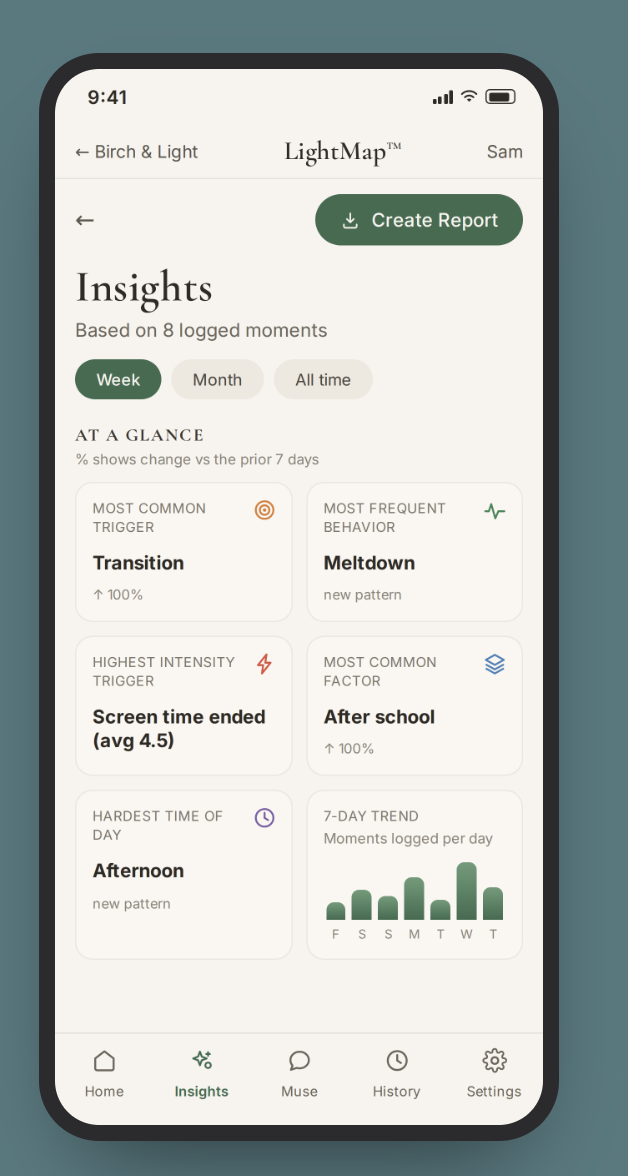

Part of the award-winning Birch & Light Method, honored with the Mom's Choice Gold Award for excellence in family resources.
A story to read together
Sometimes the easiest way in is a story you read side by side.
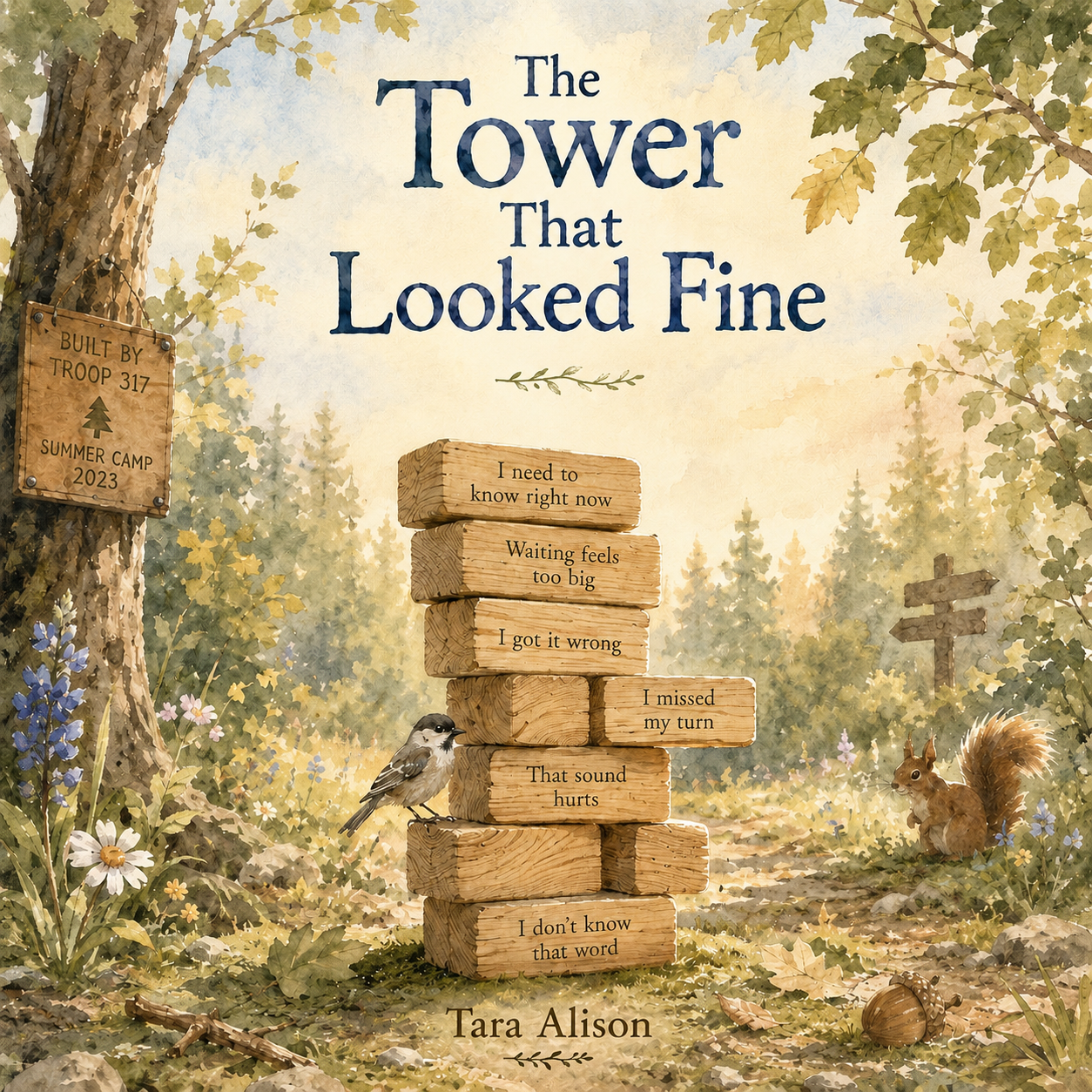 The Tower That Looked Fine
A tower in a quiet clearing tries to stay steady through every small thing nobody else seems to notice — until one tiny breath of wind causes her to fall, and a gentle hand begins to gather the blocks back.
Read the story The Boy at the Edge
A boy finds calm by watching the world move from a window. When his stillness is mistaken for defiance, the moment escalates — and he learns that being calm doesn’t always protect you from being told no.
Read the story
If today was one of those days
A few more from the library, free to read.
Researched and drafted with AI assistance, reviewed before publication. Editorial standards