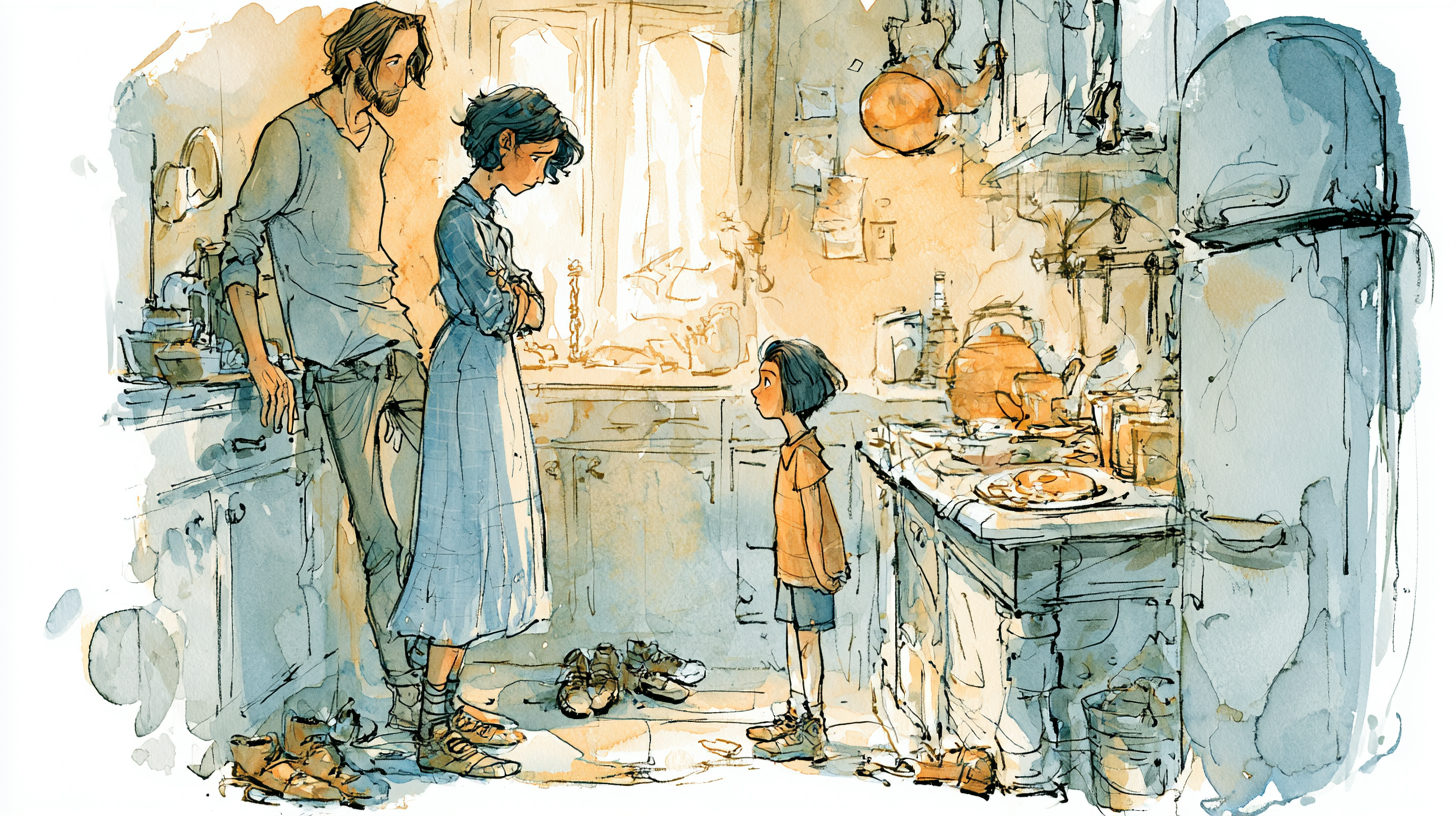
When every day feels like a battle, the fighting is usually a sign that something underneath is overloading your child, such as anxiety, tiredness, sensory strain or a skill that has not caught up yet. It is rarely a sign of bad parenting or a child who chooses to be difficult.
Some parents wake up already bracing for impact. Before breakfast there is resistance. Before getting dressed there is an argument. Before leaving the house there is a meltdown. By lunchtime everyone feels exhausted.
The hardest part isn't the behavior itself. It's the feeling that nothing seems to work. If you've read every article, tried every chart, stayed calm until you couldn't, and still ended up back in the same fight the next morning — this is for you. Not because you're doing it wrong, but because a piece of the picture may be missing.
Why does it feel so personal?
When conflict happens once, you brush it off. When it happens every single day, something shifts. You stop seeing isolated hard moments and start seeing a pattern — and patterns feel intentional.
So the thoughts creep in. Maybe I'm failing. Maybe my child doesn't like me. Maybe they're choosing this. Maybe something is wrong with our family that isn't wrong with anyone else's. You watch other families move through their mornings without the screaming, and you wonder what they know that you don't.
Here's what's true: when a child's behavior consistently creates chaos, feeling angry, hurt, defeated, and emotionally flooded isn't a character flaw. It's what happens to a nervous system that's been on alert for a long time. You are not too sensitive. You are tired in a way that's hard to explain to people who aren't living it. And feeling targeted doesn't mean you are being targeted — those are two different things, even though they live in the same body.
Behavior is the tip of the iceberg
There's an idea at the center of how we think about kids at Birch & Light: the behavior you can see is usually the smallest part of what's actually going on.
A child melts down over the wrong cup. A child refuses to put on shoes. A child says something cruel and means it in the moment. These are the visible things — the part above the waterline. But underneath, often invisible, may be:
- Anxiety they don't have words for
- Sensory overwhelm from sounds, textures, or light
- Social struggles they're carrying home from school
- Perfectionism that makes trying feel unbearable
- Learning challenges that turn ordinary tasks into uphill climbs
- Difficulty being flexible when plans shift
- Sleep deprivation
- A low tolerance for frustration
- Emotional regulation that's still under construction
The behavior is the part that surfaces. It is not the whole iceberg. When a child "won't" do something, it's worth asking whether, in that moment, they actually can't.
Why are mornings ground zero?
If your hardest moments cluster around the morning, you're not imagining it. Mornings ask an enormous amount of a developing nervous system, all at once, before anyone is fully awake.
Consider what a morning actually demands: multiple transitions in a row — out of bed, into clothes, to the table, out the door. Executive functioning to sequence all of it. Recovery from whatever sleep debt has built up. School anxiety arriving before school does. Sensory demands like cold floors, scratchy tags, bright lights, loud siblings. And decision after decision before the day has even started.
Parents often assume mornings reveal character. More often they reveal capacity. A child who falls apart at 7 a.m. isn't necessarily a difficult child. They may be a child whose tank is empty before the day asks anything of them.
Sleep deserves its own look here. The American Academy of Sleep Medicine recommends 9 to 12 hours per 24 hours for children ages 6 to 12, and 8 to 10 hours for teenagers. Research reviews link sleep problems with both emotional and behavioral difficulties in children, and the link likely runs in both directions: poor sleep makes mood and behavior harder to manage, and anxiety or stress can disrupt sleep. If mornings are your worst stretch, start by looking at the night before.
The trap families fall into
There's a cycle that catches almost everyone, and it's worth naming because it runs on autopilot.
The parent, exhausted and trying to keep things from going sideways, becomes more controlling. The child, feeling the pressure, becomes more resistant. The parent, hitting a wall, becomes more frustrated. The child, now flooded, becomes more dysregulated. And around it goes.
The cruelest part is what happens to time inside this loop. Everyone starts reacting to yesterday instead of responding to today. You brace before your child has done anything. They defend before you've said anything. By the time the actual moment arrives, you're both fighting a version of each other built out of every hard morning that came before.
Nobody designs this cycle. Families fall into it the way you fall into any rut: one understandable reaction at a time. And the way out usually isn't more force. It's a pattern interrupted somewhere it didn't expect to be.
While you're here, take the guide
What's Underneath is free: the three body-state triggers under most meltdowns, what to say in the minute before it tips over, and how to reset afterward.

You'll get the guide instantly, plus five free articles in your inbox every week. Real challenges (meltdowns, school mornings, picky eating, big feelings) and how to actually handle them. Unsubscribe anytime.
What should you ask instead?
The question that runs underneath the hardest days is often Why is my child doing this to me? It's a fair question. It's also one that rarely leads anywhere useful, because it assumes the answer is about you, and assumes the child knows.
A different set of questions tends to open more doors:
- What happens right before these moments?
- Are there patterns I haven't connected?
- Does it happen at particular times of day?
- Could there be a sensory trigger I'm not seeing?
- Could there be something social underneath it?
- Is my child struggling with something they can't yet put into words?
Curiosity reaches places punishment never does. You can consequence a behavior a hundred times and still never learn what's driving it. But pay attention to what comes just before, and the picture often starts to assemble itself.
A message for parents who feel like they're drowning
If you yell more than you ever thought you would. If you cry after bedtime, in the quiet, after they've finally gone to sleep. If you dread the weekends because they mean more hours without the structure that holds the day together. If you feel watched and judged in grocery stores and group chats and at the edges of birthday parties.
If you love your child with everything you have, and still don't enjoy what daily life has become.
You are not a bad parent. You are a person who has been doing one of the hardest things there is, for a long time, often without enough help. Loving your child and grieving the daily reality you're living in are not in conflict. Most parents in your position feel both — and feeling both does not make the love smaller. You are allowed to find this hard. It is hard.
Where Birch & Light comes in
One reason Birch & Light exists is that so many families spend years trying to stop behaviors without ever understanding the patterns underneath them. The energy goes into management, when what's needed is meaning.
The stories are written to help children see their own inner experiences reflected back gently, without labels or lectures. The parent guides translate what the stories are doing into language you can use at home. The podcasts give you something to listen to in the car, on the days when reading one more thing feels like too much. And LightMap is built for exactly the work this article describes: noticing what happens before the hard moments, tracking the patterns over time, and slowly turning a fog of difficult days into something you can actually read.
None of it is a magic fix. It's a way of looking that tends to change what you find.
The point of all of it
The goal was never to raise a child who never struggles. That child doesn't exist, and chasing them only makes the real child in front of you feel like a problem to be solved.
The goal is to understand what the struggles are trying to communicate. Because when behavior is treated as information instead of evidence that a child is broken, parents often find possibilities they genuinely couldn't see before.
Every behavior is a clue. Sometimes the hardest part is learning where it points.
Frequently asked questions
Why does my child only act out with me?
Kids often hold it together all day at school and release everything at home, with the person they feel safest with. It's exhausting to be on the receiving end, but it usually means you're the safe place — not the target.
Is my child being manipulative or defiant on purpose?
Far less often than it feels. Most hard behavior is the visible tip of something underneath — anxiety, overwhelm, a lagging skill, sensory discomfort. Looking for what's driving it tends to reveal more than asking why they're "choosing" it.
Why are mornings the worst time of day?
Mornings stack transitions, sleep debt, sensory demands, and school anxiety on top of each other before a child is fully regulated. Difficult mornings usually reflect low capacity, not bad character.
How do I stop the constant power struggles?
The escalation cycle — more control met with more resistance — rarely breaks with more force. It tends to ease when you get curious about the trigger underneath the behavior and interrupt the pattern earlier, before everyone is flooded.
Can I actually track what's setting off the hard moments?
Yes. LightMap lets you log a hard moment in about a minute and tag the context — time of day, what came before, sensory and social factors. After a couple of weeks, the pattern usually surprises parents.
Sources: Shalini Paruthi, Lee J. Brooks, Carolyn D'Ambrosio, Wendy A. Hall, Suresh Kotagal, Robin M. Lloyd, Beth A. Malow, Kiran Maski, Cynthia Nichols, Stuart F. Quan, Carol L. Rosen, Matthew M. Troester, Merrill S. Wise, "Recommended Amount of Sleep for Pediatric Populations: A Consensus Statement of the American Academy of Sleep Medicine," Journal of Clinical Sleep Medicine, 2016, 12(6), 785-786. Alice M. Gregory, Avi Sadeh, "Sleep, emotional and behavioral difficulties in children and adolescents," Sleep Medicine Reviews, 2012, 16(2), 129-136.
For education and reflection, not medical advice. Our terms
See what's underneath
Stop guessing what set it off
LightMap reads your hard days together and gives you answers. Start with one moment today.
Start with 3 moments Not sure where to start? Ask me.Message Tara on WhatsApp. It really is me, I read everything and will personally respond.Click here to message Tara →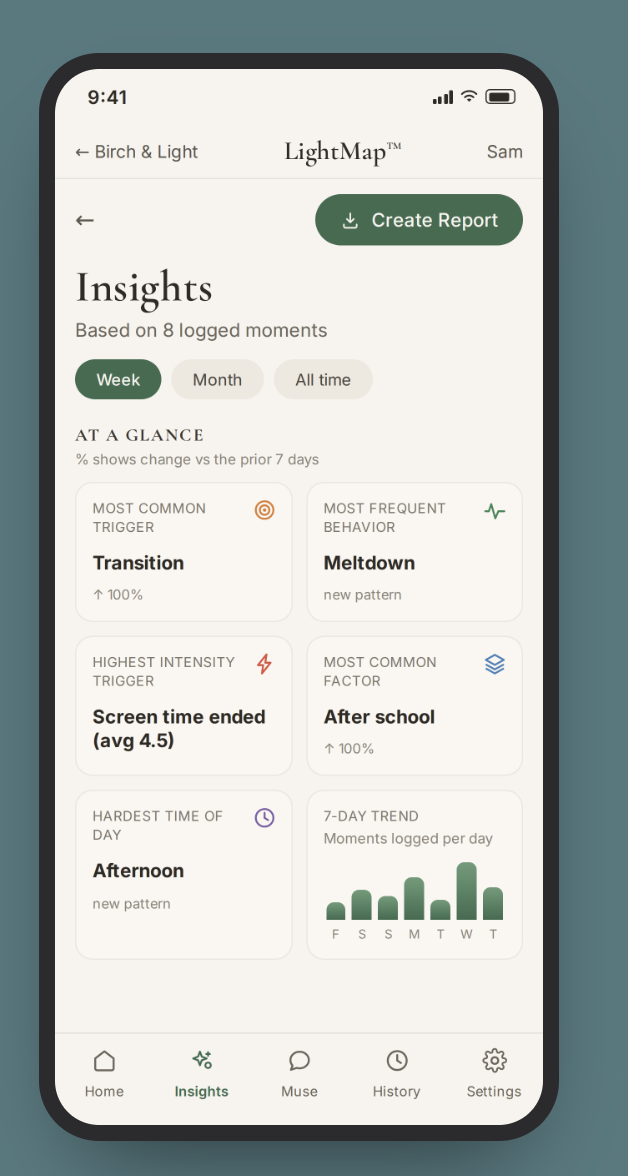

Part of the award-winning Birch & Light Method, honored with the Mom's Choice Gold Award for excellence in family resources.
A story to read together
Sometimes the easiest way in is a story you read side by side.
 The Tower That Looked Fine
A tower in a quiet clearing tries to stay steady through every small thing nobody else seems to notice — until one tiny breath of wind causes her to fall, and a gentle hand begins to gather the blocks back.
Read the story The Boy at the Edge
A boy finds calm by watching the world move from a window. When his stillness is mistaken for defiance, the moment escalates — and he learns that being calm doesn’t always protect you from being told no.
Read the story
If today was one of those days
A few more from the library, free to read.
Researched and drafted with AI assistance, reviewed before publication. Editorial standards