You balance one child's intense needs against the rest of the family by accommodating the requests that ease her distress and setting calm, pre-agreed limits on the ones that only move her distress onto everyone else. Protect the siblings on purpose, and expect to adjust the line as your child's capacity shifts.
There is a sentence parents of high-needs kids only say in whispers, usually with an apology attached: it feels like this one child holds the whole family hostage.
Who rides in the front seat. Which foods can be cooked in the house. Whether the family can start the evening while one child is still circling a decision they cannot land. Siblings waiting, plans bending, every family decision routed through one child's sensitivities and refusals. And underneath it, a parent doing constant math: is this a real need I should accommodate, or is my child running the house, and does wondering that make me a bad parent?
It does not. It makes you a parent trying to hold two truths that most advice pretends are one.
Two things are true at once
Truth one: your child is almost certainly not manipulating you. What looks like enjoying control is usually anxiety wearing a crown. A child whose nervous system experiences the world as unpredictable and threatening seeks control the way a drowning person seeks something solid, and controlling other people's movements, the seating, the smells, the schedule, is control in its most available form. The relief on her face when she wins one of these battles is not the pleasure of power over you. It is the momentary quiet of a threat system that finally got its way.
Truth two: the family system still needs protection. Understanding why a child seeks control does not make unlimited control healthy, for the family or for her. A household organized entirely around one person's threat responses teaches the other children that their needs are negotiable, teaches the anxious child that the world will always rearrange itself, and burns out the parents holding it all. Compassion for the cause does not require surrender to the pattern.
Most parents get handed only one truth. The behavior world hands them the second without the first, all boundaries and consequences, which escalates an anxious child into open war. The neurodiversity world sometimes hands them the first without the second, all accommodation, which quietly sacrifices the rest of the family. You need both, and the good news is they are compatible, if you know where the line goes.
The line: accommodate needs, bound the transfer of distress
Here is a distinction that does a lot of work. Some requests reduce your child's distress at little cost to anyone: her own familiar products, a heads-up before plans change, food served a certain way. Accommodate those freely and without resentment; they are access needs, not spoiling.
Other demands do not reduce her distress so much as relocate it onto someone else: she must be first out the door every time regardless of anyone's schedule, no one may cook certain foods while she is home, her brother must wait indefinitely for the shared computer because she has not finished not-deciding. These are understandable as anxiety, and they are still not sustainable as policy. The test is not "is the feeling real?" The feeling is always real. The test is "does meeting this demand solve her distress, or just make it everyone else's problem while the underlying anxiety stays fully intact?" Distress-transfer demands, when met endlessly, do not even help the anxious child, because the anxiety simply finds the next thing to control.
While you're here, take the guide
What's Underneath is free: the three body-state triggers under most meltdowns, what to say in the minute before it tips over, and how to reset afterward.

You'll get the guide instantly, plus five free articles in your inbox every week. Real challenges (meltdowns, school mornings, picky eating, big feelings) and how to actually handle them. Unsubscribe anytime.
When is the right time to set the rules?
Boundaries set mid-crisis feel like attacks and get treated as such. The workable version is the family agreement made in calm water: front-seat days rotate and live on a chart on the wall, dinner ends when it ends and the kitchen closes rather than the family waiting, the family menu is the family menu. Wherever possible, build the agreement with your child so her real sensory needs are engineered in from the start, her days can be fixed and visible in advance, her plate can be made before the stronger-smelling dishes start, and then let the agreement, not you, be the thing that says no. A chart is much harder to fight than a mother.
Expect the boundary to be tested hard at first, and expect meltdowns that look like proof you were cruel. A distress-transfer pattern that has worked for years does not retire quietly. Consistency plus warmth, the boundary holds and you stay kind, is what teaches her nervous system the new shape of the world, and that the world holding its shape did not actually end her.
What about the sibling who never complains?
Somewhere in your house there may be an easier child, sometimes older, sometimes younger, usually quieter, who has learned to wait, to shrink, to need less, because the family bandwidth is spent. Protecting that child is not a luxury item for after the crisis; it is a core obligation, because the durable-seeming sibling is frequently the one carrying invisible costs that surface years later.
Concretely: she gets protected in the moment when outbursts or control attempts target her, calmly and every time, so she learns her safety is not negotiable. She gets guaranteed time that is hers, protected the way medical appointments are protected. She gets truthful, age-appropriate language about her sibling's wiring, because children fill explanation-vacuums with resentment or self-blame. And she gets permission to have her own feelings about all of it, including anger, without being recruited as a third parent or told how much harder her sibling has it.
You will not calibrate this perfectly
The line between accommodation and boundary is not a fact you can look up; it moves with your child's capacity, which fluctuates daily. You will sometimes hold a boundary on a day she truly could not manage it, and sometimes bend on a day she could have stretched. Both will happen no matter how attuned you are, so retire perfection as the standard and replace it with repair: notice, name it, adjust, continue. Children are not damaged by parents who misjudge and repair. They are shaped by the repairing.
And if the pattern has the whole household white-knuckled, bring in reinforcement, a therapist or occupational therapist who genuinely understands anxiety-driven and demand-avoidant profiles (ask directly how they handle control behaviors; if the answer is a sticker chart, keep looking), and support for the parents, whose regulation is the floor the entire house stands on.
Wanting your family back is not a betrayal of your hardest child. A family where everyone's needs count, including hers, but not only hers, is the most honest accommodation there is.
It is hard to see how much of the week one child's needs are absorbing until it is written down. LightMap makes the distribution visible, which is the first step to shifting it.
For your child: The Light That Wouldn't Give Up is about one bulb in a chandelier that flickers out and fears being replaced, and the other bulbs who go and find what he needs.
Sources: Lebowitz ER, et al. Parent-based treatment as efficacious as cognitive-behavioral therapy for childhood anxiety: a randomized noninferiority study of supportive parenting for anxious childhood emotions. Journal of the American Academy of Child and Adolescent Psychiatry. 2020, 59(3), 362-372. doi 10.1016/j.jaac.2019.02.014.
For education and reflection, not medical advice. Our terms
See what's underneath
Stop guessing what set it off
LightMap reads your hard days together and gives you answers. Start with one moment today.
Start with 3 moments Not sure where to start? Ask me.Message Tara on WhatsApp. It really is me, I read everything and will personally respond.Click here to message Tara →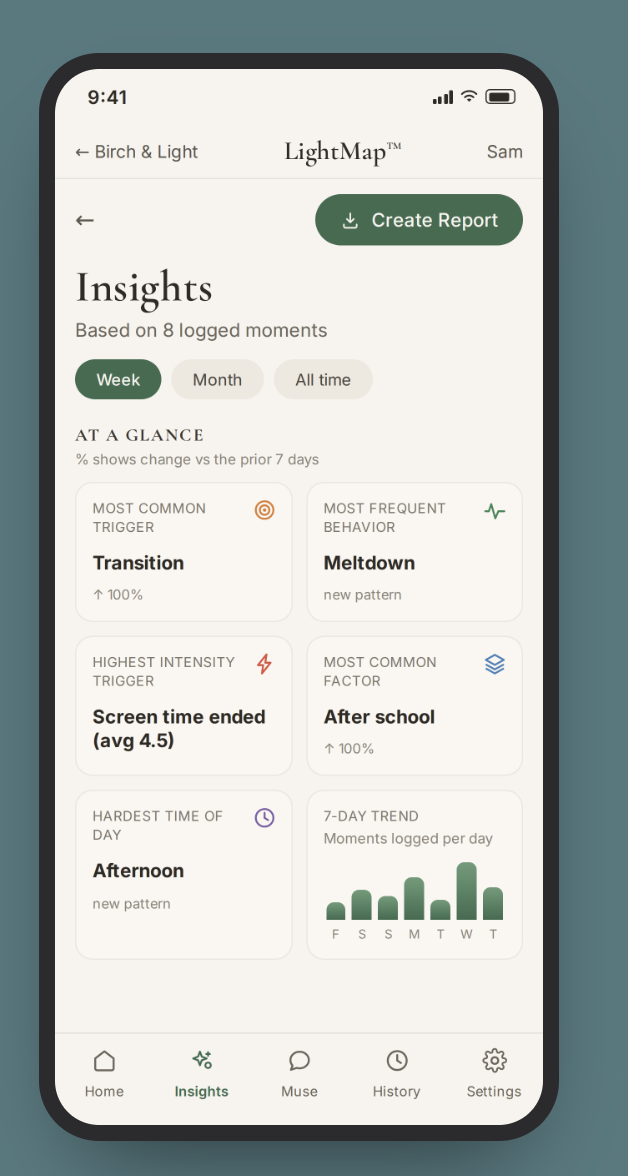

Part of the award-winning Birch & Light Method, honored with the Mom's Choice Gold Award for excellence in family resources.
A story to read together
Sometimes the easiest way in is a story you read side by side.
 The Tower That Looked Fine
A tower in a quiet clearing tries to stay steady through every small thing nobody else seems to notice — until one tiny breath of wind causes her to fall, and a gentle hand begins to gather the blocks back.
Read the story The Boy at the Edge
A boy finds calm by watching the world move from a window. When his stillness is mistaken for defiance, the moment escalates — and he learns that being calm doesn’t always protect you from being told no.
Read the story
If today was one of those days
A few more from the library, free to read.
Researched and drafted with AI assistance, reviewed before publication. Editorial standards