
When every therapy waitlist is closed, stay on all of them and try the doors most families never find: university training clinics, community mental health centers, federally qualified health centers, your pediatric practice, and your employee assistance program. Then ask your insurer for an out-of-network exception if no in-network provider has openings.
You have called nine places. Four never called back. Three are not taking new patients. One had a waitlist of eleven months and one wanted eight hundred dollars a session and does not work with insurance.
Meanwhile the thing that made you start calling is still happening at your house every day.
Searching harder is not the answer, because the problem is not that you have missed a listing. The system is gated, and most of the doors are not the one you have been knocking on.
Get on lists while you keep looking
Say yes to every waitlist, including the eleven month one, including places you are not sure about. Waitlists move constantly and unpredictably as people move, age out, or stop showing up. Being on six lists is not disloyal to any of them and costs you nothing.
Then call back. Not weekly, which annoys the front desk, but every three or four weeks, briefly and pleasantly, and ask whether anything has opened. Practices routinely fill a cancellation with whoever called that morning rather than working down the list. That is not fair and it is how it works, so be the person who called that morning.
Ask specifically about cancellation slots and about the least desirable times available. A Tuesday at 1pm is hard for working parents, which is why it is often open.
Which doors do most families never find?
University training clinics. Almost every university with a psychology, counseling, or social work graduate program runs a clinic staffed by students under supervision. Fees are frequently on a sliding scale down to very little. The clinician is early career, and is also being watched closely by a supervisor and is generally current on the research in a way a twenty year veteran may not be. These have short or no waitlists and almost nobody knows they exist. Search the name of any nearby university with the words psychology clinic.
Community mental health centers. Every county has one. They are required to serve people regardless of ability to pay, they take Medicaid, and they are usually the fastest route to a psychiatric prescriber, which is the hardest appointment in the entire system to get privately.
Federally Qualified Health Centers. These are community health centers with integrated behavioral health, sliding fee scales set by income, and they cannot turn you away for inability to pay. Find yours through the federal health center locator.
Your pediatrician's office. Many pediatric practices now have a behavioral health clinician embedded, and access is far faster through your own practice than through an outside referral. Ask directly whether they have one and how to be seen.
Your employer's assistance program. Most people never use theirs. It typically covers a set number of free sessions with no insurance involved and no deductible, and many now cover the employee's dependents. It is not a long-term solution and it can get you started in a week instead of a year.
The school. A school counselor or school-based clinician is not the same as therapy and is free, immediate, and located where your child already is. In many districts, counseling can also be written into an IEP or 504 as a related service, which makes it an entitlement rather than a favor.
While you're here, take the guide
What's Underneath is free: the three body-state triggers under most meltdowns, what to say in the minute before it tips over, and how to reset afterward.

You'll get the guide instantly, plus five free articles in your inbox every week. Real challenges (meltdowns, school mornings, picky eating, big feelings) and how to actually handle them. Unsubscribe anytime.
Make insurance work harder
Call the number on the back of the card and ask for a list of in-network providers who are accepting new patients. Then ask the question that matters: if nobody on your list has availability, what is your network adequacy process.
Insurers are generally required to provide access within a reasonable time and distance. When they cannot, many will authorize an out-of-network provider at in-network rates. They will not offer this. You have to ask for it by name, and it helps to have a documented list of who you called and what they said.
Ask about out-of-network reimbursement too. A practice that does not take insurance will usually provide a superbill, and depending on your plan you may get back a meaningful portion.
Widen what you are searching for
Many parents search for a psychologist and stop there. Licensed clinical social workers, licensed professional counselors, and marriage and family therapists all provide therapy, are far more numerous, and have shorter waits.
Telehealth opens the entire state rather than a twenty mile radius, and for kids who find offices hard it sometimes works better anyway.
And be precise about what you actually need, because the right specialty has a different waitlist. Parent management training. Exposure and response prevention for OCD. A behavioral sleep specialist. Feeding therapy. Asking for the specific intervention rather than for therapy generally often finds a shorter line.
What can you do while you wait?
The waiting is not empty time and there are things that carry real weight.
Start a written record now. Dates, what happened, what came before it. When you finally get the appointment, walking in with three months of pattern instead of three months of memory changes what that first session can accomplish and often saves several sessions of information gathering.
Look for parent-directed programs, which are frequently more effective for younger children than individual child therapy anyway and do not require a therapist to be available. Several have free or low cost online versions.
Ask your pediatrician what they can do now. They can often start medication, make a referral that carries more weight than yours does, and connect you to case management.
The one line that changes urgency
If your child is talking about not wanting to be alive, or hurting himself, this stops being a waitlist problem. Say those words to the pediatrician's office by phone, not through a portal. Say them to any practice you call. Crisis lines are staffed around the clock and are the right call in a frightening moment.
Systems that will not see a child in nine months will often see a child today when the actual risk is named out loud. That is a hard sentence to say. Say it anyway.
Sources: Health Resources and Services Administration, Health Center Program Compliance Manual, Chapter 9: Sliding Fee Discount Program (bphc.hrsa.gov), which requires that no patient be denied service because of inability to pay. 34 CFR 300.34(c)(2), Individuals with Disabilities Education Act regulations, defining counseling services as a related service (eCFR).
For education and reflection, not medical advice. Our terms
See what's underneath
Walk into that first appointment with answers
LightMap reads your hard days together and gives you answers. Start with one moment today.
Start with 3 moments Not sure where to start? Ask me.Message Tara on WhatsApp. It really is me, I read everything and will personally respond.Click here to message Tara →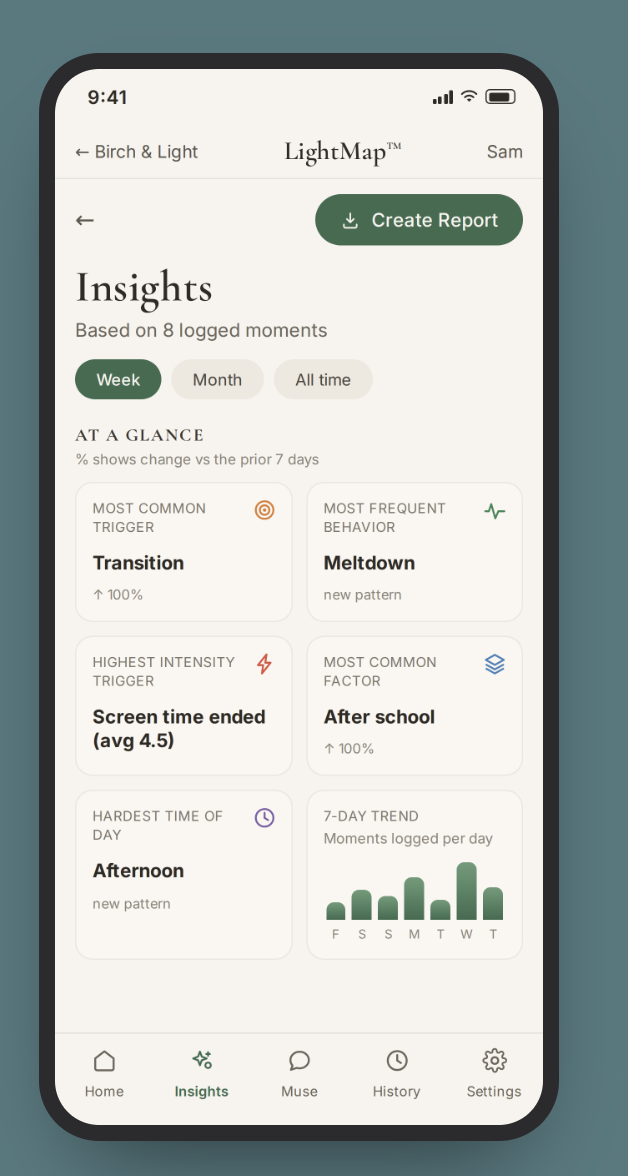

Part of the award-winning Birch & Light Method, honored with the Mom's Choice Gold Award for excellence in family resources.
If today was one of those days
A few more from the library, free to read.
Researched and drafted with AI assistance, reviewed before publication. Editorial standards