A special needs registry, also called a premise alert program, is a voluntary list your local police or 911 center keeps so dispatchers can warn responding officers about your child's disability before they arrive. Registering is free, takes about fifteen minutes, and creates no criminal record. Programs vary by state and town.
There is a form sitting at your local police department that almost nobody tells parents about. It takes fifteen minutes. It costs nothing. And it changes what the officer knows before they walk up your driveway.
If the police have already been to your house, you know why this matters. If they have not, and you have lain awake wondering what would happen if they ever did, this is the thing to do on a calm Tuesday rather than in the middle of the worst night of your year.
Note before you read on: these programs are run locally, and the name, the form, the agency that holds it and the rules around it change from state to state and sometimes from town to town. What follows is the shape of the thing and the questions to ask where you live.
What is a special needs registry?
Most 911 centers and police departments keep a voluntary list of people in their area who may need a different kind of response. The name changes depending on where you live. You will see special needs registry, premise alert program, disability awareness registry, vulnerable persons registry.
In Illinois it runs as a statewide premise alert program. In Pennsylvania some counties run it out of the county 911 center. In New Jersey it is typically county or municipal, with several county prosecutor's offices operating one for every town inside the county. The mechanics are the same everywhere.
You fill out a form describing your child. That information goes into the dispatch system attached to your address. When a call comes in from that address, the dispatcher sees the flag and passes it to the responding officer while they are still in the car.
One thing to sort out before you fill anything in: some states also run a separate registry for disasters and evacuations, meant for hurricanes and power outages rather than police calls. New Jersey's Register Ready is one of these. Those are useful and they are not the same thing. If what you need is the officer at your door to know who your child is, ask specifically for the law enforcement or premise alert registry, and check whether your county and your town each keep one.
That is the whole thing. A note that arrives before the person does.
What it is not
This is the part that stops most parents, so take it directly.
It is not a criminal record. Nothing about registering creates a file on your child in any justice system. It sits in the computer aided dispatch database, the same place your address and your call history live, and it is used to route help.
It is not a report to child protective services, and it is not a referral to anyone. Registration is voluntary, you initiate it, and you can ask to have the entry removed.
It is not permanent by default. Some systems purge entries on a schedule, in some places annually, unless you send an update. That cuts both ways: your child changes, and a description written when he was nine is useless when he is fifteen. Ask about the review cycle when you register, then put a yearly reminder in your phone.
It is also not a guarantee. Departments vary enormously in how well they use these systems. A registry does not replace knowing your rights, and it does not mean the response will go the way you want. It shifts the odds. On a night when the odds are all you have, that counts.
What goes on the form
Registries typically ask for identifying details, a recent photo, emergency contacts, and a description of the disability or condition. The section that does the real work is usually free text, and most parents leave it thin. Fill it properly.
What helps a responding officer:
- The diagnosis in plain terms, plus current medications. Write the condition, not a label you think sounds better.
- What the behavior looks like from outside. An officer arriving mid-meltdown is reading a scene in about four seconds. Tell them what your child does when he is flooded, and say clearly whether it is directed at people or at objects.
- What escalates him. Raised voices. Being surrounded. Being touched. Multiple people talking. Sirens and lights left running.
- What helps. Fewer people. Quiet voice. Space and time. One person speaking. A specific object, room or phrase that reliably lands.
- How he communicates under stress. Whether he goes silent, whether he says things he does not mean, whether questions land at all when he is dysregulated.
- Whether he is likely to run, and where he goes.
- What you are asking the responders to do differently. Many registries take this directly: approach without lights and sirens where possible, send fewer officers, come in plainclothes. Ask what your local form allows.
- Who to call. You, then a second adult, then the therapist or prescriber if you have one.
Write it as though the reader has thirty seconds and has never met your family, because that is the situation.
Some departments also issue a window decal or a car card. Take those. A decal on the door is one more second of information at a moment when seconds are the entire currency.
While you're here, take the guide
What's Underneath is free: the three body-state triggers under most meltdowns, what to say in the minute before it tips over, and how to reset afterward.

You'll get the guide instantly, plus five free articles in your inbox every week. Real challenges (meltdowns, school mornings, picky eating, big feelings) and how to actually handle them. Unsubscribe anytime.
Ask for a CIT officer by name
While you have someone from the department on the phone, ask a second question: do you have Crisis Intervention Team officers, and are they available on all shifts?
CIT started in Memphis in 1988 and now runs in thousands of communities. It is a 40-hour training in mental illness, developmental disability, de-escalation and the local mental health system, built with mental health providers and families rather than by police alone. The point of the program is to get people into treatment instead of into custody.
If your department has CIT officers, that is a request you can make on a call: my son has a psychiatric diagnosis, he is in crisis, please send a CIT officer. Ask now how to phrase it locally, so you are not workshopping language while your hands shake.
Who do I call instead of 911?
The other half of this is knowing who to call instead.
In the United States, 988 reaches the Suicide and Crisis Lifeline, answered by crisis counselors rather than police dispatch. Most areas also have a county mobile crisis team that comes to the house, and many states run a children's crisis line specifically for families. These teams are clinicians. An evaluation through them is a clinical encounter, not an arrest, and it is frequently the fastest available door into services for a child who will not sit in an office.
Find your local mobile crisis number this week and put it in your phone next to 988, under a name you can find while panicking. Then tell every adult in your house it exists. A grandparent or a babysitter reaching for 911 because it is the only number they know is how many of these nights start.
If someone calls anyway
Say the important things in the first sentence, because dispatch is triaging while you talk.
State that it is a mental health crisis, give your child's age and diagnosis, say whether there is a weapon in the house, and say whether anyone is injured. Ask for a CIT officer. Say that the address is on the special needs registry, if you have registered.
Then, if you can, meet them outside. Officers arriving at an unknown house walk in braced. A parent on the front step who says "he is in the back bedroom, he is not armed, he broke a laptop, he is scared" changes the shape of what happens next more than any form ever will.
The quiet part
Registering feels like an admission. Plenty of parents fill in the form and then sit with it for a week before sending it, because handing your child's hardest behavior to the police in writing feels like giving up on the version of him you are still fighting for.
It is the opposite. You are writing the sentence that stands between him and a stranger's assumption. Nobody else can write it, because nobody else knows what calms him.
I sat on ours for a week. When I finally called, I expected a two minute transaction and instead spent close to thirty minutes on the phone with a Lieutenant who asked real questions, told me plainly what her officers see when they walk into a house mid-crisis, and never once made me feel like I was reporting my own child. Somewhere in that conversation I stopped second guessing it. The only part I regret is the week I spent deciding.
Do it on an ordinary day, when nothing is on fire, and then hope you never need it.
The hard nights come with a pattern, and the pattern is hard to see from inside them. LightMap lets you log what happened, what came before it, and what actually helped, so the next conversation with a doctor, a school, or a crisis team starts with something more useful than memory.
Sources, tied to the claims they support. The origin of Crisis Intervention Team programs in Memphis in 1988, the 40-hour officer training in de-escalation and mental illness, and the aim of diverting people into treatment instead of custody: Smarro J, Stevens E. "Why Crisis Intervention Team Training Should Be the Standard." National Alliance on Mental Illness, December 13, 2019. Crisis counselors answering 988 through a national network of local crisis centers: 988 Suicide & Crisis Lifeline, "About 988," 988lifeline.org.
For education and reflection, not medical advice. Our terms
See what's underneath
The pattern is already in your days. Start catching it.
LightMap turns scattered hard days into a pattern you can see. Start by logging one moment today.
Start with 3 moments Not sure where to start? Ask me.Message Tara on WhatsApp. It really is me, I read everything and will personally respond.Click here to message Tara →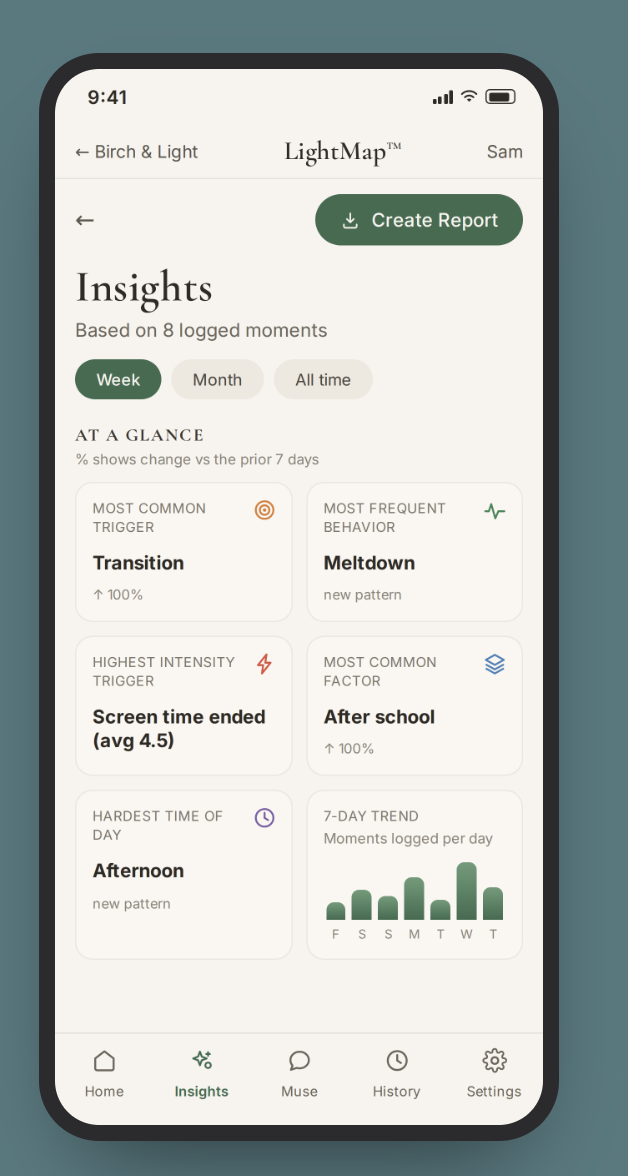

Part of the award-winning Birch & Light Method, honored with the Mom's Choice Gold Award for excellence in family resources.
If today was one of those days
A few more from the library, free to read.
Researched and drafted with AI assistance, reviewed before publication. Editorial standards