
.jpg)
For a while it worked. Your PDA child had a bedtime, more or less, and the evenings held together. Then something shifted, and now bedtime is the hardest hour of the day. She will not go to her own bed, trying ends in a meltdown, and the only thing that settles her is climbing into yours. Somehow you have ended up with a child sideways across your mattress, a partner exiled to the sofa, and a body that aches from having no room. And you are wondering how bedtime, of all things, became a war.
Here is the key that unlocks most of it: go to bed is a demand, and a PDA nervous system is built to resist demands, especially the big ones.
Tired of guessing what set your child off? Log tonight's moment in LightMap.
Why bedtime is a perfect storm for PDA
Sleep is possibly the largest demand we place on a child all day. Go to bed means stop what you are doing, give up control of your body, lie still in the dark, and surrender consciousness itself. For a nervous system organized around protecting autonomy, that is an enormous ask, and the harder it is pushed, the harder the body must push back. The meltdown at the edge of your instruction is not defiance. It is a nervous system that literally cannot let a demand this size win.
It gets more tangled. The transition itself, from the day's activities into the still, unstimulating dark, is exactly the kind of shift PDA kids struggle with most. Add the evening drop in the day's structure, the fatigue that thins everyone's coping, and often a good dose of bedtime anxiety, and you have the conditions for a nightly storm. None of it means you are doing bedtime wrong. It means the standard bedtime, built on direct instruction, is aimed at the one part of your child that cannot comply.
Take the demand out of it
The way through is almost never to push harder. It is to make going to bed feel like something other than an order.
Hand her the destination as her idea. Instead of time for bed, try something that assumes the going while giving her the control: I am making your bed cozy, do you want the fairy lights or the lamp tonight. The choice is hers, the direction is quietly assumed, and there is no demand left to resist.
Stage the landing. Some kids cannot go from your presence to alone-in-the-dark in one leap. She falls asleep near you and moves later, or she starts in her own room with you sitting in it doing something quiet of your own, presence without pressure, and you slip away once she is down. A staged move is not a failure to do it properly. It is matching the size of the step to the child.
Build a rhythm, not a rule. PDA kids often resist a fixed schedule but accept a predictable sequence, bath then story then lights, because a rhythm feels like something the body follows rather than something an adult imposes. Let the sequence carry her instead of your instructions.
And sometimes, protect the sleep and let the phase be a phase. A mattress on your floor. You starting the night in her room. Anything that gets bodies out of a single overcrowded bed while the anxious spell passes. Choosing sleep over principle is not losing. Everyone rested is the goal, and the demand-free years ahead will do the shaping the battles never could.

There's a story for this exact struggle
The Mouse Who Heard Everything
Mina Mouse hears every creak the old house makes at night. The story gently shows that her brain isn’t broken — it’s working overtime to keep her safe — and what changes when someone sits beside her in the dark.
Free to read. You'll also get five free articles a week. Unsubscribe anytime.
When there is a sibling in the mix
If another child sees the PDA kid land in your bed and decides they are missing out, you can end up with a full bed and no sleep for anyone. Worth knowing: the sibling is usually not really after the bed. They are checking they are not loved less. A separate five minutes that belongs just to them, their own small wind-down ritual, often takes the pressure off the bed itself, because the thing they actually wanted was never the mattress.
The reframe
The bored, clingy, cannot-settle version of your child at bedtime is often asking one quiet question: can you help me cross into sleep without making me obey my way there. When you answer it sideways, with cozy choices and staged steps and a rhythm she can follow, you are not giving in. You are removing the demand her nervous system was built to fight, so the sleep underneath it can finally come.
Bedtime resistance has a pattern worth catching: log what the evening looked like, when the meltdown hit, and what actually got her down, in a tool like LightMap, and within a couple of weeks the real triggers, overtired, under-transitioned, anxious, start to separate from each other so you know which lever to pull.
You did not create this by being too soft or too firm. You have a child whose nervous system treats bedtime as the biggest demand of the day, and a house that can be rearranged, gently and sideways, until sleep stops being a fight.
For education and reflection, not medical advice. Our terms
See what's underneath
Stop guessing what set it off
LightMap turns scattered hard days into a pattern you can see. Start by logging one moment tonight.
Find out why it keeps happening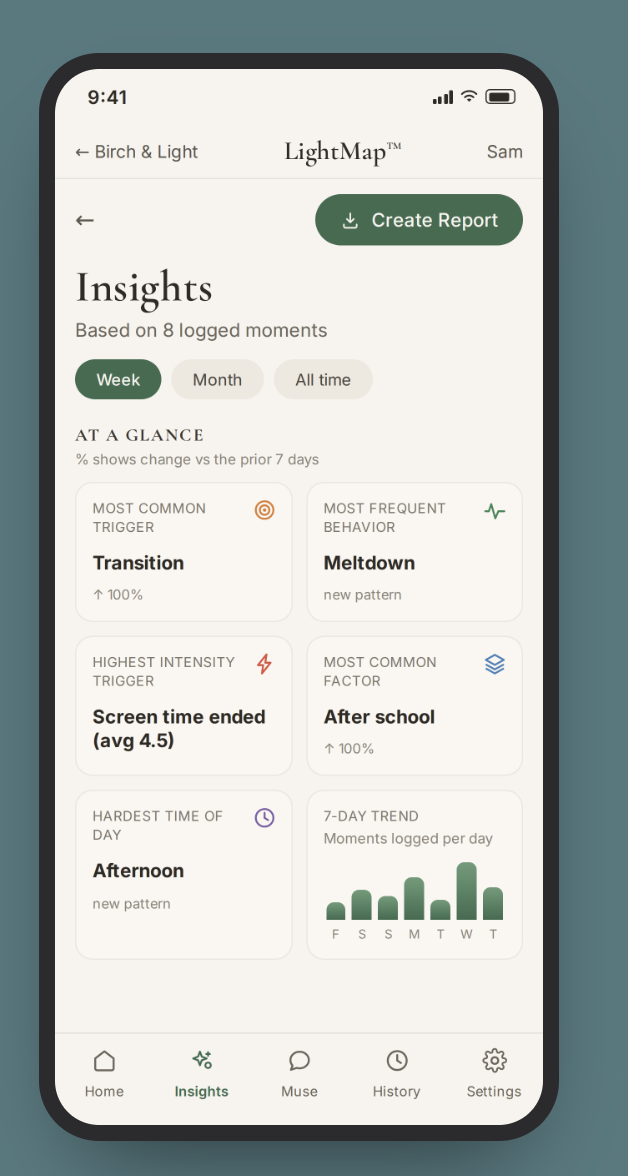

Part of the award-winning Birch & Light Method, honored with the Mom's Choice Gold Award for excellence in family resources.
Before you go, grab the free guide
The 3 body-state triggers under most meltdowns, a script for the 30 seconds before it tips over, and a reset for after. Free.

You'll get the guide instantly, plus five free articles in your inbox every week. Real challenges (meltdowns, school mornings, picky eating, big feelings) and how to actually handle them. Unsubscribe anytime.
A story to read together
Sometimes the easiest way in is a story you read side by side.
- The Mouse Who Heard Everything
Mina Mouse hears every creak the old house makes at night. The story gently shows that her brain isn’t broken — it’s working overtime to keep her safe — and what changes when someone sits beside her in the dark.
Read the story  When Axel's Engine Stayed On
After a big, exciting day, Axel's body is tired but his engine won't quiet down. A gentle story about overstimulated kids who can't settle — and the calm grown-ups who help them.
Read the story
Researched and drafted with AI assistance, reviewed before publication. Editorial standards