You love your child fiercely, and some days you also feel like you're running a three-ring circus with no break. Parenting a child with ADHD takes more structure, more patience and more repetition than anyone warned you about. Here's the short answer to how to do it: understand what ADHD changes in your child's brain, build the day around that, praise far more than you correct, and get support for yourself. This guide walks through each piece and links to deeper reading on every one.
What does ADHD change about parenting?
ADHD affects attention, activity level and impulse control. In daily life it shows up as a child who hears the instruction and forgets it before the stairs, who knows the rule and breaks it anyway, and whose feelings go from zero to a hundred in seconds. Most children with ADHD also meet criteria for another condition, such as anxiety, learning differences or oppositional behavior, so the picture is often more than attention alone.
None of this is caused by bad parenting. ADHD runs strongly in families. But how parents respond can make the days much easier or much harder, which is why parenting is part of treatment, not separate from it.
The core skills of parenting a child with ADHD
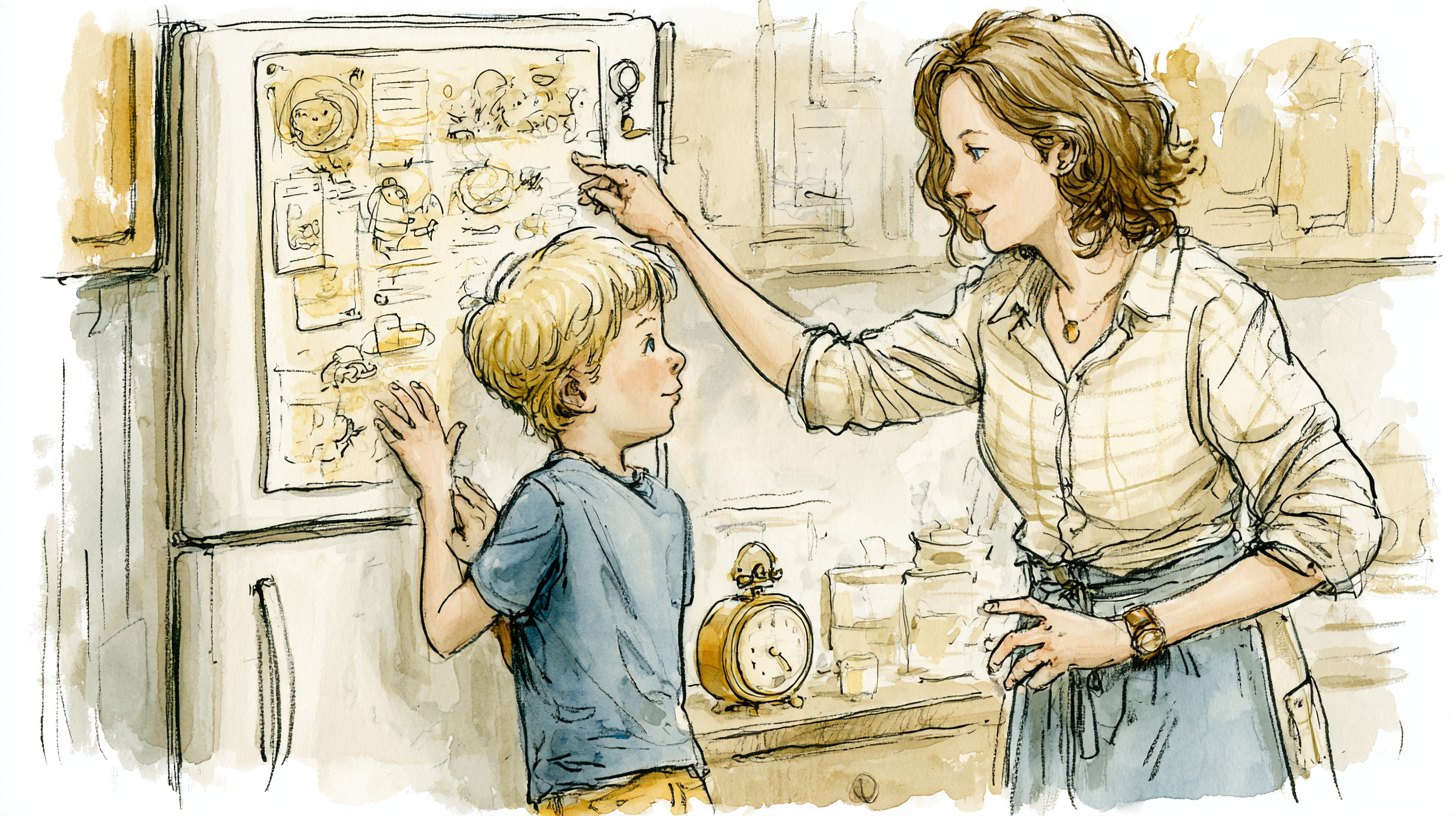
- Make expectations visible. Picture schedules, checklists on the door and a timer on the counter do the remembering your child's brain struggles to do.
- Keep routines the same every day. Same wake-up, same order of the morning, same bedtime. Predictability lowers the number of battles.
- Give one instruction at a time. Get close, get eye contact, keep it short, and wait.
- Praise the behavior you want, a lot. Children with ADHD hear "stop" and "no" all day long. Specific praise ("You started your homework without a reminder") is how new habits stick.
- Use small, fast rewards. Points, stickers or tokens earned right away work better than a big prize at the end of the month.
- Keep consequences small, quick and calm. Immediate and predictable works. Huge and delayed doesn't.
- Ignore minor annoyances on purpose. Save your attention for what matters, and praise the moment the whining stops.
- Plan for transitions. Warnings, countdowns and a clear "first this, then that" make the hardest moments of the day smoother.
These are the skills taught in parent training in behavior management, which the American Academy of Pediatrics strongly recommends for parents of children with ADHD through middle school. Our guide on how to discipline a child with ADHD shows what each one looks like at home.
How do I handle meltdowns and big feelings?
Many children with ADHD struggle with emotional regulation as much as attention. Frustration builds fast and spills over hard. In the moment, stay calm, say less, and keep everyone safe. Afterward, name the feeling and talk about what could help next time. Our article on tantrums: what's normal and what helps covers the in-the-moment steps.
While you're here, take the guide
What's Underneath is free: the three body-state triggers under most meltdowns, what to say in the minute before it tips over, and how to reset afterward.

You'll get the guide instantly, plus five free articles in your inbox every week. Real challenges (meltdowns, school mornings, picky eating, big feelings) and how to actually handle them. Unsubscribe anytime.

There's a story for this exact struggle
My Thoughts Don't Know How to Wait
Simon's thoughts arrive bright and fast — and feel like they will disappear if he doesn't say them right away. One quiet night beside fireflies, he discovers a small, surprising space between noticing a thought and chasing it.
Free to read. You'll also get five free articles a week. Unsubscribe anytime.
What about school?
School is often where ADHD shows up most. The AAP recommends that school supports be part of every treatment plan. That can mean a daily report card between home and school, classroom behavior plans, organizational help, or formal accommodations through a 504 plan or IEP. Start by asking the school, in writing, for an evaluation. Our article on what a 504 evaluation is explains the process.
Should my child take medication?
That's a decision for you and your child's doctor. For children ages 4 to 5, the AAP recommends parent training first. For children 6 and older, it recommends medication together with behavior therapy. Some families start with one, some with both, and many adjust over time. If you want to start without medication, read how to help a child with ADHD without medication. If your child already takes it, when the medication wears off each evening covers the hard after-school hours.
How do I protect sleep, food and movement?
Tired, hungry, under-moved children have fewer resources for everything else. Keep bedtime steady, plan snacks before the hard parts of the day, and build in daily movement. Exercise programs have shown benefits for executive function in children with ADHD, and a walk after school is a simple place to start.
How do I take care of myself?
Parenting a child with ADHD is linked to higher stress, and that's not a character flaw. It's the load. Some things that help: tag-teaming the hardest hours with another adult, a few minutes a day with your child where nobody is being corrected, a parent support group such as CHADD, and checking whether ADHD runs in your own family, since many parents recognize themselves after their child's diagnosis. If your patience is gone, read I have no patience for my ADHD child.
What should I focus on first?
Not everything at once. Pick the hardest hour of your day and make one change there: a visual checklist for the morning, a warning before screens go off, a snack before homework. Then watch what happens for a week.
To know where to start, write down the hard moments: what happened, what time, and what came right before. Patterns appear quickly. Our story My Thoughts Don't Know How to Wait helps your child understand their own impulsive moments, which makes these conversations easier for both of you.
This is what LightMap was built for. Log the hard moments, even a little at a time, and LightMap uncovers what is driving them, coaches you on how to handle each one, and shows you which hours of your day need the plan. Start free at LightMap.
There's no perfect way to parent a child with ADHD. There's a better way for your child, and you find it one routine, one pattern and one good moment at a time.
Start here
Find out what's really going on
The quiz points you toward what's driving it and what tends to help.
Take the quizOr get a free 15 minute LightMap Analysis with TaraFree. No card. 15 minutes.
 Not sure where to start? Ask me.Message Tara on WhatsApp. It really is me, I read everything and will personally respond.Click here to message Tara →

Part of the award-winning Birch & Light Method, honored with the Mom's Choice Gold Award for excellence in family resources.
Sources
Sources: Wolraich ML, et al. "Clinical Practice Guideline for the Diagnosis, Evaluation, and Treatment of Attention-Deficit/Hyperactivity Disorder in Children and Adolescents." Pediatrics 2019;144(4):e20192528. Summarized in American Family Physician 2020;102(1):58-60. Centers for Disease Control and Prevention. "Treatment of ADHD" and "ADHD in the Classroom." Theule J, Wiener J, Tannock R, Jenkins JM. "Parenting Stress in Families of Children With ADHD: A Meta-Analysis." Journal of Emotional and Behavioral Disorders 2013;21(1):3-17. Liang X, et al. "The impact of exercise interventions concerning executive functions of children and adolescents with ADHD: a systematic review and meta-analysis." International Journal of Behavioral Nutrition and Physical Activity 2021;18:68. Faraone SV, Larsson H. "Genetics of attention deficit hyperactivity disorder." Molecular Psychiatry 2019;24(4):562-575.
For education and reflection, not medical advice. Our terms
A story to read together
Sometimes the easiest way in is a story you read side by side.
- My Thoughts Don't Know How to Wait
Simon's thoughts arrive bright and fast — and feel like they will disappear if he doesn't say them right away. One quiet night beside fireflies, he discovers a small, surprising space between noticing a thought and chasing it.
Read the story  Until I Don't
Rosie shines at dance, at school, with neighbors. At home, the smallest thing can tip her over. One quiet hallway moment helps her family finally find language for the part of her nobody else sees.
Read the story
Researched and drafted with AI assistance, reviewed before publication. Editorial standards