
Children with ADHD often act years younger because the brain systems for self-control and emotional regulation develop later than their intelligence does. Clinicians often describe the lag as about thirty percent, so a ten-year-old may regulate like a seven-year-old. Match your expectations for self-control to that younger age, and your expectations for thinking to their real one.
There is a math problem at the center of parenting a child with ADHD, and nobody hands you the equation. Your child has a birthday age, the one on the cake, the one school and relatives and playground parents use to set their expectations. And your child has another age, the one their self-control actually runs at. Those two numbers are not the same, and the gap between them explains almost everything that makes daily life so hard, including some feelings you may be ashamed of having.
How far behind is my child, really?
ADHD researchers, most famously Dr. Russell Barkley, describe children with ADHD as running roughly thirty percent behind their peers in executive functioning, the brain systems for self-control, emotional regulation, impulse management, and reading the room. Take it as a clinical rule of thumb rather than a precise measurement, but take it seriously: it means a ten-year-old with ADHD may regulate himself like a typical seven-year-old. A twelve-year-old like an eight- or nine-year-old.
And here is the part that makes it so confusing to live with: the lag is uneven. Intelligence is usually right on time. Vocabulary, reasoning, memory for dinosaur facts, all age-appropriate or better. So you get a child who talks like his birthday age, argues like a lawyer two grades up, and then melts down over a board game like a kindergartner. The mismatch is the whole show.
A child who was globally delayed would recalibrate everyone's expectations automatically. A child who is selectively delayed, sharp mind, young self-control, gets judged against his sharpest feature and found wanting everywhere else. That is where the word everyone eventually reaches for comes from: immature.
The feeling you're not allowed to say out loud
Let's say the quiet part, because it is more common than any parent believes when they're alone with it at 10pm: sometimes your own child grates on you. The volume, the repetition, the interrupting, the joke told the ninth time, the six-year-old behavior in a nine-year-old body. Some days "annoying" is the only honest word, and then the guilt arrives, because what kind of parent finds their own child annoying?
A normal one, in an abnormal situation. Here is the reframe that matters: annoyance is not a verdict on your love. It is the friction of a mismatch, a child broadcasting on a younger frequency than everyone around him is tuned to, including you, hour after hour, with no break. The behaviors that grate are the lag itself, not a personality flaw he chose and not a parenting outcome you produced. Naming it, quietly, to yourself or one safe person, drains most of its poison. Carrying it as a shameful secret is what turns it corrosive.
What changes when you use the right age
Set regulation expectations to his executive age, and intellectual ones to his birthday age. Feed the ten-year-old mind: real conversations, real interests, real challenges. Support the seven-year-old self-control: more supervision than his birthday age suggests, shorter horizons between action and consequence, external structure doing the job his internal regulation can't yet, and adult backup during the situations that reliably outrun him. This is not babying him. It is meeting the actual child instead of the birthday certificate.
Retire "act your age." He is acting his age, the executive one. That instruction asks him for the one thing the lag makes impossible, and every repetition teaches him he is failing at something invisible that everyone else apparently got for free.
Reread the friendship struggles through the lag. Kids sort themselves by play style, not birthdate, and a child who regulates like a seven-year-old often plays most successfully with kids a year or two younger, where he might even get to be the leader for once. That is not social failure; that is a developmental match. Same-age friendships tend to work best one-on-one, in structured activities, in shorter doses, with an adult within reach. Big unstructured groups of same-age peers are the hardest possible arena, so weight his social life away from them and let wins accumulate where wins are possible.
While you're here, take the guide
What's Underneath is free: the three body-state triggers under most meltdowns, what to say in the minute before it tips over, and how to reset afterward.

You'll get the guide instantly, plus five free articles in your inbox every week. Real challenges (meltdowns, school mornings, picky eating, big feelings) and how to actually handle them. Unsubscribe anytime.
About those amazing moments
Most parents in this situation describe a maddening ratio: flashes of a wonderful, funny, tender, capable kid, wrapped in long stretches of chaos. Here is the thing about the flashes: they are not random and they are not a mask. They are the same brain operating inside the right conditions, usually some mix of genuine interest, novelty, movement, one-on-one attention, or low demand.
Which means the ratio is not fixed. Study your child's amazing moments like evidence, when do they happen, with whom, doing what, and you get a recipe you can deliberately reproduce. Families who track this (a notebook works; a tool like LightMap makes the pattern visible faster) are usually startled to find the "good moments" cluster tightly around identifiable conditions. Engineering more of those conditions is a far better project than waiting for maturity to arrive.
Your isolation is part of the condition too
One more thing that deserves naming: the loneliness. A child whose struggles read as "annoying" and "immature" rather than as a visible disability gets judgment instead of sympathy, and so do you. Friends drift, family offers advice shaped like criticism, invitations thin out, and you end up managing the hardest parenting assignment on the block with the least support on it.
The repair is specific: you need rooms, physical or online, where the lag is common knowledge and nobody needs the backstory. ADHD parent groups exist in nearly every region and all over the internet, and the first time you describe your Tuesday and watch a dozen parents nod instead of flinch, something in your chest unclenches. You cannot make the neighbors understand. You can stop needing them to.
Does the gap ever close?
A lag is not a ceiling. Executive functioning keeps developing into the mid-twenties, and children with ADHD keep developing it too, on their own delayed curve. The seven-year-old self-control becomes ten-year-old self-control, then fourteen, just later than the calendar says.
Plenty of the adults you know who bloomed late, found their footing at 25 instead of 18, and turned out marvelous were this exact kid. Your job is not to close the gap by force. It is to scaffold him safely through the years when the gap is widest, protect his sense of self from the word "immature," and stay findable until his curve catches up. It does catch up.
The gap narrows in a way that is invisible week to week and obvious across a year. Logging in LightMap is how you catch it happening rather than only noticing afterwards.
Sources: Barkley, Taking Charge of ADHD, on the approximately thirty percent developmental delay in executive functioning; peer-reviewed research on delayed cortical maturation in ADHD (Shaw et al., PNAS); research on executive function development and self-regulation in children with ADHD (PMC).
Primary sources: Shaw P, Eckstrand K, Sharp W, Blumenthal J, Lerch JP, Greenstein D, Clasen L, Evans A, Giedd J, Rapoport JL. Attention-deficit/hyperactivity disorder is characterized by a delay in cortical maturation. Proceedings of the National Academy of Sciences, 2007, 104, 19649-19654, doi 10.1073/pnas.0707741104. This is the study behind the idea that the ADHD brain follows a delayed developmental curve. Shaw P, Stringaris A, Nigg J, Leibenluft E. Emotion dysregulation in attention deficit hyperactivity disorder. American Journal of Psychiatry, 2014, 171, on emotional regulation difficulties in ADHD. The thirty percent figure is a clinician estimate from Barkley and is not a measured constant.
For education and reflection, not medical advice. Our terms
See what's underneath
Walk into the next appointment with answers
LightMap reads your hard days together and gives you answers. Start with one moment today.
Start with 3 moments Not sure where to start? Ask me.Message Tara on WhatsApp. It really is me, I read everything and will personally respond.Click here to message Tara →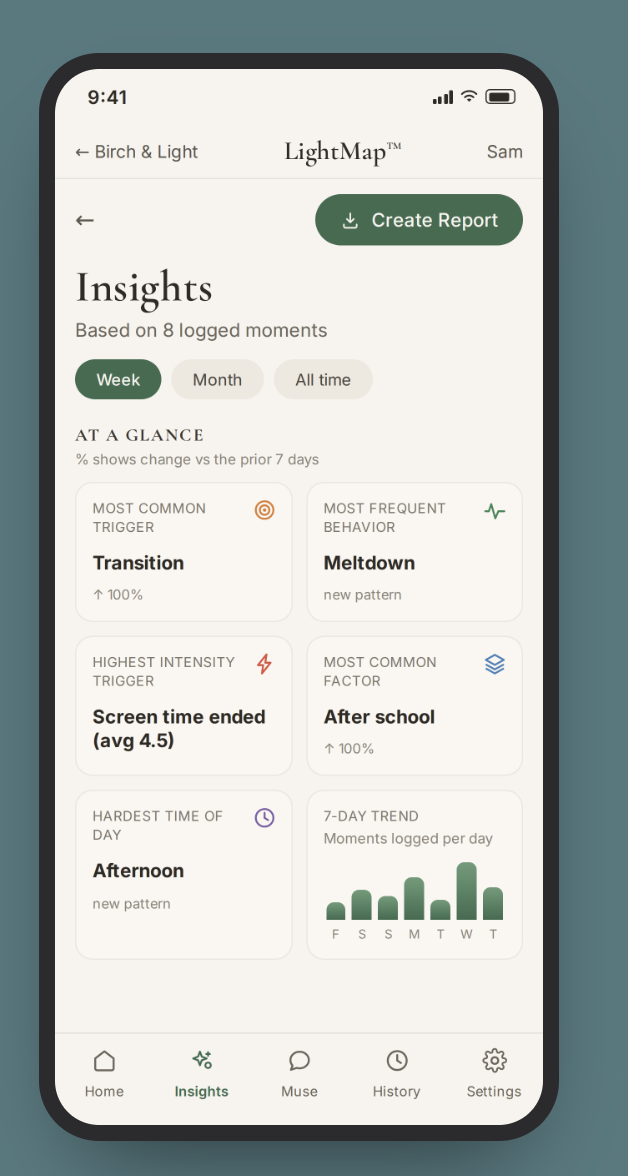

Part of the award-winning Birch & Light Method, honored with the Mom's Choice Gold Award for excellence in family resources.
A story to read together
Sometimes the easiest way in is a story you read side by side.
 My Thoughts Don't Know How to Wait
Simon's thoughts arrive bright and fast — and feel like they will disappear if he doesn't say them right away. One quiet night beside fireflies, he discovers a small, surprising space between noticing a thought and chasing it.
Read the story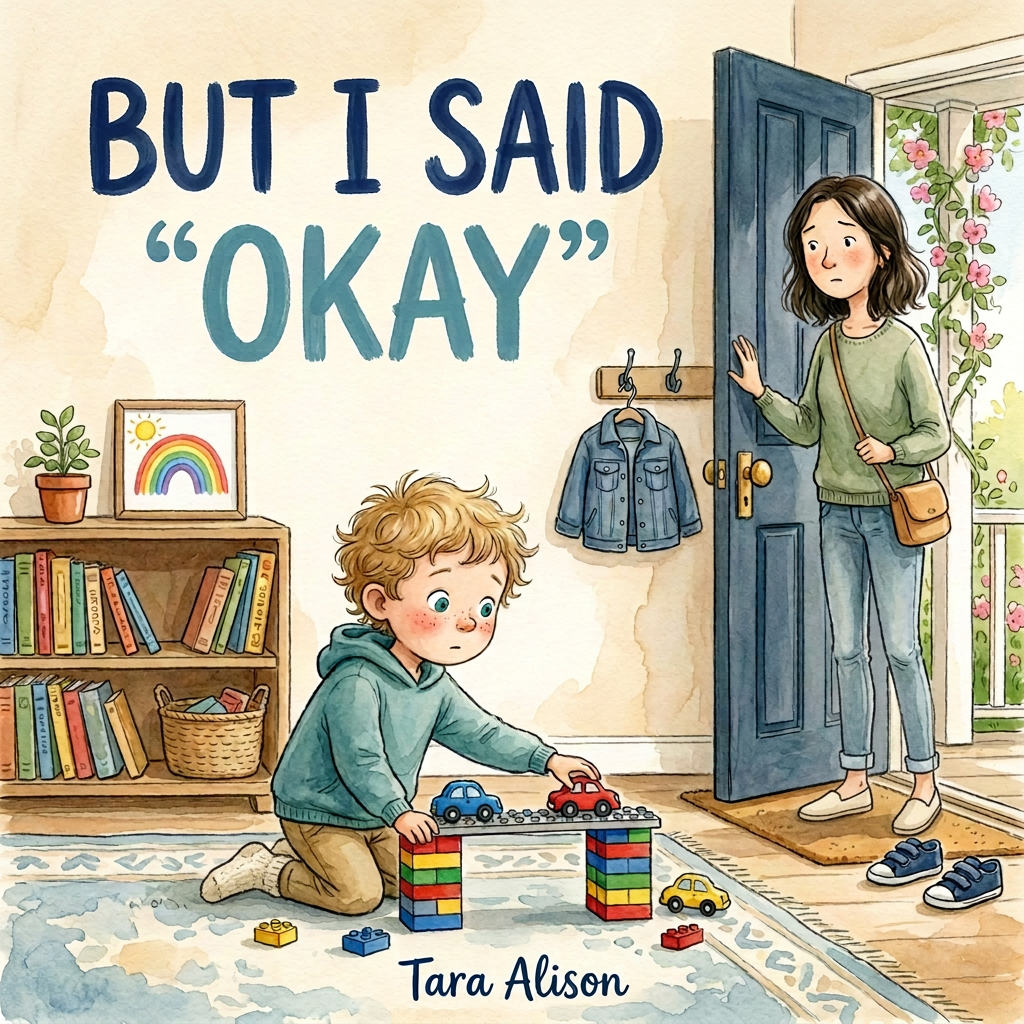 But I Said “Okay”
Owen always says okay. He means it every time. But his attention is still inside the bridge, the dragon, the cave, the music — until Mom realizes that helping him leave one thing matters more than asking him to start the next.
Read the story
If today was one of those days
A few more from the library, free to read.
Researched and drafted with AI assistance, reviewed before publication. Editorial standards