

For years it was a laundry problem. Then one morning your child asks whether other kids her age still wear pull ups, and you understand that something has changed. The wetting has not gotten worse. Her awareness has.
Most of what parents find when they start looking is either written about toddlers or written as though the only goal is making it stop faster. Neither helps much when your child is eight, has a sleepover invitation on the fridge, and has started asking questions about herself. And neither tells you the thing that matters first, which is that bedwetting is a symptom rather than a condition, and the reasons behind it range from completely benign to genuinely urgent.
First: the question that changes everything
Before anything else, answer this. Has your child never had a stretch of reliably dry nights, or was she dry for six months or more and then started wetting again?
Never dry is called primary bedwetting. It is common, usually familial, and most often a matter of timing rather than illness.
Dry and then wet again is called secondary bedwetting, and it is a different conversation. Something changed. Sometimes the change is emotional, sometimes it is medical, and it is worth finding out which before settling into a management plan.
Call the doctor today if you see this
New bedwetting in a child who was reliably dry is one of the classic first signs of type 1 diabetes, and it is the reason this section sits near the top rather than at the bottom.
The pattern to watch for is bedwetting that returns alongside constant thirst, drinking far more than usual, urinating large amounts frequently during the day, unexplained weight loss, unusual tiredness, or a change in mood and stamina.
A finger stick glucose or a urine dip takes minutes in any pediatric office. If this pattern fits, do not wait for the scheduled appointment, and do not accept a wait of several weeks for one.
The reason for the urgency is what happens when it is missed. Undiagnosed type 1 progresses to diabetic ketoacidosis, a state where the body, unable to use glucose, breaks down fat for fuel and floods the blood with acid. DKA is a medical emergency and children still die of it. It is most often mistaken for a stomach virus, because the vomiting and stomach pain look like one, and the deep rapid breathing is sometimes treated as asthma or a chest infection.
Go to an emergency room now, rather than waiting for a call back, if you see any of these: breath that smells sweet or like nail polish remover, vomiting, deep or rapid breathing, stomach pain, confusion, unusual drowsiness, or difficulty waking. Those are late signs and they move quickly.
Caught early, type 1 is a manageable diagnosis and a child goes home within days. The whole reason this section sits at the top of an article about bedwetting is that new nighttime wetting is often the first thing a parent notices, weeks before anything else looks wrong.
Why finding it early matters more than it used to
For a long time, catching type 1 early meant a gentler start and nothing more. That changed with teplizumab, sold as Tzield, the first treatment that acts on the disease process itself rather than replacing insulin that has already been lost.
Type 1 develops in stages. In stage 1 the immune system has begun attacking the insulin producing cells while blood sugar still reads normal. In stage 2 blood sugar has started to drift but the child feels fine and looks fine. Stage 3 is where most families learn about it, when symptoms appear and insulin becomes necessary. The first two stages are silent and can only be found by looking, through a blood test for autoantibodies.
Given as a 14 day course of daily infusions to children identified at stage 2, Tzield delays the arrival of stage 3 by a median of around two years. It was approved in the United States in 2022 for age eight and above, and in April 2026 the FDA extended that down to age one.
Then in June 2026 the FDA granted a second approval, for children aged eight to seventeen who have recently been diagnosed at stage 3, to slow the loss of the insulin production they still have. Recently is the operative word there, and it is one more reason that a child seen in the week the thirst started is in a different position from a child who arrives in an emergency room in ketoacidosis a month later.
The practical piece for families: if one child has type 1, siblings carry a substantially higher risk than the general population, and they can be screened with a simple autoantibody blood test. A treatment that works before symptoms only ever reaches the children whose families went looking.
The other medical causes worth ruling out
Urinary tract infection. Especially in girls. New wetting, urgency, pain, foul smelling urine, or daytime accidents alongside the night ones. A urine sample settles it.
Constipation. This one is missed constantly and it is one of the most common causes of all. A loaded bowel sits directly against the bladder and reduces how much it can hold, and children can be significantly constipated while still passing something daily. Treating the constipation resolves the wetting in a meaningful share of cases, and it is worth asking about before anything more involved.
Sleep disordered breathing. Snoring, mouth breathing, restless sleep, or large tonsils. Obstructed breathing disrupts the arousal system and the hormonal signals that concentrate urine overnight. In children where this is the driver, addressing the airway often resolves the wetting, and it tends to improve daytime attention at the same time.
Trouble concentrating urine overnight. This one is worth understanding, because it also explains a great deal of ordinary bedwetting. Overnight the body releases a hormone called vasopressin, which tells the kidneys to slow urine production while a child sleeps. Plenty of children who wet the bed simply have a blunted overnight rise in that hormone, so they produce close to a full day's volume of urine at night and the bladder cannot hold it. That is the mechanism desmopressin works on, further down, since desmopressin is a synthetic version of the same hormone.
Much more rarely, the hormone is missing altogether or the kidneys fail to respond to it. That condition carries the confusing name diabetes insipidus, and despite the word it has nothing to do with blood sugar, insulin, or type 1. The picture is enormous volumes of very pale urine around the clock alongside relentless thirst, and it needs investigating.
PANS and PANDAS
If the wetting arrived abruptly, over days rather than months, and came in alongside other new symptoms, this belongs on the list.
Urinary frequency and new bedwetting are among the recognized features of PANS and PANDAS, and they rarely arrive alone. The pattern is a sudden onset cluster: obsessive thoughts or rituals appearing out of nowhere, a sharp narrowing of what the child will eat, separation anxiety that was not there a month ago, tics, handwriting deterioration, rage episodes, and sleep disruption. Often it follows a strep infection or another illness by a few weeks.
Any parent who reads that list and recognizes their child should date the onset as precisely as they can and bring a written timeline to the doctor, because the abruptness is the diagnostic signal and it is the detail most likely to get lost in a short appointment.
Medications that deepen sleep
Waking to a full bladder requires a sleeping brain to cross an arousal threshold. Anything that raises that threshold makes wetting more likely, and several medications commonly prescribed to neurodivergent children do precisely this.
Melatonin, clonidine, guanfacine, sedating antihistamines, and some antidepressants and antipsychotics can all deepen sleep enough to matter. Stimulants play a different role, since appetite suppression during the day often shifts a child's eating and drinking into the evening, which loads the bladder at the worst possible time.
None of this means stopping anything. It means bringing the timing to the prescriber, because moving a dose earlier or shifting when the day's fluids happen is sometimes the whole fix.
Some children are simply late
Once the above has been considered, a large share of bedwetting is just developmental timing, and it runs in families with striking consistency. If a parent wet the bed late, the child often does too, and it frequently continues to eleven or twelve before resolving on its own.
This is not a failure of training and it does not respond to consequences. The bladder capacity, the overnight hormone that concentrates urine, and the arousal signal that wakes a child all mature on their own schedules, and in some children one of those runs behind. It runs later still in children with ADHD, where studies put the rate at roughly two to three times higher than peers, because the same arousal system that makes daytime attention hard makes nighttime waking hard.
She is not choosing this and she cannot try harder at it.

There's a story for this exact struggle
My Thoughts Don't Know How to Wait
Simon's thoughts arrive bright and fast — and feel like they will disappear if he doesn't say them right away. One quiet night beside fireflies, he discovers a small, surprising space between noticing a thought and chasing it.
Free to read. You'll also get five free articles a week. Unsubscribe anytime.
Regression after a period of dryness
Sometimes a child who has been dry for years starts again, and the cause is neither sinister nor mysterious. A new baby, a house move, a hospital stay, a frightening event, a divorce, a bad school year, or an illness can all do it. So can a stretch of poor sleep.
Medical causes still deserve a look, particularly the diabetes picture above. But once those are cleared, regression is usually the nervous system reporting load rather than anything that needs fixing directly, and it tends to resolve as the underlying stressor settles. What makes it worse is treating it as behavior, because a child who is already overwhelmed and now feels shamed at night has one more thing to carry.
The treatments with evidence behind them
Bedwetting alarms. The most effective long term option, and the one most parents have never tried. A small sensor clips to the underwear or sits on a pad and sounds the moment moisture is detected. It works by conditioning: over weeks, the brain learns to associate the bladder signal with waking, and eventually wakes ahead of the alarm.
On choosing one, Malem is the brand most often recommended by urologists and pediatricians, and Dr Malem built the first wearable version in 1979. The models worth paying attention to combine sound, vibration, and light rather than sound alone, because a child who sleeps through a full bladder will often sleep through a beep, and the vibration is what wakes the deep sleepers. The other feature worth having is multiple tones. Children habituate to a single repeated sound and start sleeping through it after a few weeks, which is a particular risk with kids whose brains filter out repetitive input, so an alarm that rotates through different tones holds its effect longer. The sensor clips to the outside of close fitting underwear, and the better designs let the child attach it herself, which matters more than it sounds, because an alarm she manages is one she is willing to keep using.
Two things to know before starting. It takes commitment, generally two to three months of consistent use, and the first several weeks are rough because a parent usually has to help the child wake and finish in the bathroom. And it works best when the child wants it, not when it is imposed. Started at the right moment with a child who is motivated, roughly two thirds achieve lasting dryness, and relapse rates are lower than with medication.
Desmopressin. A prescription that reduces overnight urine production. It works quickly for many children, which makes it genuinely useful for sleepovers, camp, and school trips where one night matters. Wetting usually returns when it is stopped, so it functions better as a tool for specific occasions than as a cure.
Treating constipation first. If there is any constipation in the picture, this comes before alarms or medication, because clearing it sometimes resolves everything without further intervention.
Books written for the child. A book does something no parent explanation quite manages, because reading about a character in the same situation tells a child she is one of many rather than the only one, and it gives her language for something she has probably never said out loud. The one parents recommend most often is Dry All Night: The Picture Book Technique That Stops Bedwetting by Alison Mack, which is structured in two halves, a section for the parent explaining the mechanism and a picture story written directly to the child. It is an older book and the child section runs wordier than a modern picture book, so younger readers usually need it read aloud at first. What makes it work is repetition and visualization rather than instruction, and many families use it alongside an alarm rather than instead of one. For a child who has started noticing the social stigma, this often lands harder than any conversation.
What does not work. Restricting fluids aggressively, waking a child at random hours to carry her to the toilet, reward charts, and consequences. None of these address the mechanism, and the last two attach shame to something she does not control.
The shame is what leaves a mark
Here is the part worth holding onto. The wetting almost always resolves. What can persist for decades is what a child decided about herself during the years it was happening.
For a child who already carries rejection fears, the danger is sharper. Rejection sensitive kids do not experience embarrassment as a passing moment. They experience it as evidence, and they file it. One bad sleepover can set the terms for how she thinks about friendship for years.
Give her control of the information
Almost every child in this situation is afraid of the same specific thing, which is not being wet. It is being found out by someone she did not choose.
So hand her authority over who knows. Decide together, explicitly, who is on the list. Perhaps one grandparent, perhaps one best friend, perhaps nobody outside the house. Then hold that line without exception, including with relatives who think it is funny and siblings who need to be told plainly that this is not theirs to mention. When she is the one deciding, the secret stops being something kept about her and becomes something she manages.
Give her the words before she needs them
Children freeze when caught without a script, and freezing in front of a peer is the moment that gets remembered. Build the script in advance, on a calm afternoon, and let her practice until it sounds boring to her.
Short and flat works better than clever. Something like: my body sleeps really deeply, so I wear something at night, it is not a big deal. Delivered without apology, that ends most conversations, because children take their cue from how the other child reacts.
It helps her to know the number too. Kids assume they are the only one. Telling her straight that in a class of thirty she is unlikely to be the only one, and that the others are keeping quiet about it, does more good than telling her not to worry.
Make sleepovers logistically possible
The instinct is to avoid sleepovers until this resolves. Try not to, because withdrawal costs her more than the risk does, and the friendships built at eight and nine are the ones that carry her.
What makes them workable is planning that removes the moment of exposure. She packs her own bag so nobody else handles it. She changes in the bathroom rather than the bedroom. You tell the host parent quietly ahead of time, adult to adult, so no grown up is surprised into a comment. A dark sleeping bag hides more than a light one. She knows she can call you at any hour with no questions, which she will almost never use but which lowers the anxiety of the whole evening. And this is where desmopressin earns its place, if her doctor agrees.
Camp works the same way, and camp nurses handle this constantly without blinking.
Watch for the invitations she starts declining
A child who suddenly loses interest in sleepovers, or who develops a stomach ache on the day of one, is often not telling you about a change in what she wants. She is solving a problem the only way she knows how.
Treat that as the bedwetting talking rather than a real shift in her social life, and solve the logistics rather than accepting the withdrawal.
What to bring to the appointment
Plenty of pediatricians are relaxed about bedwetting, and often that is appropriate, because time resolves most cases. But relaxed is different from unexamined, and the questions worth asking directly are whether constipation has been ruled out, whether anything about the onset pattern warrants a urine or glucose check, and what the plan is if this is still happening at ten.
The observation that gets the most useful response is the social one. A doctor who hears that a child has started avoiding sleepovers is being told something different from a doctor who hears that a child is still wet, and it tends to open the conversation about options rather than closing it.
Bring dates rather than impressions. Dry nights against wet ones over a few weeks, whether anything changed around the time it started or restarted, what she is drinking and when, and how her bowels are actually working.
If the wetting arrived suddenly alongside other new symptoms, finding a doctor who actually understands PANS is the next thing to read. If she has started pulling back from sleepovers and friendships, why a child avoids friends they say they miss covers what is happening underneath that.
Dry nights against wet ones, what changed the week it started, the sleepovers she says yes to and the ones she quietly turns down: log it in LightMap as you notice it, and a few weeks later you walk into the appointment reading a pattern instead of reconstructing a memory.
She will almost certainly be dry before this matters to anyone but her. What you are really protecting, in the meantime, is what she believes about herself on the way there.
Sources: International Children's Continence Society standardization documents on nocturnal enuresis in children; NICE Clinical Guideline CG111, Bedwetting in under 19s; peer-reviewed research on the association between ADHD and enuresis (PMC; Journal of Urology); research on constipation as an underrecognized contributor to enuresis (PMC).
For education and reflection, not medical advice. Our terms
See what's underneath
Walk into the next appointment with a pattern
LightMap turns scattered hard days into a pattern you can see. Start by logging one moment tonight.
Log today's hard moment, no account needed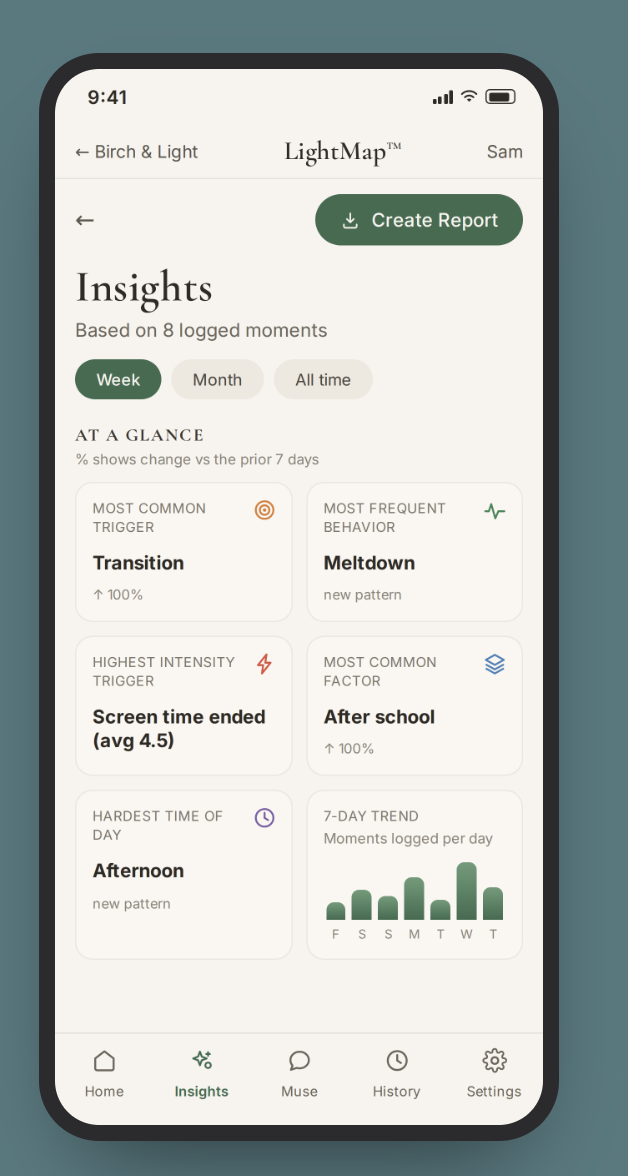

Part of the award-winning Birch & Light Method, honored with the Mom's Choice Gold Award for excellence in family resources.
Before you go, grab the free guide
The 3 body-state triggers under most meltdowns, a script for the 30 seconds before it tips over, and a reset for after. Free.

You'll get the guide instantly, plus five free articles in your inbox every week. Real challenges (meltdowns, school mornings, picky eating, big feelings) and how to actually handle them. Unsubscribe anytime.
A story to read together
Sometimes the easiest way in is a story you read side by side.
- My Thoughts Don't Know How to Wait
Simon's thoughts arrive bright and fast — and feel like they will disappear if he doesn't say them right away. One quiet night beside fireflies, he discovers a small, surprising space between noticing a thought and chasing it.
Read the story  But I Said “Okay”
Owen always says okay. He means it every time. But his attention is still inside the bridge, the dragon, the cave, the music — until Mom realizes that helping him leave one thing matters more than asking him to start the next.
Read the story
Researched and drafted with AI assistance, reviewed before publication. Editorial standards