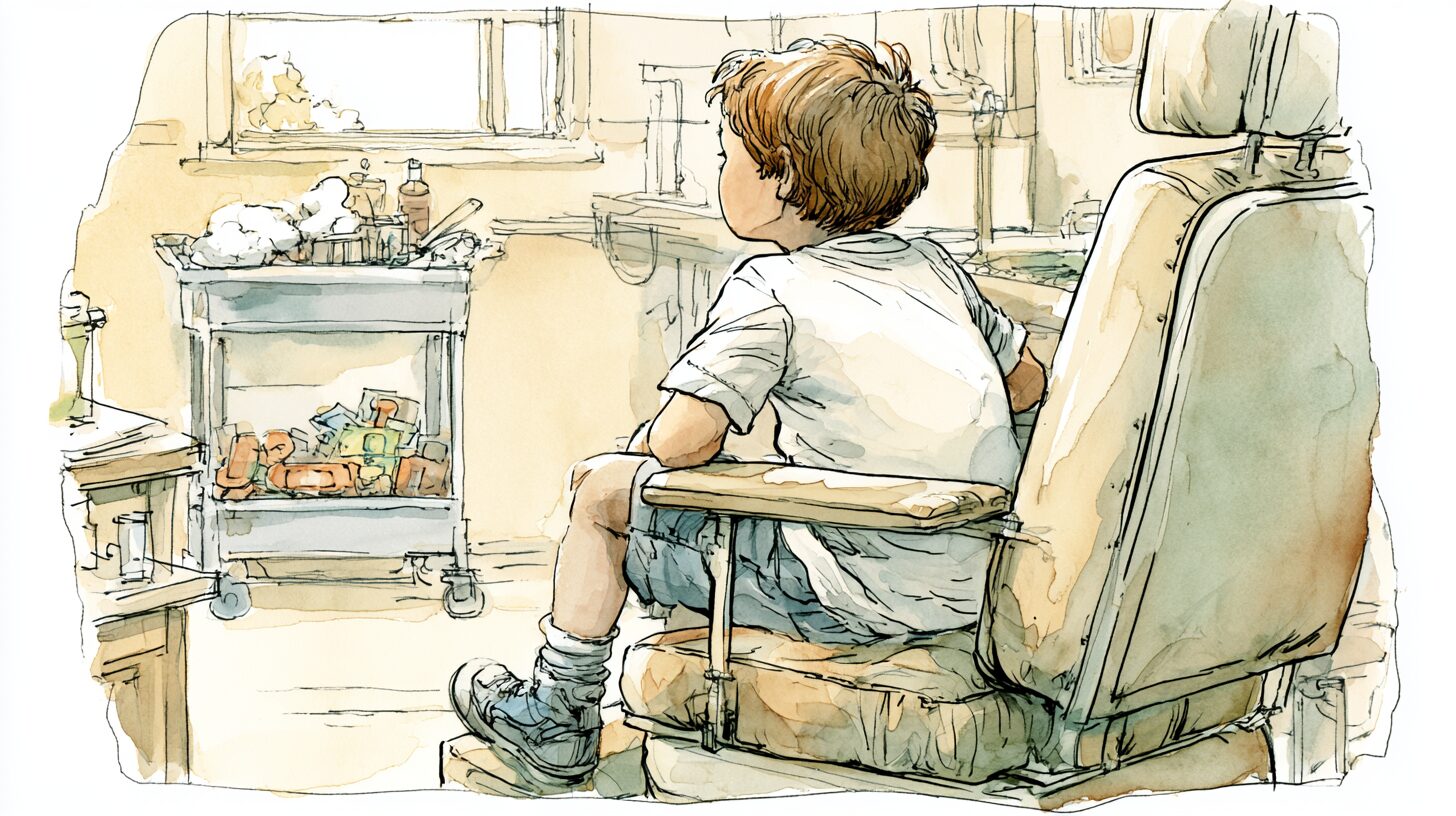
It happens most days, often more than once. You clean him up without comment, because you already know that shame makes this worse, and you start again. Somewhere nearby there is someone, a partner, a grandparent, a teacher, who thinks a firmer line would sort it out, and a quieter voice in you that wonders whether they are right and you have simply been too soft.
They are not right, and neither is the voice. Daily soiling in a school age child is very rarely a discipline problem that has been allowed to run. In the large majority of cases it is a physical problem that has been wearing a behavioral costume for months. Once you can see the mechanism, both the sympathy and the treatment stop being guesswork.
What is happening inside
The clinical name for soiling past about age four is encopresis. The word that matters more is retentive, because the great majority of cases, commonly put at four in five or higher, follow the same physical sequence.
It starts with one stool that hurts, or one toilet that felt unsafe, or one week of illness. The child holds. Held stool sits longer, water is drawn out of it, and it becomes harder. The next one hurts more, so the holding makes sense to him, and the cycle closes.
Over weeks, a mass builds in the rectum and stretches it. A rectum held open like that stops reporting accurately. The signal that says go now gets fainter and eventually stops arriving. Meanwhile new, softer stool keeps coming down from above, cannot get past the mass, and travels around it instead. That is what leaks out.
This explains the two details that confuse parents most. It happens repeatedly through the day without warning, because overflow is not a decision. And a severely constipated child produces something that looks like diarrhea, which is the opposite of what anyone expects.
He is not feeling it come. That is not a story he tells to stay out of trouble. The nerves that would tell him have been stretched flat for months.
The questions that sort this quickly
Before an appointment, look for the retention pattern rather than the leaking:
- Has there ever been a stool big enough or hard enough to block the toilet, or one that clearly hurt?
- How many days pass between proper bowel movements, as opposed to smears and streaks?
- Does he hold? Crossing legs, going up on tiptoes, stiffening, rocking, hiding behind furniture or curtains at the moment it arrives.
- Does he complain of tummy ache, eat less than he used to, or fill up fast at meals?
- Is his abdomen hard or full to the touch on the lower left side?
Any of these point toward retained stool, and they matter more than the frequency of the accidents.
When to call sooner rather than later
Most of this is not urgent, but some of it is. Get seen promptly for constipation dating from the first weeks of life or a delayed first stool after birth, ribbon-thin stools, a swollen abdomen with vomiting, blood, weight loss or growth that has flattened, or anything neurological such as leg weakness, a change in how he walks, or a dimple or tuft of hair at the base of the spine.
Separately, if daily soiling arrived abruptly in a child who was reliably clean, alongside other new symptoms such as sudden anxiety, tics, urinary frequency, or a personality change over days rather than months, that onset pattern deserves a wider look than a bowel plan alone.
What treatment actually looks like
There is a standard sequence, and most families who feel that treatment failed stopped partway through it.
Clear out first. An impacted rectum has to be emptied before anything else can work. This is usually done with a macrogol laxative, sold as Movicol in the UK and Miralax in the US, at an escalating dose over several days. Here is the part families are often not warned about: the leaking frequently gets worse during the clear-out, sometimes much worse, before it stops. Parents who have not been told this stop on day three and conclude the medicine made everything worse.
Then maintain, for months. A stretched rectum needs time at a normal size before its nerves start reporting again. Maintenance doses commonly run six months or longer, and the single most common reason families end up back at the start is stopping when the accidents stop. The accidents stopping is the first sign it is working, not the sign it is finished. Weaning happens slowly, guided by the clinician.
Diet is support, not treatment. Fiber and fluids help maintain a healthy bowel. They will not clear an existing impaction, and being told to add more fruit is not a treatment plan.
Position matters more than people think. A child on an adult toilet with feet dangling is trying to open a passage that is still partly kinked. Feet flat on a step stool, knees higher than hips, leaning forward with forearms on thighs. This one change alone makes some children able to pass what they could not before.
Timing borrows the body. The bowel gets a natural push about twenty to thirty minutes after eating. A sit at that point is working with something already happening rather than asking a child to produce on request.
Two things to know about examinations: this is a clinical diagnosis, so an abdominal x-ray is not routinely needed to confirm it, and current UK guidance advises against digital rectal examination in primary care for this. A careful history and an abdominal examination are the standard.
While you're here, take the guide
What's Underneath is free: the three body-state triggers under most meltdowns, what to say in the minute before it tips over, and how to reset afterward.

You'll get the guide instantly, plus five free articles in your inbox every week. Real challenges (meltdowns, school mornings, picky eating, big feelings) and how to actually handle them. Unsubscribe anytime.
Where the neurodivergent piece changes the plan
Everything above is the general protocol. For a child with a demand avoidant profile, or an autistic or ADHD child, several parts of it collide with how he is built.
Interoception. Many neurodivergent children have a weaker read on internal signals to begin with, whether that is hunger, temperature, needing the bathroom, or the early edge of anger. Add a stretched rectum and the signal is gone twice over.
The cost of stopping. Getting up mid-activity is expensive for a child who struggles to shift attention. The urge arrives, gets deprioritized, and by the time the activity ends the moment has gone.
Sensory load. Hand dryers, echo, smell, a cold seat, fluorescent light, no privacy. School bathrooms are unusable for a lot of children, so plenty of children hold from morning until home time. Some hold at home too. If nighttime wetting is running alongside the soiling, bedwetting in ADHD kids covers why the two so often travel together, since constipation is one of the most missed causes of both.
Demand avoidance. The standard plan asks for scheduled sits after meals. For a demand avoidant child, that is a daily instruction attached to a body function, which is where these plans reliably fall apart. The plan is not wrong. The delivery has to change.
What that looks like in practice:
- Do not ask him to sit. Make sitting available and let him arrive at it. Declarative language rather than instruction: the step stool is by the toilet now, or the audiobook is loaded.
- Put the sit inside something he already wants. One tablet game, one podcast, one comic that exists only in that room.
- Never make the bowel movement the target. If you notice anything at all, notice the sit, and notice it lightly.
- Hand him every variable you can. Door open or closed, light on or off, who is in the hallway, which pants, which wipes.
- On cleanup, let him take whatever part he wants and no more. Passing him a wipe is participation. Requiring him to clean it is a demand and a shame event in the same moment.
- Drop the word accident as a verdict, and drop questions that ask him to explain something he did not feel.
If the demand side of this is the harder half, the difference between won't and can't and low demand parenting when some things are not optional both cover how to hold a medical necessity without turning it into a daily battle.
When someone thinks you should be stricter
That instinct is usually not cruelty. It is a different theory of the cause. If you believe a child can feel it coming and is choosing not to act, then consequences look reasonable. The disagreement tends to dissolve once everyone is looking at the same mechanism.
The sentence that tends to land: he cannot feel it, so there is nothing here for a consequence to teach.
If you have been carrying this for months and the effort has not yet shown up as progress, you are doing everything right and it is still this hard was written for that stretch.
And firmness is not neutral in this situation. Pressure and shame increase withholding, withholding increases the impaction, and a bigger impaction produces more leaking. The stricter approach actively worsens the physical problem. If you can, get the doctor to say this out loud with that person in the room, because it lands differently from a professional than from the parent who has been doing the cleaning.
What to bring to the appointment
Bring dates and counts rather than impressions. How many episodes a day and at what times. When the last full, formed bowel movement happened and how big it was. Whether there is pain. When all of this started and what else changed that month. Holding postures. Appetite. Tummy pain.
Then ask three direct questions. Is he impacted. What is the clear-out plan and how long should it take. How long is the maintenance phase and how will we wean.
If the answer is that he will grow out of it, offered without an abdominal examination, that is a fair moment to ask for another look or a referral to pediatric gastroenterology. Daily soiling in a school age child is not a wait and see situation.
Times of day, what he ate, when the last proper bowel movement happened, which sits happened without a fight: log it in LightMap as it happens, and a few weeks later you walk into the appointment reading a pattern instead of reconstructing a memory.
You have been doing the hardest part of this already. The steadiness, the absence of shame, the refusal to make a child carry blame for something their nerves cannot report. Keep all of it. Then add the medical treatment underneath, because the steadiness you have been holding is the thing that will let it work.
Sources: NICE Clinical Guideline CG99, Constipation in children and young people: diagnosis and management; NASPGHAN and ESPGHAN joint evidence-based recommendations on functional constipation in infants and children; Rome IV diagnostic criteria for functional constipation and functional non-retentive fecal incontinence; American Academy of Pediatrics guidance on encopresis and toileting; peer-reviewed research on polyethylene glycol for disimpaction and long-term maintenance in childhood constipation (Cochrane; PMC); research on interoceptive differences in autistic and ADHD children (PMC); PDA Society (UK) guidance on demand-avoidant profiles and personal care routines.
For education and reflection, not medical advice. Our terms
See what's underneath
Understand the why, not just the what
LightMap reads your hard days together and gives you answers. Start with one moment today.
Start with 3 moments Not sure where to start? Ask me.Message Tara on WhatsApp. It really is me, I read everything and will personally respond.Click here to message Tara →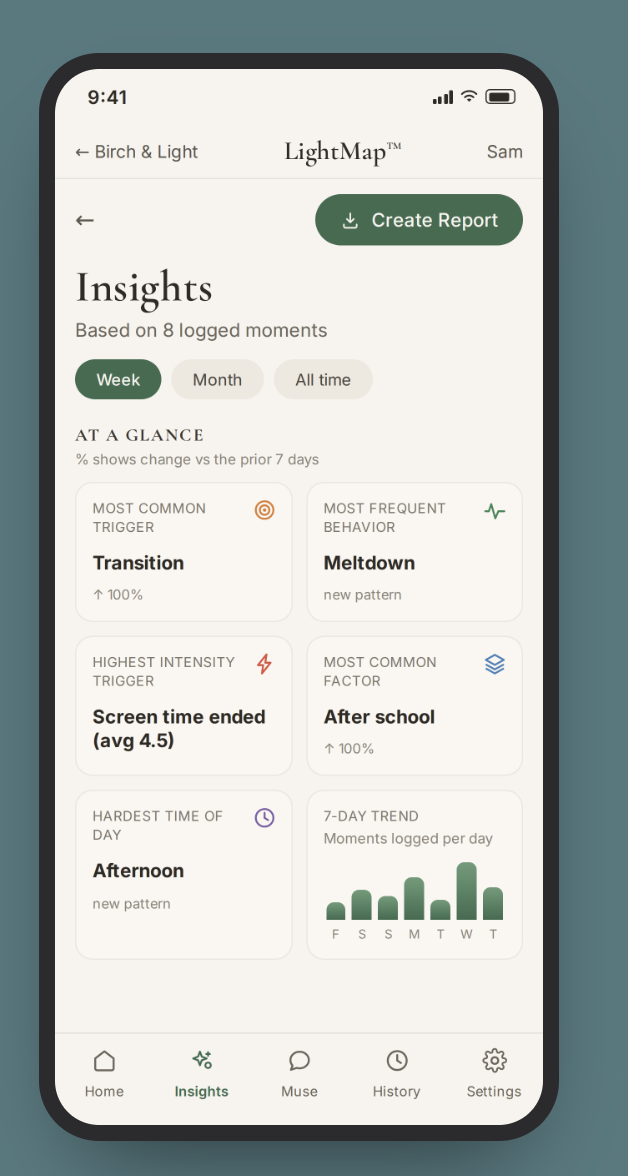

Part of the award-winning Birch & Light Method, honored with the Mom's Choice Gold Award for excellence in family resources.
A story to read together
Sometimes the easiest way in is a story you read side by side.
 The Mosquito Who Thought He Was a Dragonfly
Raised by dragonflies after a summer storm, Miro learns one night that the world sometimes sees him differently than the family who loves him — and that being misunderstood isn’t the same as being bad.
Read the story Otto Filled Everything
Otto can't stop filling things with water. His family doesn't understand — until Grandma Willow helps them listen to what his body is actually asking for.
Read the story
If today was one of those days
A few more from the library, free to read.
Researched and drafted with AI assistance, reviewed before publication. Editorial standards