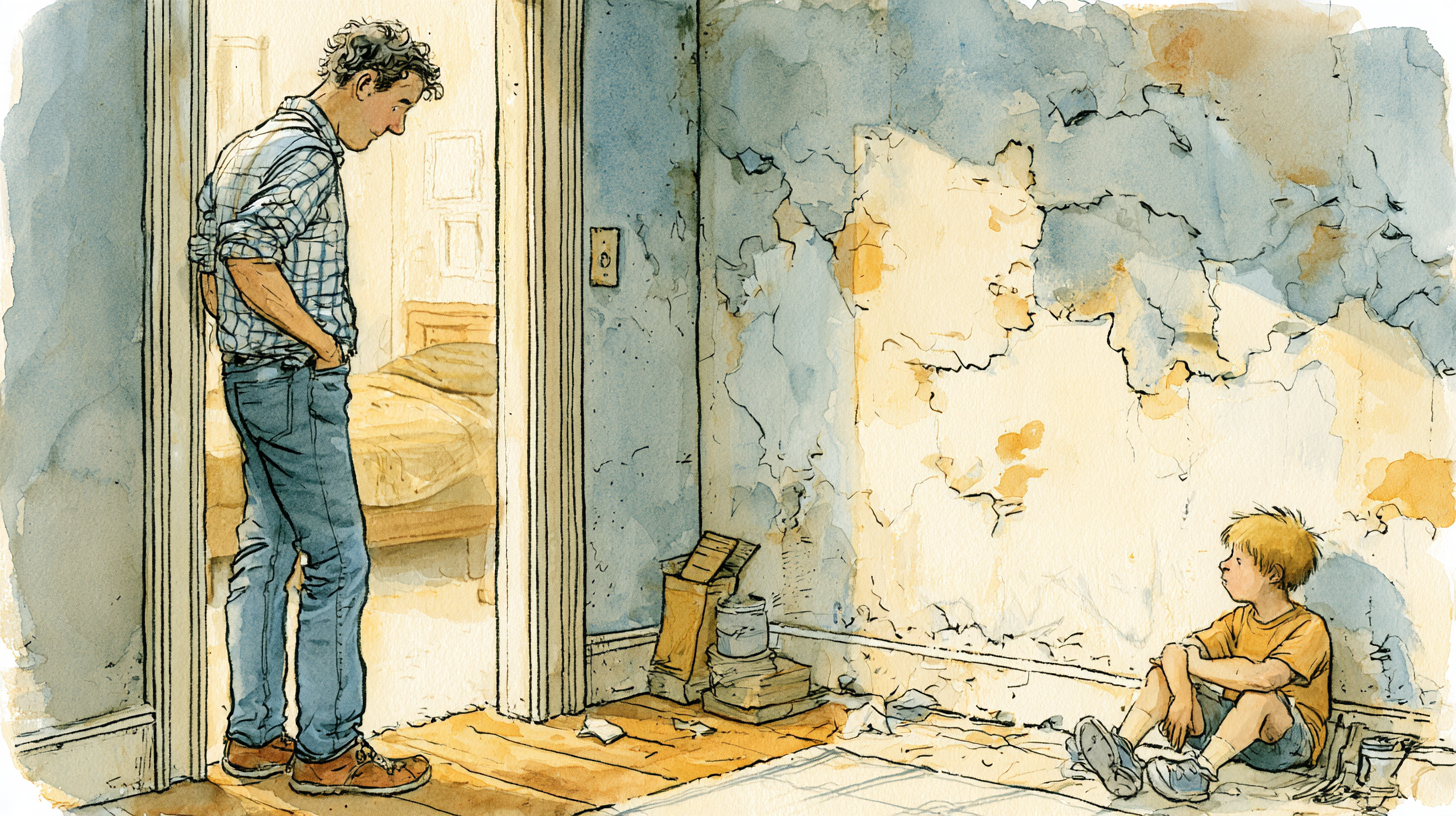
Young children usually do deliberate, strange things for ordinary reasons: they are running an experiment, copying something they saw, chasing a sensory feeling, fishing for connection, or acting before their brakes catch up. It is rarely malice. Find the driver, give it a safe yes, and keep your reaction flat.
This is a specific flavor of parenting bewilderment, and it deserves its own name. It is not the meltdown. It is not the tantrum. It is the calm, deliberate, almost experimental weirdness: putting something inedible in the food, doing strange things to the pets, pouring things out, small acts of sabotage that seem to come from nowhere and serve no obvious purpose. You stand there holding the ruined milk thinking, why on earth would she do this, and no explanation you can think of fits.
The good news is that there usually is an explanation, and it is almost never the frightening one that flashes through a parent's mind at 2am. Let us walk through what is actually going on, because once you can see the driver, you know what to do.
Is this a sign that something is wrong?
A young child doing these things is, in the overwhelming majority of cases, not a sign of something sinister. Deliberate, odd, boundary-pushing behavior is developmentally common in young kids, especially intense or neurodivergent ones, and it tends to come from fairly ordinary drivers wearing an alarming costume. The behavior looks calculated and cold, but the engine underneath is usually curiosity, testing, or a bid for something, not malice. Holding that frame is what lets you respond instead of panic.
Driver one: they are running an experiment
Young children are scientists, and their favorite branch of science is cause and effect. What happens if I pour this out. What does the cat do if I put it here. What face does mom make if the milk is wrong. To an adult these look like destruction. To a 6-year-old they can be pure investigation, with no real grasp yet of the cost, the waste, or the yuck factor that makes it obvious to us. Preschoolers in a 2007 study preferred to keep exploring a toy whose cause and effect was unclear over switching to a new toy, and most of them went on to test its parts one at a time.
The tell for this one: the behavior often comes with watching. They are studying the result, including your reaction, because your reaction is part of the experiment. It is not that they want to upset you exactly. It is that a big reaction is fascinating data.
Driver two: they saw it somewhere
This is such a common source that it is worth checking first. A huge amount of children's media, especially the prank and challenge genre of online video, models exactly this kind of behavior and frames it as funny, clever, and consequence-free. A child who watches someone doctor a drink for laughs and get a big reaction absorbs the script without absorbing the part where a real person feels tricked or an animal gets scared.
If your child has had access to that kind of content, it is often the single biggest lever you have. Cutting off the source and having a concrete conversation about what a prank actually does to the person on the other end can shift things faster than any consequence. Kids frequently do not connect the funny idea on the screen to the real result in the kitchen until an adult draws the line between them out loud.
Driver three: sensory and just plain interesting
Some of these behaviors are sensory at the root. Pouring, mixing, squishing, watching liquid move, the physical experience is genuinely satisfying to a nervous system that seeks that kind of input. The milk was not the target; the pouring was the point. For a sensory-seeking kid, "don't do that" without offering a yes-version of the same input (pour THIS, in the tub, at the water table) tends to fail, because the drive underneath is still unmet.
Driver four: it works to get something
Behavior that keeps happening is usually being fed by something. For a lot of kids, the fuel is connection, even negative connection. If the surest way to get a parent's full, focused attention is to do something outrageous, a child running low on connection will reliably reach for the outrageous thing. It is not manipulation in the cynical sense. It is a young nervous system discovering that this move reliably summons the parent, and using it.
The uncomfortable but useful question is not "how do I punish this" but "is she getting enough of me when she is NOT doing this." Often the behavior shrinks when the connection it was fishing for arrives before the sabotage, not after.
While you're here, take the guide
What's Underneath is free: the three body-state triggers under most meltdowns, what to say in the minute before it tips over, and how to reset afterward.

You'll get the guide instantly, plus five free articles in your inbox every week. Real challenges (meltdowns, school mornings, picky eating, big feelings) and how to actually handle them. Unsubscribe anytime.
Driver five: the impulse got ahead of the brakes
And sometimes an idea simply arrives and gets acted on before the part of the brain that would say "wait, no" comes online. In young kids, and especially in kids with ADHD or related profiles, the gap between having a thought and doing the thing is genuinely short. The result looks premeditated because it was specific, but there was no real deliberation, just an idea and a body that moved faster than judgment. Self-control, or response inhibition, is part of inhibitory control, one of three core executive functions in Adele Diamond's 2013 review, which also lists ADHD among the conditions where executive functions are impaired. This is where the nervous system beneath impulsivity is worth understanding, because the fix is about capacity, not character.
What helps when it keeps happening?
Stay boring. The single most useful move for experiment-and-attention driven behavior is to make your reaction as flat and undramatic as possible. Clean it up matter-of-factly, minimal words, minimal face. A behavior that stops producing a fascinating explosion loses much of its appeal.
Find and cut the model. If prank or challenge media is in the picture, address that directly and specifically, both the access and the understanding of what those pranks actually do to real people and animals.
Give the drive a yes. If it is sensory, offer the same input in an allowed form. If it is connection, front-load focused time before the behavior shows up. You are not rewarding the act; you are meeting the need it was clumsily reaching for.
Make repair concrete, not shaming. At this age, "you're bad" lands as shame and teaches nothing. "The cat got scared when you did that, so let's help him feel safe" connects the action to the real result, which is the actual lesson their developing empathy needs, delivered in a way a young brain can absorb.
Protect what needs protecting. None of this means the milk stays reachable. Practical prevention, moving the tempting targets out of range while you work on the underneath, is completely fair and reduces everyone's stress.
When should I look closer?
Most of this behavior is ordinary development in a loud costume. A few things are worth a conversation with a professional rather than riding out: behavior specifically aimed at hurting animals with apparent intent to cause pain, escalation that does not respond to any of the usual levers over time, or anything that comes with a level of distress or disconnection that feels different from garden-variety mischief. Trusting your gut here is reasonable; a pediatrician or child therapist can help you tell developmental weirdness from something that wants more support. If the behavior is mostly the everyday kind, though, take a breath, because a child pouring out the milk to see what happens is doing something very old and very normal, even when it is maddening.
This can be a stressful thing to sit with, and if it is wearing you down, talking it through with someone who understands can help.
Behavior that looks random rarely is, and the trigger usually sits hours earlier in the day. Logging the whole day in LightMap is how that connection surfaces.
For your child: Otto Filled Everything is about an otter who keeps filling things with water and being stopped, until someone notices when and why he does it and builds him a place to do it.
Sources: Functional behavior analysis literature on sensory and exploratory behavioral functions (Journal of Applied Behavior Analysis; PMC); peer-reviewed research on cause-and-effect exploration in early childhood (PMC); research on the development of inhibitory control (PMC). Schulz LE, Bonawitz EB, "Serious fun: Preschoolers engage in more exploratory play when evidence is confounded," Developmental Psychology, 2007, volume 43, issue 4. Diamond A, "Executive Functions," Annual Review of Psychology, 2013, volume 64, pages 135-168.
For education and reflection, not medical advice. Our terms
See what's underneath
Understand the why, not just the what
LightMap reads your hard days together and gives you answers. Start with one moment today.
Start with 3 moments Not sure where to start? Ask me.Message Tara on WhatsApp. It really is me, I read everything and will personally respond.Click here to message Tara →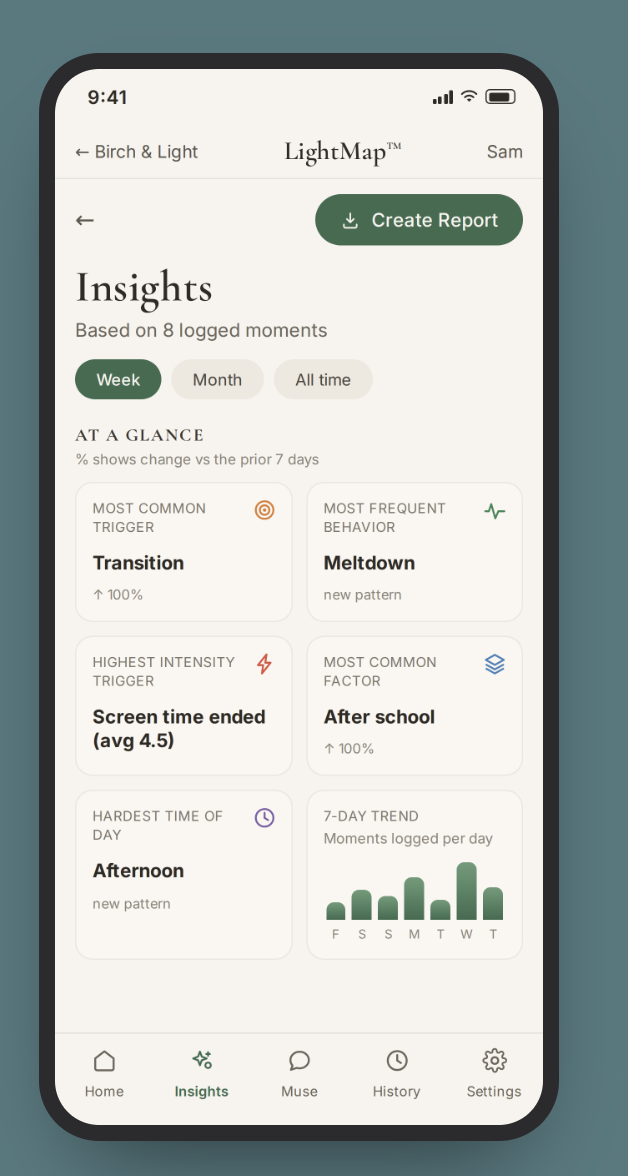

Part of the award-winning Birch & Light Method, honored with the Mom's Choice Gold Award for excellence in family resources.
A story to read together
Sometimes the easiest way in is a story you read side by side.
 Taste Bud 17
Taste Bud 17 feels everything more — and learns that big sensory feelings deserve the same care as everyone else’s.
Read the story The Mosquito Who Thought He Was a Dragonfly
Raised by dragonflies after a summer storm, Miro learns one night that the world sometimes sees him differently than the family who loves him — and that being misunderstood isn’t the same as being bad.
Read the story
If today was one of those days
A few more from the library, free to read.
Researched and drafted with AI assistance, reviewed before publication. Editorial standards