
A weighted blanket that quiets a bedtime tic. A vibrating pillow a child asks for every day. Firm pressure on the shoulders that seems to settle a neck tic. A buzzing device meant for a parent's sore back that a six-year-old adopts as his own and swears by.
If you spend any time in parent groups for tic disorders, Tourette's, or PANDAS, you have seen these stories. A parent stumbles onto some form of sensory input — pressure, vibration, rhythm, temperature — and their child's tics visibly change. The comments fill with two camps: parents saying "trying this tonight" and skeptics saying "that's not a treatment."
Here is the more interesting truth: both camps are missing something. The parents are noticing a real phenomenon. And the skeptics are right that one child's good afternoon doesn't prove anything. This article is about holding both of those at once — because the science here is genuinely fascinating, and the trap for parents is genuinely real.
The pattern parents keep reporting
Tics are not random muscle glitches. Most children with tics describe a premonitory urge — a building, itchy, pressure-like sensation that the tic briefly relieves, the way a sneeze relieves a tickle. Tics also respond to state: they surge with stress, excitement, fatigue, and illness, and they often quiet during absorbing activity, deep focus, or certain kinds of touch.
That last part is why sensory strategies keep surfacing in parent communities. Competing sensory input — deep pressure, vibration, rhythmic sensation — seems to change what the nervous system is attending to. Some children describe it as the urge getting quieter. Others just visibly settle. Occupational therapists have used versions of this for years with weighted lap pads, compression garments, and vibration tools, mostly on the strength of clinical observation rather than large trials.
Where the science has caught up
For a long time, "sensory tricks help my kid's tics" lived entirely in anecdote. That changed when researchers at the University of Nottingham began studying whether rhythmic electrical pulses delivered to a nerve at the wrist could influence the brain rhythms involved in suppressing movement.
The idea sounds almost too simple: stimulate the median nerve at the wrist with a steady rhythm, around ten pulses per second, and the sensorimotor cortex begins to echo that rhythm — a brain state associated with holding movement back. In their double-blind trial of 121 people with Tourette syndrome, the group receiving real stimulation saw tic frequency drop by more than a quarter while the device was running, and tic severity scores fall meaningfully over four weeks of daily ten-minute sessions, compared to people receiving sham stimulation. The work has since moved toward a wrist-worn device designed specifically for tic reduction.
Two things follow from this, and they point in opposite directions.
First: a child who finds relief in vibration or stimulation is not imagining it, and neither are you. There is a plausible neurological mechanism by which rhythmic sensory input changes tic expression. The parents noticing this were early, not wrong. It's worth reframing what the child is doing, too: a kid who reaches for the vibrating pillow isn't misbehaving or being dramatic — their nervous system is seeking regulation, and finding it. That's a competent body doing exactly what it should.
Second: the research tested a specific rhythm, at a specific nerve, at a specific intensity, in controlled conditions. A massage gun, a weighted blanket, or a drugstore muscle stimulator is not that. When a child finds relief from an improvised sensory tool, something real may be happening — sensory competition, relaxation, the comfort of a ritual that gives them agency over their own body — but it is a clue about your particular child, not a discovered treatment.
The trap: tics wax and wane, dramatically
Here is the part that trips up nearly every parent, and it has nothing to do with sensory input.
Tics naturally surge and fade in waves — over hours, days, and weeks. In post-infectious presentations like PANDAS, the swings can be extreme: a child thrashing at the peak of a flare may look dramatically better within days no matter what anyone does. And parents, being human, reach for new strategies at the worst moments. Which means almost anything tried at the peak of a wave will look like it worked, because the wave was about to break anyway.
This is not a reason to dismiss what you saw. It is a reason to check it. The difference between "this helps my child" and "this coincided with the wave receding" is not something you can feel your way to in the moment — memory compresses hard weeks and highlights turning points. The only way through is the boring one: observation over time.
While you're here, take the guide
What's Underneath is free: the three body-state triggers under most meltdowns, what to say in the minute before it tips over, and how to reset afterward.

You'll get the guide instantly, plus five free articles in your inbox every week. Real challenges (meltdowns, school mornings, picky eating, big feelings) and how to actually handle them. Unsubscribe anytime.
How to observe like a researcher (without turning your home into a lab)
You do not need equipment. You need a record. A few things worth noticing, briefly, each day:
- Baseline first. Before crediting any strategy, know what a normal week looks like — when tics spike, what precedes the spikes, how long waves last.
- Note the context, not just the tool. Was the sensory strategy used during calm or during a flare? After sleep or before it? During illness?
- Watch what happens when it's absent. If tics are just as quiet on days the strategy isn't used, the strategy may not be the variable.
- Track the child's own report. "It makes the feeling smaller" is meaningful data from a child old enough to say it.
- Give it weeks, not days. A pattern that survives two or three tic waves is worth taking seriously. One that only ever appears at wave-peaks probably isn't the strategy.
This is also exactly what makes a conversation with your child's clinician productive. "We tried X and it seemed to help" invites a shrug. "Over three weeks, tics dropped within minutes of using X on eleven of thirteen tries, including twice outside a flare" invites actual engagement — and lets the clinician weigh in on whether the specific tool is appropriate for your specific child, which is their call to make, not a Facebook thread's.
A word on safety, because the tools are physical
Device manufacturers and researchers are consistent on a few points worth knowing: electrical stimulation devices are not meant to be worn during sleep, are not placed on the head, the front of the neck, or across the chest, and carry their own contraindications listed in the manual. The research devices used in trials operate under protocols an over-the-counter unit doesn't replicate. None of that makes sensory strategies off-limits — pressure, vibration, and rhythm come in many low-tech forms — but anything involving electrical stimulation of a child belongs in a conversation with their clinician before it becomes a routine.
Where LightMap helps
Everything above comes down to one skill: separating a real pattern from a hopeful coincidence. That is precisely what LightMap is built for. Logging tic intensity, triggers, and what was tried — in seconds, in the moment — builds the record that memory can't: whether the strategy works outside of flares, whether waves are shortening, whether the "miracle" holds up across a month.
Every behavior is a clue.
If your child's tics surge and fade and you're trying to figure out what actually helps, LightMap can hold the pattern for you. Explore LightMap at birchandlight.com/lightmap.
Frequently asked questions
My child says a vibrating device makes the tic urge go away. Is that real?
Very possibly. Children with tics often describe a premonitory urge that competing sensory input seems to quiet, and research on rhythmic nerve stimulation suggests a genuine neurological basis for sensory input changing tic expression. What one child's experience can't tell you is whether the effect is the device, relaxation, ritual, or a tic wave receding on its own — that takes observation over time.
Should I buy the device I saw in a parent group?
Treat parent-group finds as hypotheses, not endorsements. Low-tech sensory strategies like deep pressure are reasonable to try and observe. Anything electrical warrants a conversation with your child's clinician first — both for safety and because they can tell you whether the specific approach makes sense for your specific child.
Why did something work amazingly during a flare and then stop working?
This is the classic wax-and-wane pattern. Tics surge and recede in waves, and strategies started at a wave's peak get credit for the wave breaking. If a strategy only ever "works" during flares and shows nothing during calm periods, the wave — not the strategy — may be doing the work. That's not failure; it's information.
Is there an actual evidence-based device for tics?
Wrist-worn rhythmic median nerve stimulation is the most developed version — it showed meaningful reductions in tic frequency and severity in a double-blind trial and is being developed into a consumer medical device. If your child's tics are significant, it's a reasonable thing to ask their clinician about by name, alongside established approaches like CBIT (Comprehensive Behavioral Intervention for Tics).
Sources: Peer-reviewed research on sensory tricks, or geste antagoniste, in tic disorders and dystonia (Movement Disorders; PMC); research on premonitory urges and competing responses in Tourette syndrome (PMC); research on deep pressure stimulation and arousal regulation (American Journal of Occupational Therapy; PMC); American Academy of Neurology practice guideline on the treatment of tics.
For education and reflection, not medical advice. Our terms
See what's underneath
Understand the why, not just the what
LightMap reads your hard days together and gives you answers. Start with one moment today.
Start with 3 moments Not sure where to start? Ask me.Message Tara on WhatsApp. It really is me, I read everything and will personally respond.Click here to message Tara →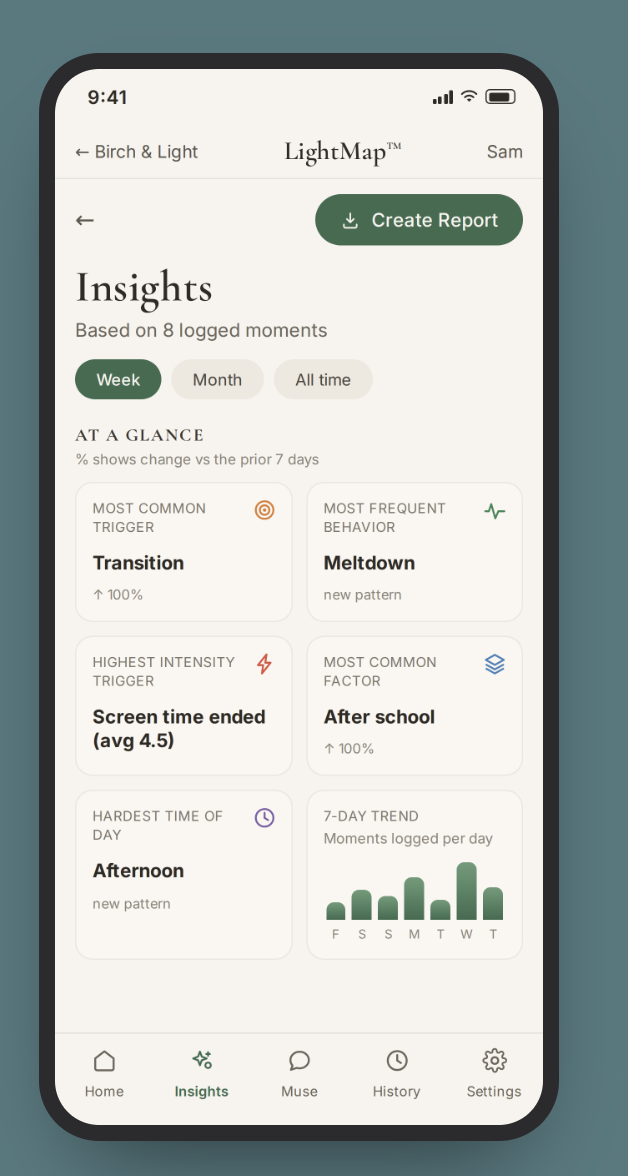

Part of the award-winning Birch & Light Method, honored with the Mom's Choice Gold Award for excellence in family resources.
A story to read together
Sometimes the easiest way in is a story you read side by side.
 The Mosquito Who Thought He Was a Dragonfly
Raised by dragonflies after a summer storm, Miro learns one night that the world sometimes sees him differently than the family who loves him — and that being misunderstood isn’t the same as being bad.
Read the story Otto Filled Everything
Otto can't stop filling things with water. His family doesn't understand — until Grandma Willow helps them listen to what his body is actually asking for.
Read the story
If today was one of those days
A few more from the library, free to read.
Researched and drafted with AI assistance, reviewed before publication. Editorial standards