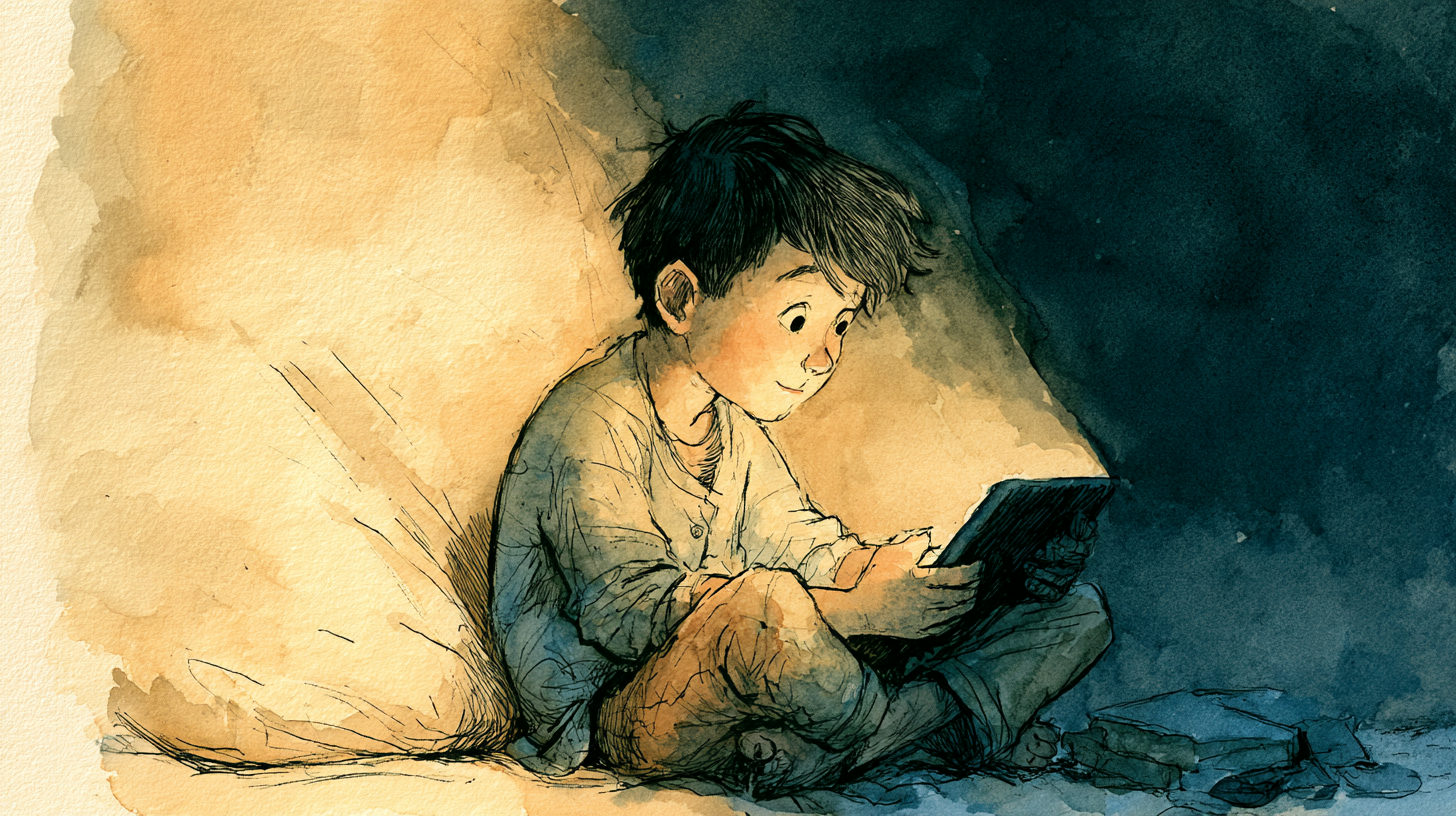
Neurodivergent kids are often drawn to horror because it makes feelings visible. Fear gets a face, the danger has edges, and the story ends. For some children it also supplies stimulation, clear emotional rules, or a safe place to rehearse worry. In many cases the pull is toward understanding, not fear.
Your child flinches at loud noises, melts down over a change in plans, and worries about things that haven't happened yet — and yet they can't get enough of horror movies, creepy stories, villains, monsters, or disaster footage. If that contradiction has ever made you pause, you're not alone, and you're not missing something obvious.
When a child who struggles with anxiety, emotional regulation, OCD, autism, ADHD, or PDA seeks out the very thing that seems most likely to frighten them, it's tempting to read it as a red flag. But the answer is usually more interesting — and more reassuring — than it looks.
In many cases, neurodivergent children aren't seeking fear at all. They're seeking understanding.
The Surprising Relationship Between Neurodivergence and Horror
Every child is different, and the research here is still emerging — much of what we know comes from the accounts of neurodivergent people themselves rather than large formal studies. But a striking number describe a lifelong pull toward horror that began in childhood, and the explanations that come up again and again have little to do with a love of being scared.
For some children, horror delivers intense stimulation and novelty. For others, it offers something real life rarely does: structure, predictability, and clear emotional rules. Some kids find genuine comfort in stories where the danger is visible and nameable rather than hidden and uncertain. What looks like a fascination with scary content is often a child's way of making sense of feelings they carry every single day.
ADHD and the Need for Stimulation
Some children with ADHD are drawn to high-intensity experiences. Horror is built almost entirely out of suspense, surprise, and anticipation — the exact ingredients that hold a restless brain's attention.
The constant shifts between tension and release, quiet and shock, can supply the level of stimulation that some ADHD brains are always quietly hunting for. A slow-building scene followed by a sudden jolt isn't unpleasant to that kind of nervous system; it's satisfying. This doesn't mean every child with ADHD enjoys scary movies, but it helps explain why, for many of them, the genre is so hard to look away from.
Autism and Predictable Emotional Worlds
Some autistic people describe horror in a way that surprises their neurotypical peers: they find it calming.
Social dramas can feel bewildering — full of unspoken rules, shifting motivations, and emotional subtext that's hard to decode in real time. Horror, by contrast, tends to lay everything out plainly. There's a threat. There's a mystery. There are clues, and there are consequences. The emotional landscape is often easier to read than an ordinary lunchroom.
It's also no accident that so many autistic kids gravitate toward the lore, world-building, and recurring patterns of horror franchises and supernatural stories. The structure is the appeal. When the rules are consistent, the world feels safe enough to explore.
Anxiety and the Appeal of Controlled Fear
Here's one of the most counterintuitive patterns: many anxious people report that they genuinely love horror.
Real anxiety is shapeless. Children worry about things they can't predict, can't see coming, and can't control. Horror takes that formless dread and gives it edges. The monster is visible. The danger has a source. The story has a beginning, a middle, and — crucially — an end.
Horror lets a person feel fear inside safe boundaries, with a guaranteed resolution waiting on the other side. For an anxious child, rehearsing fear with a known exit can feel less like distress and more like relief.
While you're here, take the guide
What's Underneath is free: the three body-state triggers under most meltdowns, what to say in the minute before it tips over, and how to reset afterward.
You'll get the guide instantly, plus five free articles in your inbox every week. Real challenges (meltdowns, school mornings, picky eating, big feelings) and how to actually handle them. Unsubscribe anytime.
Does Horror Help or Hurt a Child With OCD?
The relationship between OCD and horror is more complicated, and it cuts both ways.
Some children with OCD avoid scary content entirely, because it feeds intrusive thoughts and makes frightening loops louder. For them, horror is a clear no. Others find it strangely steadying — it externalizes the kind of disturbing ideas they already experience internally, and seeing those fears on a screen, happening to someone else, can make them feel less alone and less unspeakable. Which response a child has depends on their specific symptoms, triggers, and overall mental health, so this is one area where watching your individual child closely matters most.
Why Do Emotionally Intense Kids Love Dark Stories?
Many emotionally intense children are drawn to volcanoes, monsters, witches, dragons, natural disasters, and characters who can't quite contain their own enormous feelings. Parents often worry these stories are stirring something up. Usually it's the reverse.
These stories give a child language and imagery for feelings they already have but can't yet name. A child who feels explosive anger may see themselves in a dragon breathing fire. A child who feels misunderstood may connect with the monster everyone runs from. A child who fears rejection may recognize something true in the villain who was left out. The metaphor does what a lecture never could. It hands the child a mirror.
Horror as Emotional Translation
This is the heart of it. Dark fairy tales, spooky stories, and emotionally complex characters resonate with so many neurodivergent children because they translate invisible feelings into something a child can actually see. Fear becomes a monster. Anxiety becomes a storm. Anger becomes a volcano. Jealousy becomes a fire.
And once a feeling becomes visible — once it has a shape and a name and a face — it becomes something a child can finally start to understand, talk about, and live alongside.
When Should You Worry About Scary Content?
A fascination with scary things is not, on its own, a problem. For most kids, it's a healthy way of processing big emotions at a safe distance.
That said, it's worth paying attention if scary content consistently leads to nightmares, panic, sleep disruption, escalating intrusive thoughts, or distress that lingers long after the screen goes dark. The goal isn't to eliminate everything frightening from your child's world — it's to understand how your particular child responds, and to follow their lead. If the stories seem to soothe, they're probably doing exactly what your child needs. If they consistently overwhelm, that's useful information too.
The Bottom Line
Most neurodivergent children aren't drawn to horror because they like being scared. They're drawn to stories that reflect the intensity, confusion, and sheer size of the emotions they already carry inside — and that finally show those feelings somewhere outside their own body.
Sometimes the monster isn't the point at all. Sometimes a child just wants to see their own feelings represented on the screen, named at last, and survivable.
Every behavior is a clue.
This is the whole idea behind the Birch & Light stories: turning big, invisible feelings — anger, anxiety, jealousy, fear — into gentle watercolor metaphors a child can meet safely on the page. A volcano learning to cool. A witch who turns out to be misunderstood. A small light afraid of the dark. Because a child who can see their feelings can begin to understand them. Explore the stories at birchandlight.com.
If you are trying to work out where the line sits for your particular child, log what he watched and how the night went in LightMap. The answer arrives faster than the debate does.
Sources: Scrivner and colleagues on recreational fear and its regulatory function (Emotion; PMC); peer-reviewed research on intolerance of uncertainty and controlled exposure (PMC); research on horror engagement and anxiety in young people (PMC).
Primary sources: Andersen MM and colleagues, "Playing With Fear: A Field Study in Recreational Horror," Psychological Science, 2020, 31, 1497-1510. Scrivner C and colleagues, "Pandemic practice: Horror fans and morbidly curious individuals are more psychologically resilient during the COVID-19 pandemic," Personality and Individual Differences, 2021, 168, 110397.
For education and reflection, not medical advice. Our terms
See what's underneath
Understand the why, not just the what
LightMap reads your hard days together and gives you answers. Start with one moment today.
Start with 3 moments Not sure where to start? Ask me.Message Tara on WhatsApp. It really is me, I read everything and will personally respond.Click here to message Tara →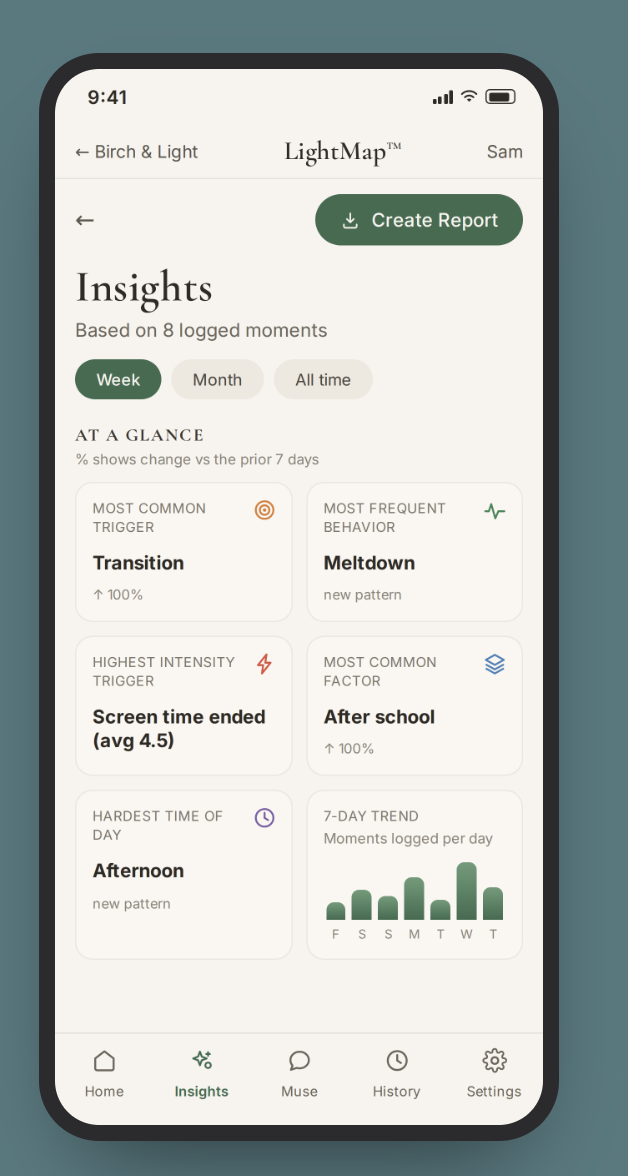
Part of the award-winning Birch & Light Method, honored with the Mom's Choice Gold Award for excellence in family resources.
A story to read together
Sometimes the easiest way in is a story you read side by side.
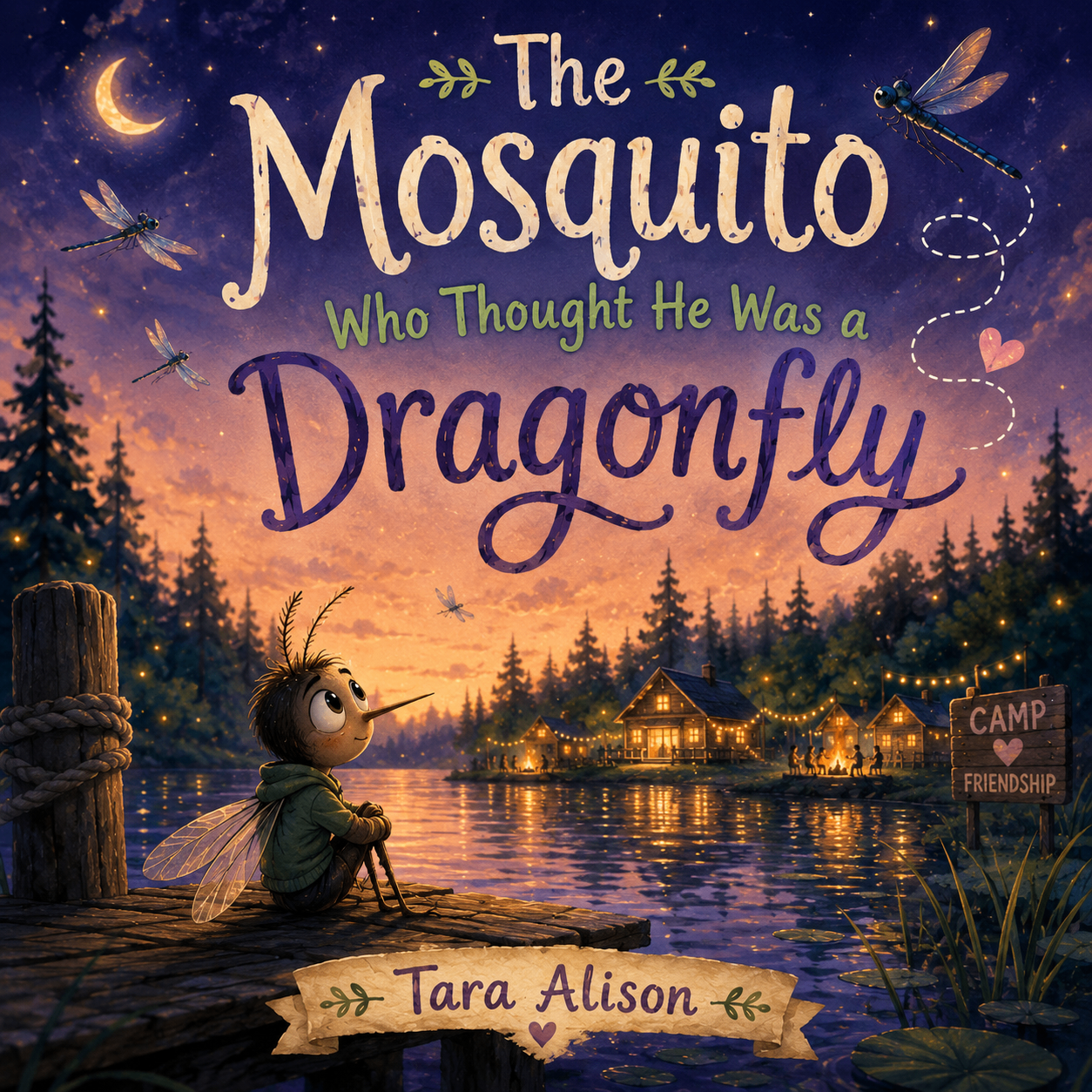 The Mosquito Who Thought He Was a Dragonfly
Raised by dragonflies after a summer storm, Miro learns one night that the world sometimes sees him differently than the family who loves him — and that being misunderstood isn’t the same as being bad.
Read the story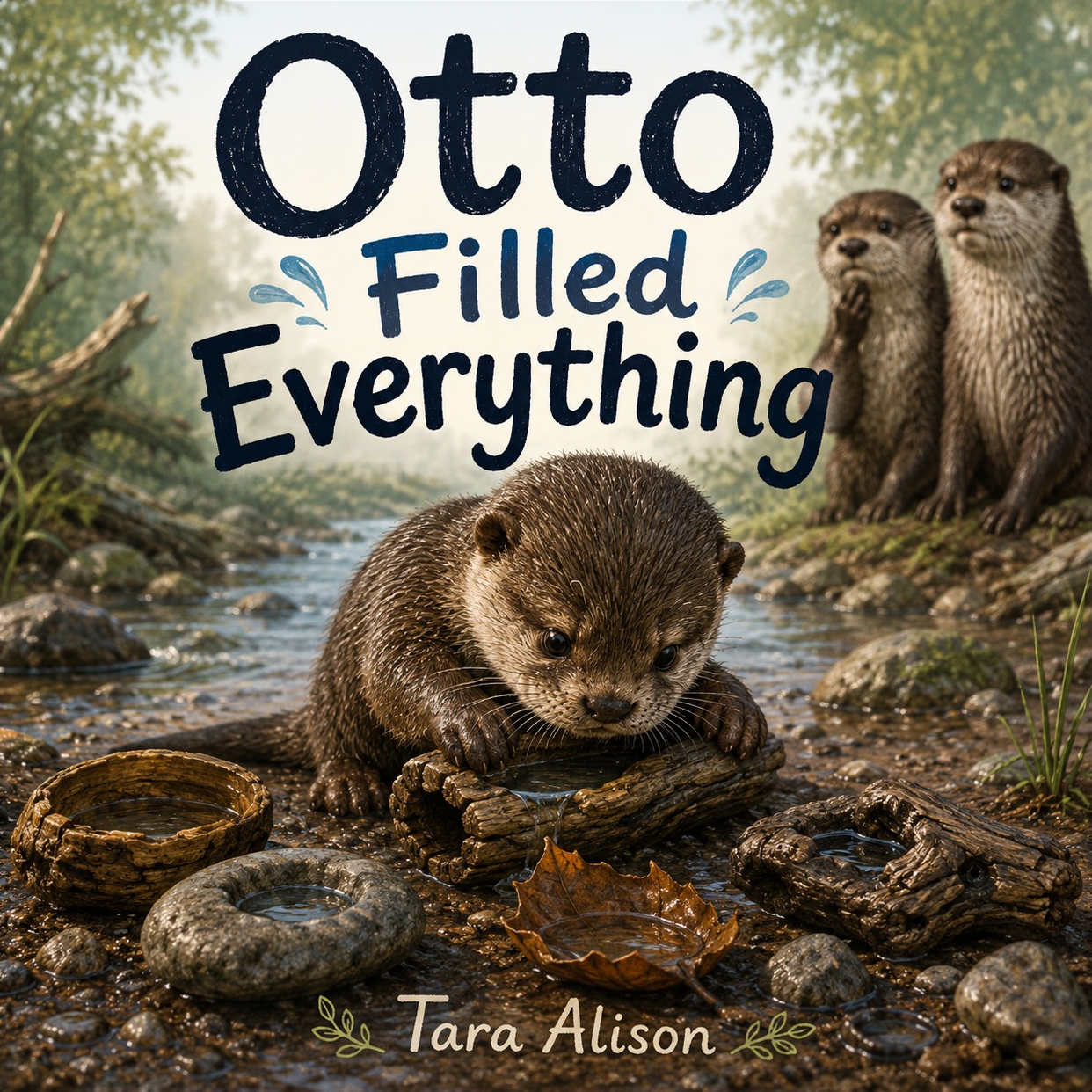 Otto Filled Everything
Otto can't stop filling things with water. His family doesn't understand — until Grandma Willow helps them listen to what his body is actually asking for.
Read the story
If today was one of those days
A few more from the library, free to read.
- NeurodivergenceWhy Sensory Input Sometimes Calms Tics: What Parents Notice and What Science Is Finding
- NeurodivergenceWhy Your Child Soils Every Day and What Actually Helps
- NeurodivergenceWhy Your Neurodivergent Child Is Wiped Out After School
- PANS/PANDASCan Antibiotics Make PANDAS Symptoms Worse at First?
Researched and drafted with AI assistance, reviewed before publication. Editorial standards