
Here is a strange gap in the system that nobody warns you about: getting an ADHD diagnosis and getting ADHD treated are two different doors, and they are not always in the same building. Plenty of families walk out of the evaluation with a confirmed diagnosis and then discover, months or years later, that no single professional actually owns their child's care. The primary care office defers. The therapist helps with one slice. And when things get harder, you realize you are not sure who you are even supposed to call.
So let us map the cast of characters, what each one actually does, and how to figure out which one your child needs right now. (Titles and systems vary by country. This is US-shaped, and none of it replaces your own clinicians' guidance.)
The provider types, translated
Pediatrician or family doctor. Some are comfortable managing ADHD, including medication if you ever go that route. Many are not, especially when the picture includes big emotions or overlapping anxiety. If yours has told you they do not treat ADHD, that is not a dead end. It is a referral request waiting to happen, and you are allowed to ask them directly: who do you send your ADHD patients to?
Child and adolescent psychiatrist. A medical doctor who specializes in exactly this territory: ADHD, anxiety, mood, and the messy places where they overlap. Two things parents often get wrong about psychiatrists. First, seeing one does not commit you to medication. They are the best diagnosticians in the system, and an appointment can simply be an expert second look. Second, they are most valuable precisely when the picture is complicated, when the original label does not seem to explain everything you are seeing anymore.
Psychiatric nurse practitioner (PMHNP). Often the fastest door into the same hallway. Many specialize in children and adolescents, can prescribe, and frequently have shorter waitlists than psychiatrists. Search the acronym PMHNP along with your state rather than searching for a psychiatrist, because that is how most directories index them, and filter for someone who sees children, since plenty of them work only with adults. Prescribing authority varies by state. In some states they practice independently, and in others they prescribe under an agreement with a collaborating physician. Either way they can prescribe, so the distinction rarely changes anything for you as a parent.
Physician assistant (PA). Physician assistants work inside pediatric and psychiatry practices, and ADHD stimulants are a controlled substance category where state rules genuinely vary, most states allow PAs to prescribe them under a supervising physician's practice agreement, but a handful, Texas among them, block PAs and nurse practitioners from prescribing this category to outpatients entirely. It is worth asking the practice directly rather than assuming either way, because a PA appointment is often available weeks sooner than one with the physician you were first offered, when it is an option where you live.
Developmental-behavioral pediatrician, also called a developmental pediatrician. A pediatrician with extra training in development and behavior. Excellent for whole-picture evaluations. The catch is notorious waitlists, sometimes six months or more, so if you want one, get on the list now and keep other supports running in the meantime.
Pediatric neurologist. A medical doctor for the brain and nervous system. Some do diagnose and manage ADHD, but their real value is when something neurological is tangled into the picture: tics, staring spells, suspected seizures, chronic headaches, or sleep problems that will not resolve. If none of that applies, a neurologist is usually not the best owner of ADHD care, because the emotional and behavioral side of things is not their home turf.
Neuropsychologist. A psychologist with advanced training in how the brain affects learning and behavior, and the person behind the deep-dive testing you hear other parents mention. A full neuropsychological evaluation maps attention, memory, processing speed, executive function, and learning differences over several hours of testing. It is the gold standard when you suspect ADHD is not the whole story, or when school decisions need hard data behind them. Two honest caveats: it is expensive, insurance coverage is inconsistent, and you leave with a detailed report and recommendations rather than ongoing treatment. Testing is a map, not a driver.
Psychologist. Does formal testing and therapy. Cannot prescribe in most states. If you want a deeper evaluation or structured therapy, this is the person. If you want someone to quarterback the medical side, it is not.
Occupational therapist. Often overlooked in ADHD conversations and quietly one of the most useful people on the team, especially for kids whose struggles are as much about sensory overload and body regulation as attention. OTs work on the nuts and bolts: managing big physical energy, sensory triggers, transitions, and the daily routines that keep falling apart. If your child's hardest moments look like a nervous system problem rather than a focus problem, an OT evaluation is worth its weight.
Therapist or counselor. Valuable for skills, emotional regulation work, and family dynamics. But therapy quality varies enormously with fit, and a string of therapists who each helped a little is one of the most common stories in ADHD care. If therapy alone has not moved things, that is information, not failure.
While you're here, take the guide
What's Underneath is free: the three body-state triggers under most meltdowns, what to say in the minute before it tips over, and how to reset afterward.

You'll get the guide instantly, plus five free articles in your inbox every week. Real challenges (meltdowns, school mornings, picky eating, big feelings) and how to actually handle them. Unsubscribe anytime.
Managing without medication is a real plan, but it still needs a team
Choosing not to medicate does not mean choosing not to treat. The strongest evidence-based non-medication tool for school-age kids is not something done to the child at all. It is parent behavior training: structured programs (look for names like Parent-Child Interaction Therapy, Parent Management Training, or the Kazdin method) that change the patterns around the child. Add a therapist who actually specializes in ADHD rather than general talk therapy, consistent sleep and movement, and school supports, and you have a legitimate treatment plan with no prescription in it.
The mistake is not skipping medication. The mistake is letting no-medication quietly become no-clinician.
Do not skip the medical question
One more route that deserves a mention, especially when symptoms appeared suddenly or a child's baseline changed dramatically rather than gradually: sometimes behavior has a body-based driver, and no amount of therapy or coaching fixes what a workup would find. Worth ruling out with your doctor: sleep problems including apnea, iron deficiency, thyroid issues, and vision or hearing gaps.
Beyond the basics, some families end up in more specialized territory. If a child's personality or behavior shifted abruptly, particularly after an illness, PANS and PANDAS are worth learning about, and clinicians who specialize in them will run the infectious and immune testing a standard visit will not. An immunologist can be part of that same picture. In tick-endemic regions, parents also ask about Lyme, and you will encounter the term Lyme-literate doctor in these circles. Go in informed: this is a genuinely polarized corner of medicine, so look for clinicians who rely on testing and evidence rather than diagnosing from symptom checklists alone. The point is not that every struggling kid has an underlying infection. It is that a sudden, unexplained change is a medical question before it is a behavioral one.
When it is time to level up
Watch for these signals that your current setup is outgrown:
- Emotional storms are getting bigger, not smaller, and the strategies that used to work have stopped working
- Conflict has become the family's default weather
- You are starting to suspect the original diagnosis is not the whole story
- Therapy has been steady for months without real traction
- You, the parent, are running on fumes
Any one of these is a reason to get a child psychiatrist or psychiatric NP into the picture, even if your position on medication has not changed. What you are buying is expertise and a fresh set of trained eyes, not a prescription pad.
How to actually find the person
Ask your pediatrician for their specific referral list, even if they do not treat ADHD themselves. Call your insurance for in-network child psychiatry and ask about telehealth, which has quietly become one of the best ways around geography and waitlists. Check the nearest children's hospital, which usually has a developmental or behavioral health department. And when you get a waitlist quote that makes your stomach drop, take the spot anyway. You can always cancel, and slots open constantly.
A word about cost
Some of these doors are expensive, so two things worth knowing. First, if a university near you has a psychology doctoral program, its training clinic likely offers full neuropsychological testing at a fraction of private rates, supervised by licensed faculty. Quality is genuinely good and waitlists are often shorter. Second, the school evaluation route is free and can run alongside anything medical, and we have walked through exactly how that works in our guide to getting an ADHD diagnosis.
What the right team usually looks like
For most families it is two people, not one. A prescriber-capable clinician (psychiatrist, psychiatric NP, or a genuinely engaged pediatrician) who owns the medical picture and sees the whole child, plus a skills person (therapist or psychologist) doing the week-to-week work, ideally with you in the room for part of it. The prescriber does not have to prescribe anything. They just have to be the person who knows your kid's full story, so that when things shift, and they always eventually shift, you are adjusting a plan instead of starting a search.
Whoever ends up managing his care will ask what has changed since the last visit. Logging it in LightMap between appointments means you are adjusting a plan from a record rather than from memory.
Sources: American Academy of Pediatrics Clinical Practice Guideline for ADHD (2019); state medical board regulations on physician assistant and nurse practitioner controlled substance prescribing authority.
For education and reflection, not medical advice. Our terms
See what's underneath
Walk into the next appointment with answers
LightMap reads your hard days together and gives you answers. Start with one moment today.
Start with 3 moments Not sure where to start? Ask me.Message Tara on WhatsApp. It really is me, I read everything and will personally respond.Click here to message Tara →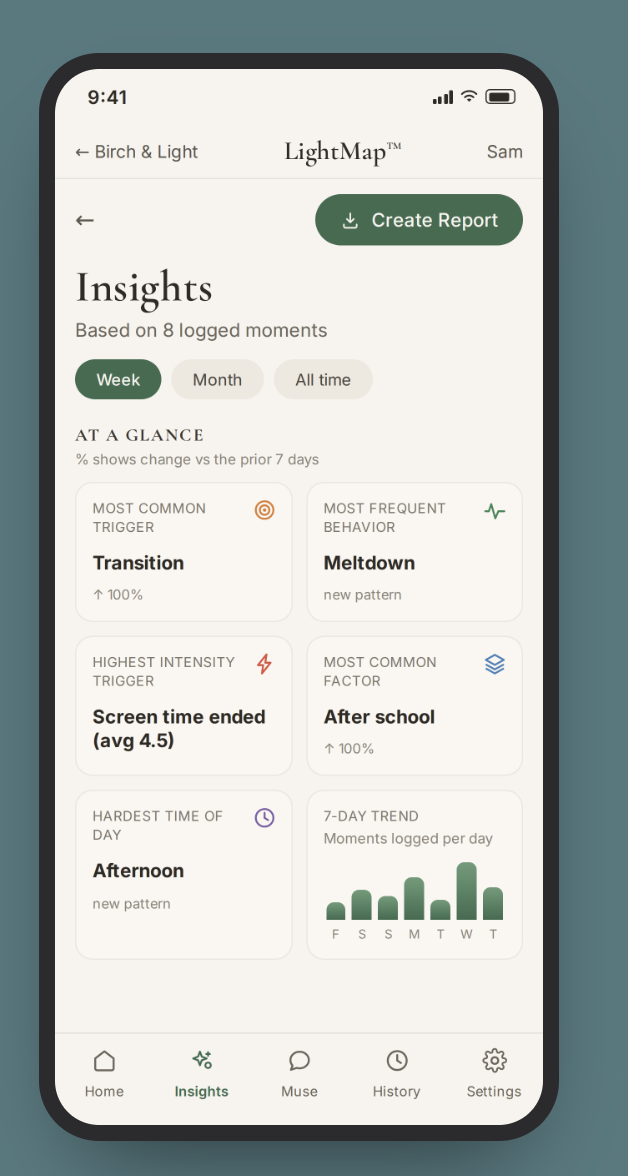

Part of the award-winning Birch & Light Method, honored with the Mom's Choice Gold Award for excellence in family resources.
A story to read together
Sometimes the easiest way in is a story you read side by side.
 Taste Bud 17
Taste Bud 17 feels everything more — and learns that big sensory feelings deserve the same care as everyone else’s.
Read the story Otto Filled Everything
Otto can't stop filling things with water. His family doesn't understand — until Grandma Willow helps them listen to what his body is actually asking for.
Read the story
If today was one of those days
A few more from the library, free to read.
Researched and drafted with AI assistance, reviewed before publication. Editorial standards