
You can feel it coming from the moment she wakes up. Site change day. By mid afternoon you are negotiating, then bargaining, then following her from room to room while a two minute task swallows the whole evening. The supplies sit open on the counter like an accusation. By the time it is done, both of you are wrung out, and tomorrow the countdown to the next one begins.
If this is your house right now, you are not doing it wrong and your child is not being dramatic. Site changes sit at the intersection of pain, fear, and control, which is about the hardest place a parenting task can live. Here is what is going on underneath the refusal, and what tends to make it easier.
Why a two minute task takes two hours
Three things are usually stacked on top of each other.
The first is real pain memory. Insertions are usually fine, until one is not. A cannula that hits a nerve or a bad angle hurts, and a child's brain does what brains are built to do with pain: it generalizes. One bad insertion out of twenty does not register as five percent. It registers as proof that this can hurt, which means every insertion is now a threat until proven otherwise.
The second is anticipatory anxiety, which is often worse than the insertion itself. The waiting, the wondering, the watching you get the supplies out. For many kids the dread costs more than the needle. This is why the refusal often starts hours before you have touched anything.
The third is control. Your child did not choose this condition, does not get a vote on whether devices happen, and lives in a body that adults are constantly monitoring, measuring, and puncturing. Site change is one of the few moments where saying no produces a visible result. Refusal is not defiance. It is a child grabbing the only lever available.
The trap most of us fall into
When you are exhausted and the pod is expired and insulin delivery is on the line, force starts to look reasonable. Hold her still, get it done, everyone recovers. And sometimes, in a true emergency, you will have to prioritize the medical need. But as a routine strategy, overpowering a frightened child teaches her nervous system that site changes are something done to her while she is helpless. That lesson makes the next one harder, and the one after that. You win the change and lose the war.
Escalating bribes has a similar shape. There is nothing wrong with a treat or a small celebration. The trouble starts when each change requires a bigger payout than the last, because the payment confirms the story that this is an ordeal worth being paid for.
Give back every ounce of control you can
The change itself is not optional. Almost everything around it can be. This distinction is the backbone of the whole approach: hold the line on the what, hand over the when, where, and how.
Let her choose the site from the approved rotation. The room. The chair or the couch. Whether she watches or looks away. Whether she presses the button herself, or counts down, or holds the used pod afterward and throws it away with ceremony. Whether it happens before dinner or after the show. Some families keep a small written menu of these choices so the child can see the control she has instead of only feeling the control she lacks.
For kids who need more, consider handing over real jobs: she peels the backing, she cleans the site, she runs the countdown. A child who is directing the procedure has far less need to fight it.
Make it boring
Fear feeds on unpredictability. The goal is a site change so routine it becomes almost dull. Same day, same time, same order of steps, every time. Some families post the steps as a short visual list and check them off together, which moves the child's attention from what might happen to what comes next. Others tie the change to something fixed and pleasant, so the sequence always ends the same way: change, then the show, or change, then the special snack. The ritual does the emotional work so you do not have to.
A gentle technique for the insertion itself
In our house, my husband landed on this through trial and error, and it made a real difference. The idea is to give the cannula a soft cushion of skin instead of a tense surface, and to keep the site lifted away from the muscle.
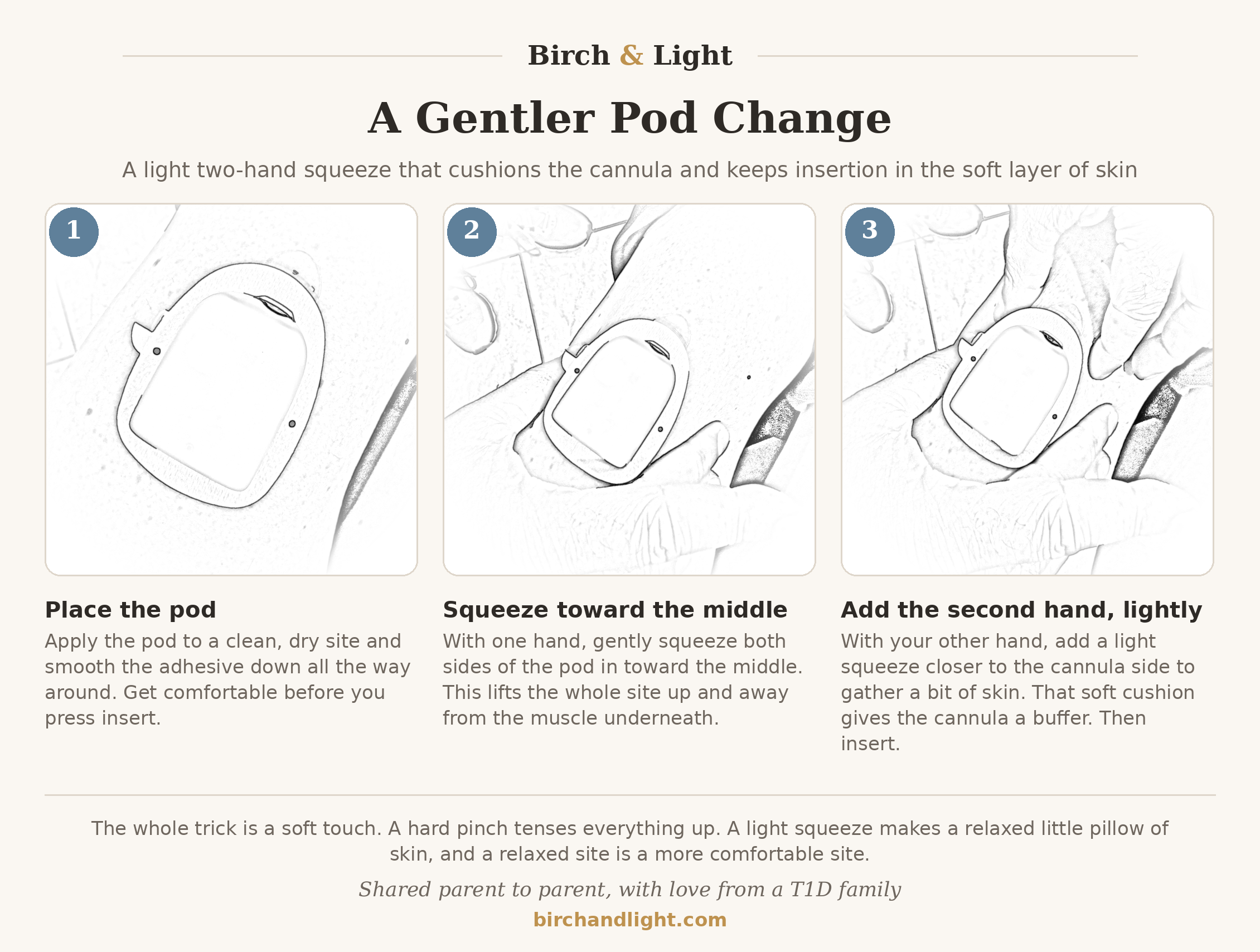
Step one, place the pod. Apply it to a clean, dry site, smooth the adhesive down all the way around, and get comfortable before you press insert.
Step two, squeeze toward the middle. With one hand, gently squeeze both sides of the pod in toward the middle. This lifts the whole site up and away from the muscle underneath.
Step three, add the second hand, lightly. With your other hand, add a light squeeze closer to the cannula side to gather a bit of skin. Then insert.
The key word is light. A hard pinch tenses everything up. A light squeeze makes a relaxed little pillow of skin, and a relaxed site is a more comfortable site. We use a pod, but the same idea carries over to most insertion devices.
Comfort tools worth asking about
Your care team can walk you through options like numbing creams, a brief ice pack over the site beforehand, and small vibration tools designed to compete with the pain signal. None of these is magic on its own. Their real value is often psychological: they give a frightened child evidence that the adults are taking her pain seriously and actively working to reduce it. That evidence buys cooperation that no amount of reassurance can.
Distraction still earns its keep too. A show she only gets during site changes, a game on your phone, a conversation she has to concentrate on. The brain is bad at fully attending to two things at once, and you can use that.
When an insertion goes wrong
If a site hits a nerve or a change goes badly, expect a setback, and name what happened instead of minimizing it. That one really hurt, and it makes sense that you are scared of the next one. Most were fine, and one was not, and your body remembered the bad one. Kids trust adults who tell the truth about pain far more than adults who insist it was not that bad.
Then rebuild slowly. Extra choices, extra ritual, extra patience for a few changes in a row. Trust that was lost in one moment comes back in installments, not all at once.
Your nervous system is half of this
Kids read us before we say a word. If site change day fills you with dread, she knows, and your dread confirms hers. This is not a reason to feel guilty. It is a reason to take care of your own state before you pick up the supplies. A slower breath, a calmer voice, a decision that you have time and this can take as long as it takes. A parent who is not braced for battle is the strongest signal a child can receive that there is no battle coming.
And if site changes have been swallowing your evenings for weeks, be gentle with yourself too. This is one of the genuinely hard parts of raising a child with a device on her body. The fear does fade for most kids, especially once a stretch of calm, uneventful changes rebuilds the record. You are not failing because it is hard right now. You are in the hard chapter, and hard chapters end.
Sources: Association of Child Life Professionals; peer-reviewed research on pediatric procedural pain, anticipatory anxiety, and control in medical settings.
For education and reflection, not medical advice. Our terms
See what's underneath
See the pattern behind the hard days
LightMap turns scattered hard days into a pattern you can see. Start by logging one moment tonight.
Log today's hard moment, no account needed Not sure where to start? Ask me.Message Tara on WhatsApp. It really is me, I read everything and will personally respond.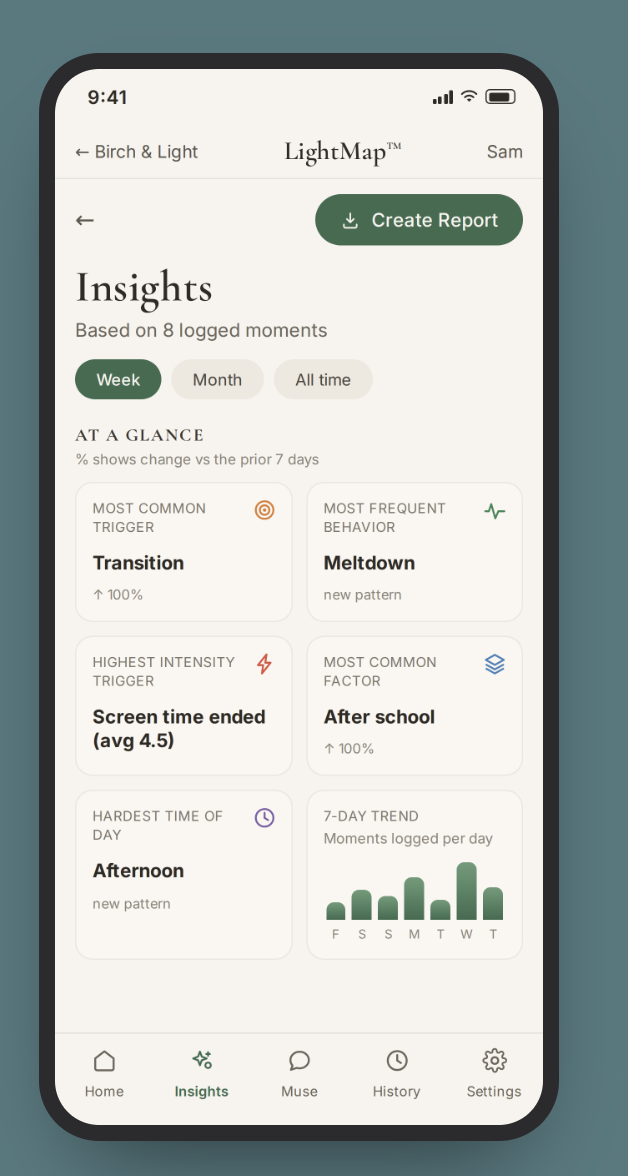

Part of the award-winning Birch & Light Method, honored with the Mom's Choice Gold Award for excellence in family resources.
Before you go, grab the free guide
The 3 body-state triggers under most meltdowns, a script for the moment before it tips over, and a reset for after. Free.

You'll get the guide instantly, plus five free articles in your inbox every week. Real challenges (meltdowns, school mornings, picky eating, big feelings) and how to actually handle them. Unsubscribe anytime.
A story to read together
Sometimes the easiest way in is a story you read side by side.
 June on the Blacktop
On a sunny gym day, June’s body sends a small alarm — and she learns that pausing for what she needs is not the same as quitting.
Read the story June and the Window That Took Time
When June receives special Valentine’s Day window clings from Grandma, she learns that some things take time, help, and persistence.
Read the story
Researched and drafted with AI assistance, reviewed before publication. Editorial standards