
In New Jersey, the public school district where the private school building sits must provide nursing services to students enrolled there under Chapter 226, funded by the state. It buys a shared school nurse, not a one to one aide. Call that district first, then ask the school whether it requested the service.
A private school that has been handling your child's type 1 diabetes without much fuss tells you it can no longer do it. Sometimes the reason given is staffing. Sometimes it is liability. Sometimes it arrives as a suggestion that a different school might be a better fit.
Nothing about your child's diabetes has changed. What usually changed is that somebody read the rules, or the one staff member who had been quietly covering it moved on, or an insurer asked a question nobody had asked before. Whether it lands before the year starts or halfway through it, the position it puts you in is the same, and it is one the system is remarkably bad at explaining a way out of.
This is an orientation to a system almost nobody explains to parents until they are already inside it. It reflects our best research at the time of writing and it is not guaranteed. Statutes, regulations, funding levels and agency practice all change, districts interpret the same rules differently, and none of this is legal or medical advice. Your own attorney, your endocrinologist and your district are the ones who know your specifics. Treat it as a map of what exists, what does not, and which phone calls have something behind them, and verify anything you are about to rely on.
Why is the school saying no?
In New Jersey, the reason is almost always the same, and it has very little to do with willingness.
Two different rules are doing the work here, and parents get told about neither.
The first governs public districts. N.J.A.C. 6A:16-2.1 lists who may administer medication in a district school: the school physician, a certified or noncertified nurse, a substitute school nurse employed by the district, the student's parent, and a student approved to self-administer.
There are two delegate carve-outs and only two. Trained volunteers may give epinephrine, and trained volunteers may give glucagon under N.J.S.A. 18A:40-12.14, a statute that says plainly that doing so does not constitute the practice of nursing. Insulin appears in neither carve-out.
The second is what actually reaches a private school, which is not bound by the district regulation at all. Administering insulin is a nursing act under state licensing law, and the only reason a trained non-nurse can push glucagon is that the Legislature wrote a specific exemption for it. No such exemption exists for insulin. The American Diabetes Association's state summary answers the question in one word: asked whether New Jersey allows non-health-care school staff to administer insulin, the answer is no.
So a school with no nurse, or a nurse two days a week, is looking at a child who needs someone to read a CGM, count carbohydrates, decide on a correction and deliver insulin, and it is looking at a job that a licensed person has to do. The school is not being asked for goodwill. It is being asked to put a nurse in the building, which it can absolutely do by hiring or contracting one, and which costs money it has not budgeted.
Understanding this changes what you ask for. You stop asking the school to be more accommodating and start asking who is going to fund a nurse.
The hard part: the laws you assume you have
Most parents arrive at this problem holding three legal ideas, and at a religious private school all three may be weaker than expected. Check each one before you spend a week building a case on it.
Section 504 of the Rehabilitation Act reaches programs and activities that receive federal financial assistance. Public districts are covered. Private schools are covered only if they take federal money, and the U.S. Department of Education says outright that some private schools receive none, in which case Section 504 does not apply to them. This is a factual question about your specific school, not a philosophical one, and it is answerable. Ask the school directly, in writing, whether it receives federal financial assistance.
The Americans with Disabilities Act has a religious exemption written into the statute at 42 U.S.C. 12187. Title III does not apply to religious organizations or entities controlled by religious organizations. The Department of Justice has been blunt about its breadth: if a church or a diocese operates a school, that school's operations are not subject to Title III, and the exemption covers all of the school's activities, religious and secular alike.
The test is whether a religious organization actually operates or controls the school, not whether the school describes itself as religious, and the Department has found schools with religious character but independent governance to be outside the exemption and therefore covered. A parish or diocesan school is very likely exempt. A school with a religious name and an ordinary independent board may not be.
The New Jersey Law Against Discrimination closes the same door at the state level. The LAD's public accommodation provisions carry an explicit carve-out: nothing in the act applies to any educational facility operated or maintained by a bona fide religious or sectarian institution. New Jersey's own Division on Civil Rights materials state it in those terms.
None of that means your child has no options. It means the leverage is not going to come from a demand letter to the school, and finding that out in week one instead of week six saves you the only resource you actually have. The leverage is somewhere else.
What does New Jersey give you under Chapter 226?
Here is the piece almost nobody tells parents about.
Under N.J.S.A. 18A:40-23 and following, known as Chapter 226, the public school district in which a nonpublic school is located is required to provide nursing services to students enrolled full time in that nonpublic school. Not the district where you live. The district where the school building physically sits. If the school is in a different town from the one you live in, the district that owns that obligation is the one the building is in, and parents lose weeks calling the wrong one.
The Legislature said the point out loud in the statute itself: all school age children should be assured equal access to appropriate health care services, in both public and nonpublic schools.
A few mechanics that matter when you make the call.
It is state funded, not funded out of the district's own budget. The Department of Education allocates money to the district for this purpose, and the district has to report annually to the county superintendent on how the funds were distributed and what services were delivered. That matters because the first instinct of a district administrator hearing a new request is to protect a budget, and this one is not coming out of theirs.
Services are delivered by a licensed registered nurse, who may be a district employee, a third party contractor, or an independent contractor. Districts routinely contract this out to educational services commissions, which is why the nurse in a parochial school is often not a district employee at all.
There is a required annual consultation between the district and the nonpublic school, and it exists specifically to agree on the basic health services to be provided and on any additional medical services, equipment, or supplies. That phrase is the opening. A student who needs insulin coverage during the school day is a health service need, and the consultation is the forum where it gets named.
If the district and the school cannot agree, the county office of education is written into the process to assist. Beyond that, the Department of Education maintains a Nonpublic School State Program Complaint Resolution Process, with a form, covering the state funded nonpublic programs. Two named escalation routes for a program most parents have never heard of.
Now the honest limits, because you should not walk into this expecting a dedicated nurse at your child's side.
Chapter 226 typically buys a nurse assigned to a school on a schedule, sometimes part of a week, shared across a building. It is not designed as one to one coverage, and the allocation is not calibrated to any single child's medical need. It also cannot include instructional services. And there is one provision that stings: a nonpublic school is permitted to decline the nursing services offered under the program. If your school has declined them, or has never requested them, that is the thing to find out first, and it is the thing to push on.
Can you make them do it?
This is the question the whole thing turns on, and the honest answer is a qualified no.
Chapter 226 creates a duty running from the district to the nonpublic school as a program. It is not an individual entitlement to a nurse for your child. There is no equivalent of an IEP here, no due process hearing, no stay put. The district owes nursing services to that school's students. It does not owe your child a dedicated adult, and nothing in the statute says the level of service has to match the level of one child's medical need.
The funding shape reinforces that. The Department allocates an amount to the district for nonpublic health services, and the district reports on how it distributed those funds among the nonpublic schools in its boundaries. It is an allocation to be divided, not a benefit that scales when one family's needs grow.
So what can you actually move?
You can make sure the school has requested the services rather than declined them, which is the single most common failure point. You can make sure diabetes coverage is named in the annual consultation, where the district and the school agree on the basic health services plus any additional medical services, equipment or supplies. The consultation rule contemplates meaningful consultation with nonpublic school representatives including parents before changes to nursing services, so ask to be part of it rather than assuming you have no standing. You can escalate to the county office of education when the district and the school disagree, and you can file through the Department's nonpublic program complaint process if the district is not delivering what the program requires.
What that realistically produces is a nurse in the building more of the week than there is now, or a nurse assigned who is trained on your child's plan, or a school that stops saying it has no options because it has learned it has a funded one. It may well not produce all-day coverage. Go in wanting the door opened, not the whole building.
And plan in parallel. Work the insurance question and keep a public school seat available at the same time. Everything in this article is a route that might work, and none of it is a route you can compel on a timeline.
Where does the nurse actually come from?
Not from the private school, and usually not from the district's own staff either.
Under the regulation, services are provided by a registered nurse licensed by the New Jersey Board of Nursing who is a district employee, a third party contractor, or an independent contractor. Districts may also contract with other districts, or with a public or private agency approved by the Commissioner.
In practice most districts contract it out, and two kinds of organizations do the work. Educational services commissions, the county level public agencies that already run shared services for districts, staff a large share of nonpublic school nursing in New Jersey. Nursing agencies fill the rest, and the Department of Education publishes an Approved Clinics and Agencies Directory that districts use to find them. There is also a sample vendor evaluation rubric published for exactly this purpose, which tells you how routine this contracting is.
This is useful to know because it changes the tone of the conversation. You are not asking a school to invent a position. You are asking a district to add hours to a contract it already holds with an agency that already sends nurses into parochial and independent schools every week.
While you're here, take the guide
What's Underneath is free: the three body-state triggers under most meltdowns, what to say in the minute before it tips over, and how to reset afterward.

You'll get the guide instantly, plus five free articles in your inbox every week. Real challenges (meltdowns, school mornings, picky eating, big feelings) and how to actually handle them. Unsubscribe anytime.
Chapter 192 and Chapter 193, and what they are not
You will see these two cited constantly in nonpublic school conversations, so it helps to know what they hold.
Chapter 192 covers auxiliary services: compensatory education in math and language arts, English language learning, and home instruction. Chapter 193 covers remedial services: evaluation and determination of eligibility for special education, supplemental instruction, and speech and language services. Both run through the district in which the nonpublic school is located, both require parent consent, and both are instructional programs.
Neither one produces a health aide or a nurse. Do not spend your two weeks here expecting one.
Two things in them are still useful. The evaluation piece of Chapter 193 gets your child assessed at public expense while staying at the same school, which produces an Individualized Service Plan if the child qualifies. Type 1 diabetes on its own frequently does not qualify a child for special education, because eligibility turns on educational impact rather than on diagnosis, so go in without an expectation. But if there is any question of learning impact, the evaluation is free and it is documentation you will not otherwise have.
The other is home instruction under Chapter 192, which is a genuine safety net rather than a plan. If your child physically cannot attend, it is a real service that exists and is not widely known.
The nursing hours nobody suggests: private duty
Separate from anything the school system funds, there is a health care route. Private duty nursing is a benefit under many commercial plans and under state Medicaid programs, and where a child qualifies for skilled nursing hours, those hours can sometimes be used in the setting where the child actually is during the day.
This is plan specific and it is not a fast answer, but it is a question your endocrinology team can answer in one appointment and almost never volunteers. Two sentences to bring in: does my child qualify for private duty nursing hours, and would our plan authorize any of those hours in a school setting. If the answer is yes, the school's problem changes shape entirely, because the licensed person walking through the door is no longer someone the school has to hire.
New Jersey's Medicaid route to private duty nursing runs through Managed Long Term Services and Supports. For a child from birth through age 20, the Division of Disability Services is the entry point for an assessment. Be realistic about the gate: MLTSS eligibility turns on meeting a nursing facility level of care, and type 1 diabetes on its own will very rarely meet that standard. If your child has additional medical complexity, the assessment is a reasonable thing to request. If diabetes is the only diagnosis, put your effort into the commercial insurance question instead.
The document every route asks for
Get a signed Diabetes Medical Management Plan from your endocrinologist now, before you know which route you are taking, because all of them ask for it and none of them move without it.
New Jersey's statute for public schools spells out what the equivalent plan contains, and it is a useful checklist even when you are dealing with a private school that is not bound by it: written orders for insulin dosing and for glucagon, symptoms and treatment of hypoglycemia and hyperglycemia for that particular child, blood glucose testing frequency, meal and snack timing, full participation in exercise and sports with any accommodations named, coverage for trips and after school activities, and education for every staff member who may come into contact with the student.
Bring that document to every conversation. A plan signed by a physician moves a school administrator in a way that a parent's explanation of the same facts does not, and it is not because they doubt you.
Can your child manage diabetes at school alone?
New Jersey law permits students with diabetes to manage and care for their own diabetes at school with authorization. For an older child, that provision is the whole answer.
For a child in the early grades, it is not. Young children can often do more than adults assume: tell someone they feel low, carry glucose tabs, say a number out loud to an adult. They cannot carry a dosing decision, and no honest plan should be built on the idea that they can.
What technology does change is the size of the ask. Remote CGM monitoring means a parent or a nurse can be watching numbers without standing in the room. A pump with a phone controller can shift where a decision gets made. None of this removes the need for an adult who can act, and it is not a workaround for the licensing rule, but it can narrow the gap between what the school can staff and what your child needs to a size someone is willing to solve.
The option you are trying not to look at
A public district must employ a certified school nurse to provide nursing services while school is in session, and must adopt a nursing services plan every year describing how coverage is assigned across its buildings. It is bound by the state diabetes statute, has to develop an Individualized Health Care Plan and an Individualized Emergency Health Care Plan, trains glucagon delegates, and is squarely covered by Section 504. Coverage still varies building to building, and a shared nurse is a real thing, so ask about the specific school rather than assuming.
Every structural protection this article has been hunting for exists there by default.
And there is a second half to that, which is the part that actually matters: if the district does not deliver, you have somewhere to go. A Section 504 complaint, the Office for Civil Rights, due process. On the private side there is no equivalent. You can ask, and if the answer is no, the conversation is over. That is the whole asymmetry in one sentence. Same child, same insulin, and in one setting the obligation is the default while in the other every hour of coverage has to be assembled and re-assembled.
Two honest limits before you treat the public school as solved. The duty is to provide appropriate coverage, not a dedicated nurse standing beside your child, and a nurse shared across buildings is common, so ask about the specific school rather than the district.
And watch the edges of the day, because that is where families actually get burned. Field trips, after school activities, sports, early dismissals, the day the nurse is out. New Jersey's Department of Education issued guidance in 2025 stating that when a student requires health services during a field trip or school sponsored event, failing to provide them may violate that student's rights under Section 504. Get trips, activities and substitute coverage written into the 504 plan in those terms. A verbal assurance from a principal in September does not survive a bus leaving at seven in the morning in May.
That does not make moving your child the right answer. A school a child is settled in and loves is not a small thing to trade, and plenty of families make the private school work. But if you have been treating the public school as failure, it is worth putting it back on the table as what it actually is, which is the one setting where none of this has to be fought for. You can also enroll there and keep working the other routes. Those are not mutually exclusive.
The order to do this in
One: call the public school district where the private school building is located, not your home district. Ask for whoever administers nonpublic school health services under Chapter 226. Ask whether your child's school participates, when the annual consultation happens, and what nursing coverage is currently funded for that building.
Two: ask the private school administrator, in writing, three questions. Does the school receive any federal financial assistance. Has it requested or declined Chapter 226 nursing services. What did the last annual consultation with the district conclude about health services for this building. Written, because you may need the answers later, and because written questions get routed to someone who knows.
Three: call your endocrinology office for the signed management plan and the private duty nursing question in the same call.
Four: if the district and the school disagree, or if one of them tells you the other is responsible, call the county office of education. That escalation is built into the regulation.
Five: call the American Diabetes Association. Their Safe at School program maintains state by state legal information and has advocates who take these calls, and they will know your state's specifics faster than a general education attorney will.
If you are not in New Jersey
The structure repeats across states even though the names change. Two questions decide almost everything.
First, does your state allow trained unlicensed school staff to administer insulin. Some states allow it broadly, some allow it only for glucagon, and some allow nothing without a nurse. That single answer determines whether the school's problem is willingness or staffing, and it is published for every state on the American Diabetes Association's Safe at School legal pages.
Second, does your state fund health or nursing services to nonpublic school students, and through which agency. Many states have some version of this, and it is nearly always administered through the public district where the private school sits rather than where you live. Search your state department of education site for nonpublic school health or nursing services and you will find whether the door exists.
The part that has nothing to do with statutes
There is a particular exhaustion in being told the arrangement you had is gone, and being expected to build a new one while also being the person who counts every carbohydrate and wakes at 2am to check a number.
The scramble is not a sign that you missed something you should have caught. The system does not tell parents these routes exist, and the school itself often does not know they exist either. You are not behind. You are being handed a map that should have come with the diagnosis.
Researched and written in 2026. Everything here reflects our best reading of the law and agency practice at that time and is offered without any guarantee of accuracy or outcome. Rules change, and two districts can read the same regulation differently. Confirm anything you plan to act on with the agency itself or with an attorney.
Sources: N.J.S.A. 18A:40-23 et seq. and N.J.A.C. 6A:16-2.5, nursing services to nonpublic schools, including the annual consultation, the county office role and a nonpublic school's right to decline; New Jersey Department of Education, Nonpublic School Health Services, including the annual reporting requirements and the Nonpublic School State Program Complaint Resolution Process; N.J.A.C. 6A:16-2.1, individuals authorized to administer medication in a district school; N.J.A.C. 6A:16-2.3(b) and N.J.S.A. 18A:40-1 and 3.3, the requirement that a district employ a certified school nurse; New Jersey Department of Education 2025 guidance on school nursing services, field trips, substitute coverage and compliance considerations; N.J.S.A. 18A:40-12.11 through 12.21, care of the student with diabetes, including 18A:40-12.13 on health care plans, 18A:40-12.14 on glucagon delegates, and 18A:40-12.15 on self-management; New Jersey Department of Education, Auxiliary and Remedial Services for Nonpublic Schools, Chapters 192 and 193; N.J.S.A. 10:5-5, New Jersey Law Against Discrimination, and New Jersey Division on Civil Rights guidance on the religious educational facility exemption; 42 U.S.C. 12187 and U.S. Department of Justice technical assistance and letters of finding on the ADA Title III religious entity exemption; U.S. Department of Education Office for Civil Rights, frequently asked questions on disability discrimination and Section 504 coverage of private schools; New Jersey Division of Disability Services and NJ FamilyCare materials on Managed Long Term Services and Supports and private duty nursing for children; American Diabetes Association Safe at School New Jersey state law summary.
For education and reflection, not medical advice. Our terms
See what's underneath
See what is behind the hard days
LightMap reads your hard days together and gives you answers. Start with one moment today.
Start with 3 moments Not sure where to start? Ask me.Message Tara on WhatsApp. It really is me, I read everything and will personally respond.Click here to message Tara →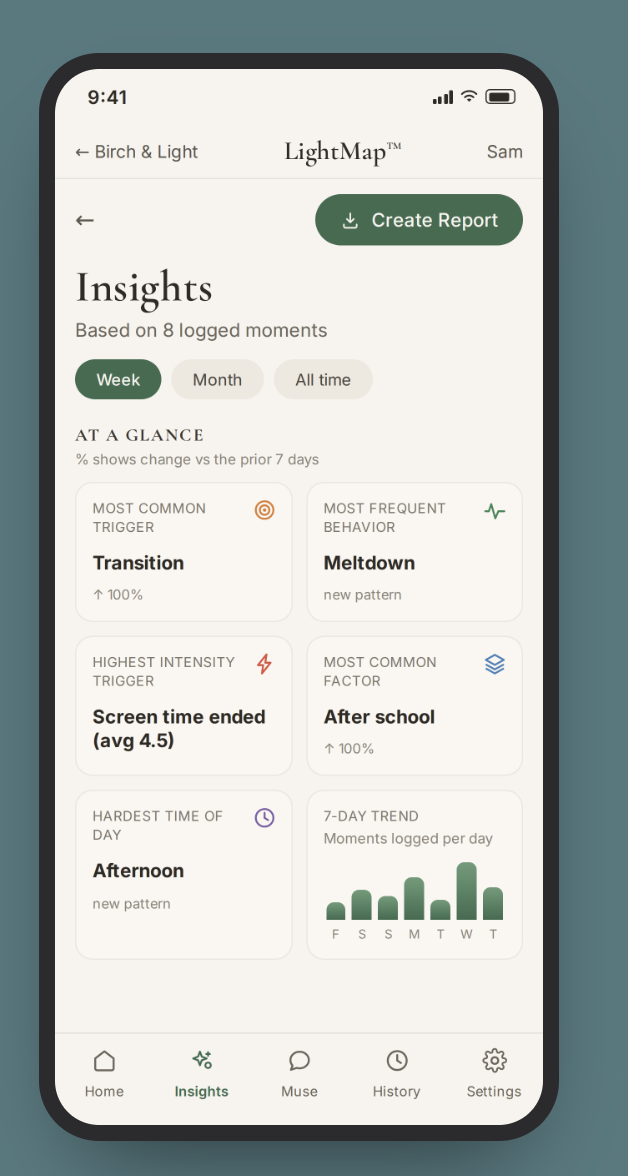
Part of the award-winning Birch & Light Method, honored with the Mom's Choice Gold Award for excellence in family resources.
If today was one of those days
A few more from the library, free to read.
Researched and drafted with AI assistance, reviewed before publication. Editorial standards