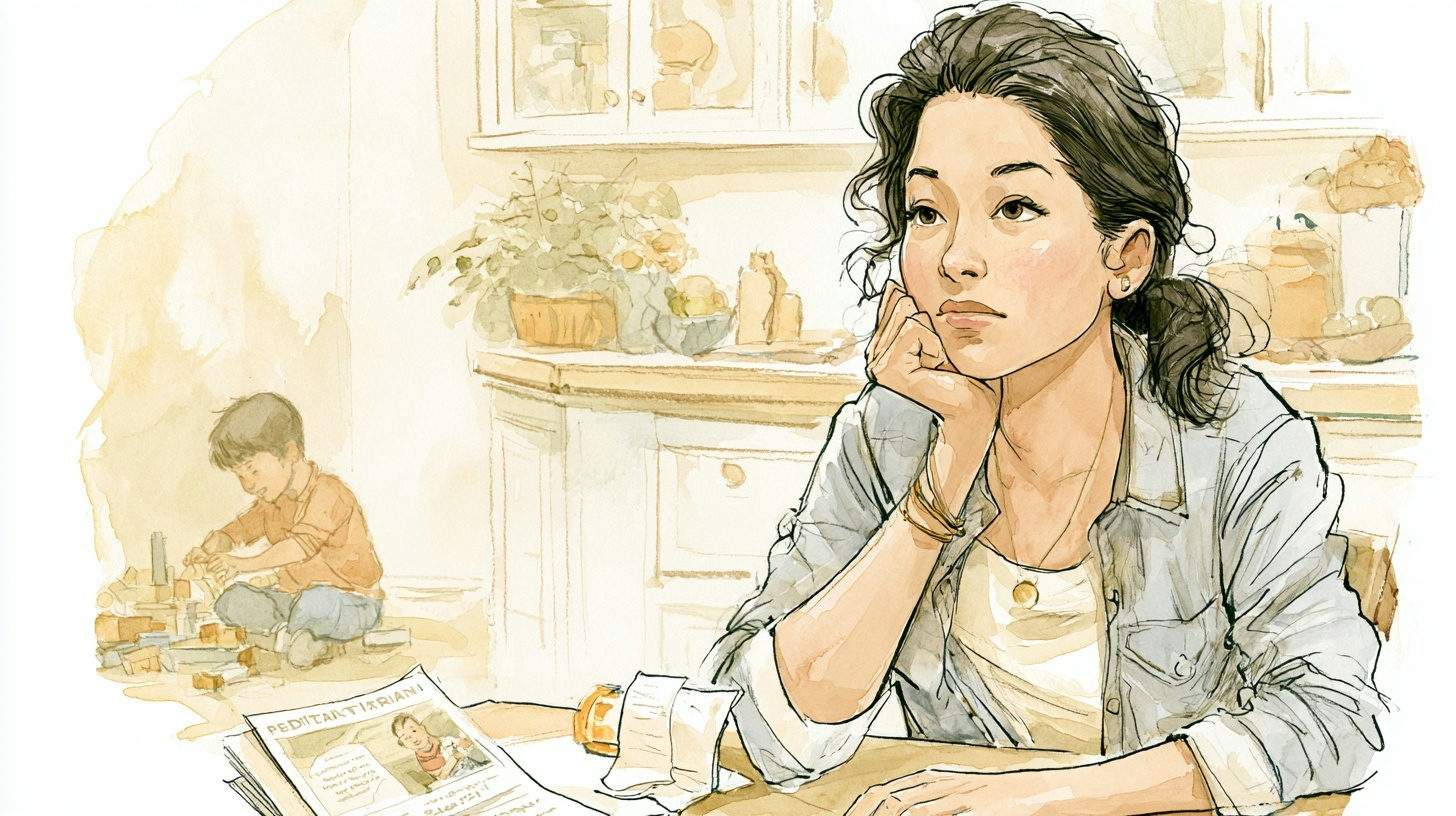
The diagnosis might not even have been a surprise. You may have suspected it for a year. But there is something about hearing it made official — and then hearing a medication name in the very next breath — that can make the whole thing feel like it is moving faster than you are.
If your young child was just diagnosed with ADHD and the first treatment offered was a stimulant, and your instinct was to slow down, you are not being difficult. You are asking a reasonable question: is medication really the first step for a child this small, and what else exists?
Here is what I want you to know — not to talk you into medication or out of it, but so you can make this decision with real information instead of pressure or fear.
What the guidelines actually say for young children
For children under six, the American Academy of Pediatrics recommends behavioral treatment first — specifically, parent training in behavior management — with medication considered when behavioral approaches alone do not produce enough improvement, or when symptoms are severe enough that the child is at risk or the family is in crisis.
That matters for two reasons. First, it means your instinct to ask about non-medication options for a four- or five-year-old is not fringe skepticism. It is consistent with mainstream pediatric guidance, and a clinician worth keeping will welcome the question. Second, it means the recommendation to medicate a young child is not automatically wrong either. "Severe" diagnoses are exactly the cases where guidelines leave room to move faster, because the cost of a hard year at this age — to the child's self-image, to school entry, to the parent-child relationship — is real too.
So the honest framing is not medication versus no medication. It is: what order do we try things in, and how will we know if what we are trying is working?
The behavioral options with real evidence behind them
Behavioral treatment for young children with ADHD does not mean therapy where your child talks about feelings. At this age, the evidence-based interventions mostly work through you.
Parent training in behavior management (PTBM). This is the umbrella term for structured programs that teach parents specific techniques — how to give instructions a child with ADHD can actually follow, how to catch and reinforce the behavior you want, how to make consequences predictable instead of escalating. Programs include Parent-Child Interaction Therapy, Triple P, and the Incredible Years, among others. These have decades of evidence behind them for young children.
Parent-Child Interaction Therapy (PCIT). Worth naming on its own because it is often the best fit for the four-to-six range. A therapist coaches you live, usually through an earpiece, while you play with and direct your child. It is skills training for the parent-child relationship itself, and many families see meaningful change within a few months.
School and preschool supports. A young child with an ADHD diagnosis may qualify for classroom accommodations or an evaluation for support services. Movement breaks, seating changes, shortened instructions, and a teacher who understands what they are looking at can change a child's entire experience of school.
The unglamorous foundations. Sleep, daily physical activity, and predictable routines will not treat ADHD on their own, but poor sleep in particular can make symptoms dramatically worse, and it is worth ruling out before concluding that anything else is or is not working.
If and when medication enters the picture
A few things that tend to lower the temperature of this decision.
Stimulant medication is not a one-way door. It works the day it is taken and is out of the system quickly, which is why prescribers can adjust or stop it without a long process. A trial is genuinely a trial. If the side effects are not acceptable or it is not helping, you stop, and you have learned something.
There is also more than one medication. If the specific one offered is the part you are hesitant about, say that. There are multiple stimulants with different profiles, and there are non-stimulant options as well. Which is appropriate for your child at their age is a conversation for the prescriber — but "I am not comfortable with this particular one, what else exists" is a completely legitimate thing to say in that room.
And medication plus behavioral treatment is not either-or. For families who do end up medicating, the combination consistently outperforms medication alone, because the pill can improve attention and impulse control but it cannot teach skills — to the child or to you.
While you're here, take the guide
What's Underneath is free: the three body-state triggers under most meltdowns, what to say in the minute before it tips over, and how to reset afterward.

You'll get the guide instantly, plus five free articles in your inbox every week. Real challenges (meltdowns, school mornings, picky eating, big feelings) and how to actually handle them. Unsubscribe anytime.
Questions worth asking before you decide
- What does the guideline say for a child this age, and where does my child fall relative to it?
- What behavioral treatment is available near us, and can you refer us to it now — whether or not we medicate?
- If we try behavioral treatment first, how long do we give it, and what would tell us it is not enough?
- If we try medication, what specifically are we watching for — improvement and side effects — and when do we check in?
- What happens if we do nothing for six months?
That last one is not rhetorical. Sometimes the honest answer is "probably a harder kindergarten entry," and that is information you deserve to weigh openly rather than have implied at you.
The part nobody says out loud
Some of the hesitation about medicating a small child is not about the medication. It is about what it means. Agreeing to a prescription can feel like signing something permanent about who your child is, and grief about the diagnosis often disguises itself as a treatment debate.
You are allowed to be in both places at once: grieving the version of this where everything was simpler, and still making a clear-eyed decision about what your actual child needs this year. Taking two or three weeks to get a second opinion, start a parent training program, and let the diagnosis settle is not neglect. It is process. And there's a practical reason not to decide from panic: a parent running on adrenaline can't think clearly, and children read our nervous systems before they hear our words. Settling yourself first isn't a delay of the decision — it's part of making a good one. The only real mistake at this stage is deciding by avoidance — letting months pass because the decision feels too heavy to pick up.
Where LightMap helps
Whichever path you choose, the question you will face next is the same: is it working? And memory is a terrible instrument for that. A hard Tuesday can erase two good weeks in your mind, and a charming morning at the pediatrician's office can hide what every school pickup looks like.
Tracking what actually happens — when the hard moments hit, what preceded them, how long recovery took — gives you a real baseline before you start any treatment, and real evidence afterward. That turns your follow-up appointments from vague impressions into specific information a prescriber or therapist can actually use.
Every behavior is a clue.
Before you change anything, know your baseline — the pattern is what tells you whether a treatment is working. Explore LightMap at birchandlight.com/lightmap.
Frequently asked questions
Is it bad that I don't want to medicate my five-year-old?
No. For children under six, behavioral treatment first is the mainstream recommendation, not an alternative one. Wanting to start there puts you inside the guidelines, not outside them. The thing to watch is only that hesitation turns into a plan — parent training, school supports, a follow-up date — rather than into indefinite waiting.
Will trying medication once change my child permanently?
Stimulants act while they are in the system and clear quickly, which is why prescribers treat the first weeks as an adjustable trial rather than a commitment. If it does not help or the side effects are unacceptable, it is stopped. What a trial gives you is information you cannot get any other way.
What if behavioral therapy isn't available where we live?
Ask the diagnosing clinician for telehealth options — several evidence-based parent training programs, including PCIT, now have well-studied online versions. Waitlists are common, so get on one immediately even while you are deciding about everything else. A spot you do not need is easy to give up; a spot you need in three months is hard to conjure.
My child's doctor seemed annoyed that I questioned the prescription. Is that a red flag?
A clinician being brisk is common; a clinician being unwilling to discuss the treatment order for a young child is worth noting. This is a years-long relationship, and you need one where "help me understand why medication first" gets an answer instead of a sigh. A second opinion is a normal move here, not an insult.
Sources: American Academy of Pediatrics Clinical Practice Guideline for ADHD (2019); Preschool ADHD Treatment Study (PATS), National Institute of Mental Health; PCIT International.
Watching together helps too: Your Amazing ADHD Brain is a short video that explains the ADHD brain to kids, in language a nine year old can hear without shame.
For education and reflection, not medical advice. Our terms
See what's underneath
Walk into the next appointment with answers
LightMap reads your hard days together and gives you answers. Start with one moment today.
Start with 3 moments Not sure where to start? Ask me.Message Tara on WhatsApp. It really is me, I read everything and will personally respond.Click here to message Tara →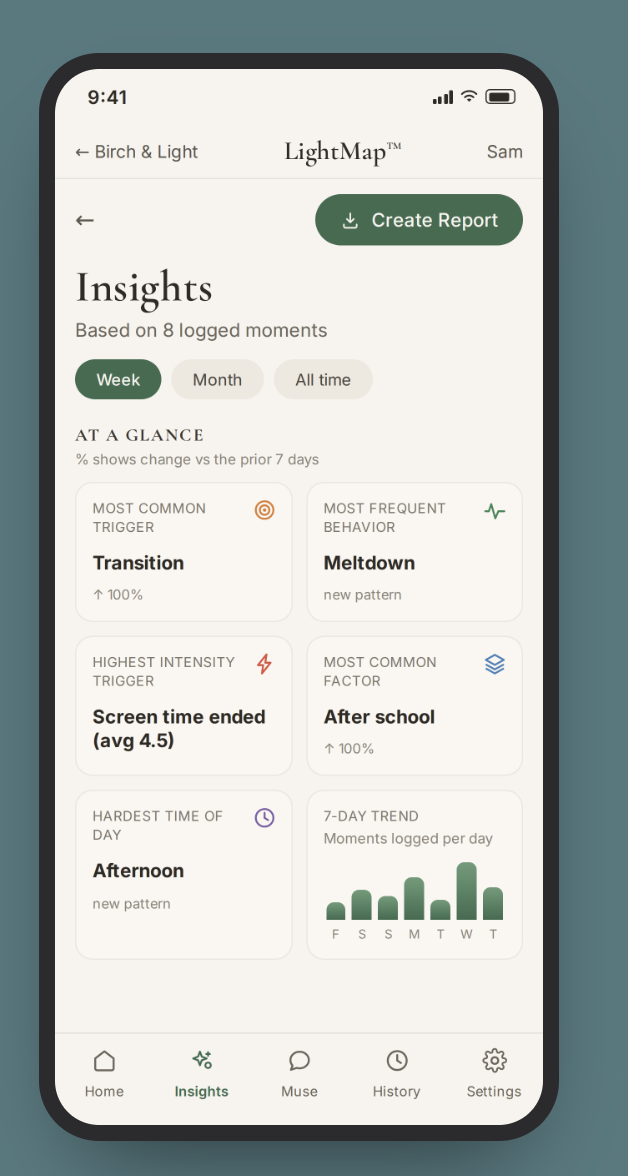

Part of the award-winning Birch & Light Method, honored with the Mom's Choice Gold Award for excellence in family resources.
A story to read together
Sometimes the easiest way in is a story you read side by side.
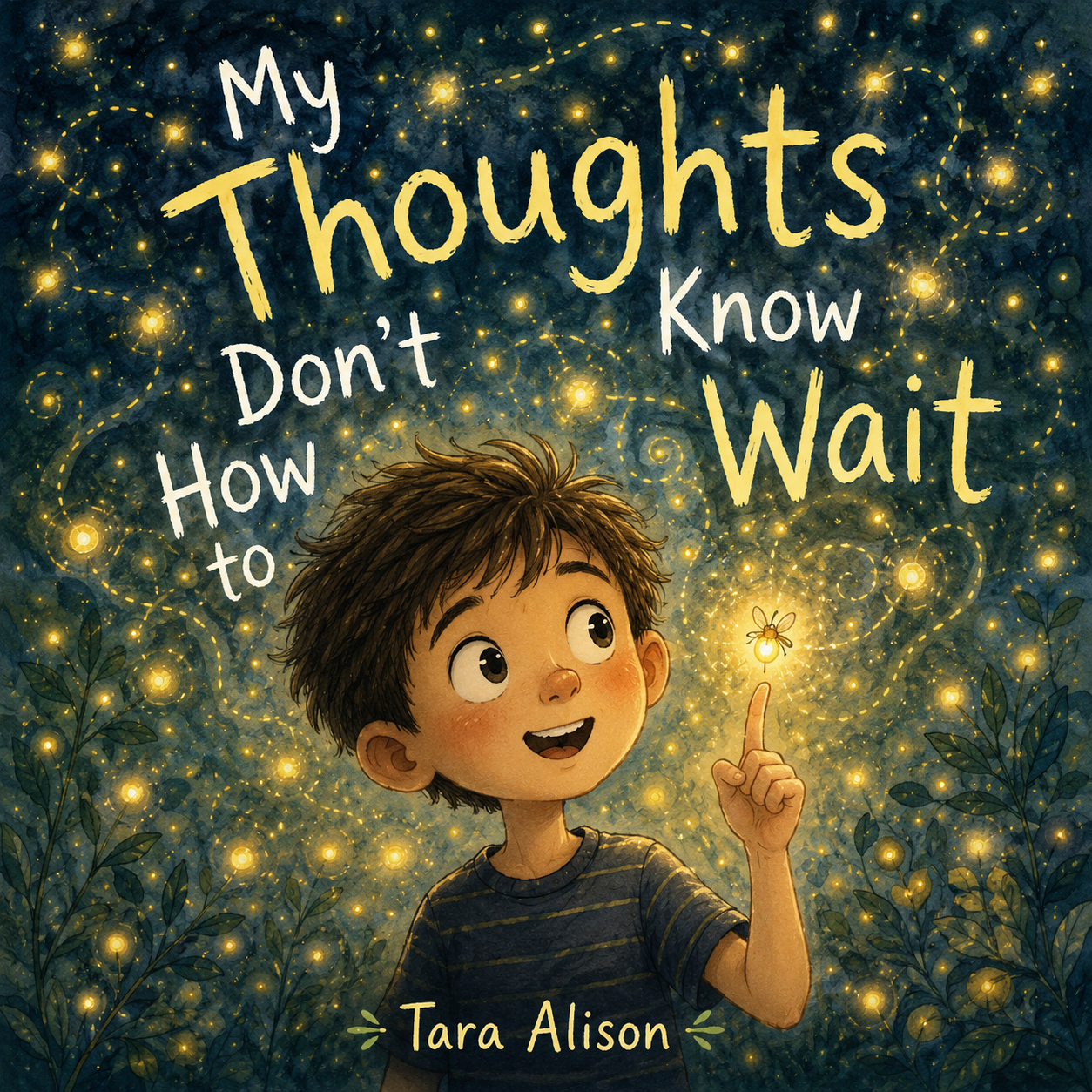 My Thoughts Don't Know How to Wait
Simon's thoughts arrive bright and fast — and feel like they will disappear if he doesn't say them right away. One quiet night beside fireflies, he discovers a small, surprising space between noticing a thought and chasing it.
Read the story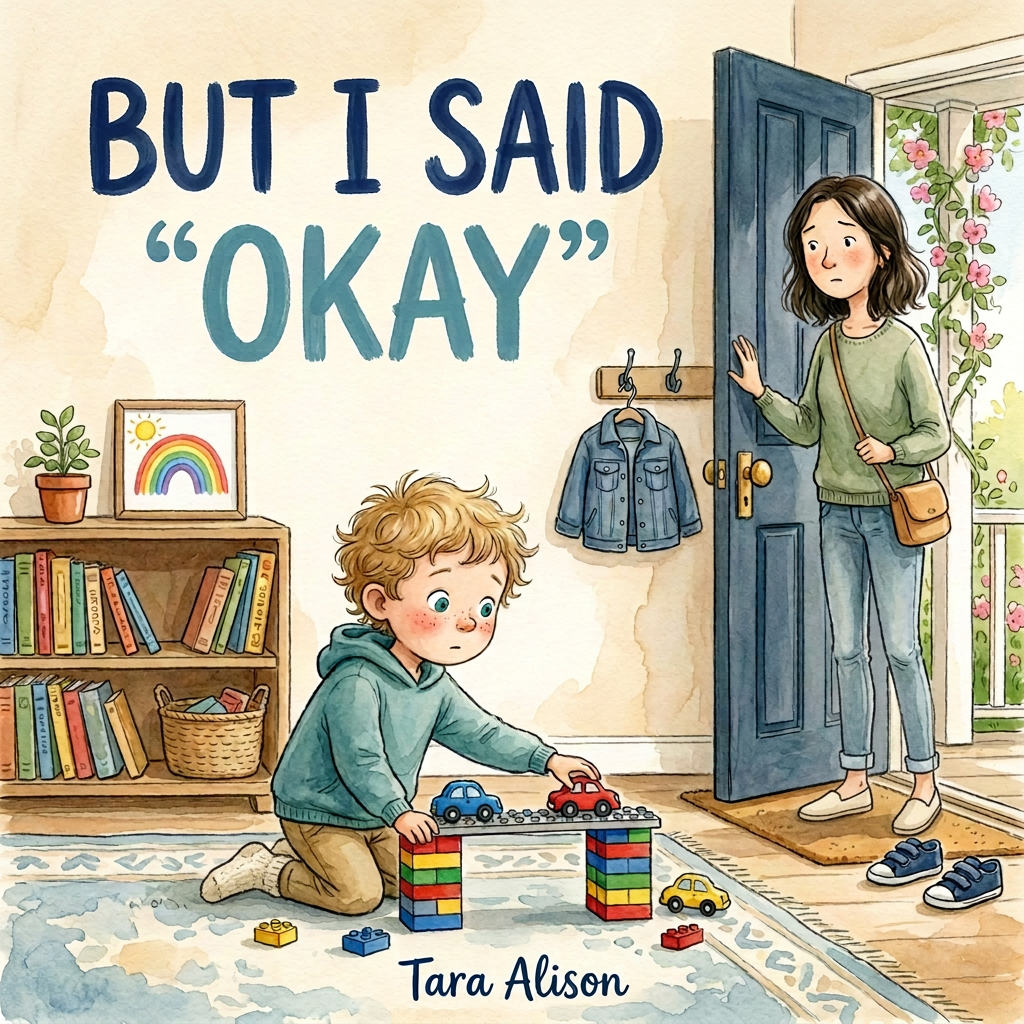 But I Said “Okay”
Owen always says okay. He means it every time. But his attention is still inside the bridge, the dragon, the cave, the music — until Mom realizes that helping him leave one thing matters more than asking him to start the next.
Read the story
If today was one of those days
A few more from the library, free to read.
Researched and drafted with AI assistance, reviewed before publication. Editorial standards