
Use AI by giving it months of structured observations about your child, then ask mechanism questions instead of label questions. Track dated, specific moments first, export the full pattern, and ask what connects the triggers. Treat every answer as a hypothesis for your child's clinician, and remove identifying details before pasting anything into a chatbot.
Why does AI give you a generic answer about your child?
Ask an AI chatbot "why does my child melt down over small things" and you get a generic listicle: sensory overload, hunger, transitions, big feelings. True, useless, and nothing you didn't already know. The problem isn't the AI. It's that you handed it a question with no data attached, so it answered for the average child, and no one is parenting the average child.
Hand the same AI six months of structured, real observations about your specific child, and something completely different happens. I know because it happened to us.
Step one: track before you ask
The workflow starts weeks before any AI conversation. You need a real record of the hard moments: what happened, what came right before, what was going on underneath (sleep, food, blood sugar, medication changes, social stress), how intense it got, what helped, what didn't. We use LightMap for this because it structures every moment the same way and compiles everything into a report, but the principle matters more than the tool: consistent, dated, specific observations. Vibes and memory are not data.
Step two: generate the full picture
After a month or more, export the whole thing: every logged moment, the trigger frequencies, the time-of-day patterns, contributing factors, the bright spots too. The bright spots matter more than you'd think, because what your child can do when regulated is half the diagnostic picture.
Step three: ask the AI mechanism questions, not label questions
This is where most people go wrong. Don't ask "does my child have autism." Label questions get hedged non-answers, and labels weren't the bottleneck anyway. Ask mechanism questions:
- "What patterns connect these triggers that might not be obvious from inside individual moments?"
- "What psychological mechanisms could explain why this range of situations all end the same way?"
- "What does this data suggest we should watch for that we haven't been tracking?"
- "What questions should we bring to her therapist based on this report?"
What this found for our family
Our daughter's trigger list looked like everything: transitions, demands, sounds, waiting, words she didn't know, medical stress. We'd spent years cycling through diagnostic questions. When we put the full tracking report in front of an AI and asked what connected it all, it surfaced a research construct we had never once heard in years of evaluations: intolerance of uncertainty, the well studied finding that for some brains, not knowing is itself the threat, which is why no reassurance ever worked. Not a new diagnosis. A mechanism, with an evidence base and specific treatment approaches attached, that suddenly organized a dozen "unrelated" problems into one thread we could bring to her care team.
Months of daily data plus one good question did what years of worried Googling never had.
While you're here, take the guide
What's Underneath is free: the three body-state triggers under most meltdowns, what to say in the minute before it tips over, and how to reset afterward.

You'll get the guide instantly, plus five free articles in your inbox every week. Real challenges (meltdowns, school mornings, picky eating, big feelings) and how to actually handle them. Unsubscribe anytime.
What is intolerance of uncertainty?
Intolerance of uncertainty, often shortened to IU, is the tendency to find not knowing hard to bear. Researchers measure it in children with the Intolerance of Uncertainty Scale for Children, built for ages 7 to 17. In the 2009 study that evaluated the scale, children with anxiety disorders scored substantially higher than community peers, and scores tracked with anxiety, worry, and reassurance-seeking. A later study in youth with generalized anxiety disorder found IU levels differed across children with GAD alone, children with GAD plus another condition, and healthy controls, which suggests IU cuts across conditions rather than belonging to one.
Neither study says your child has it. They show IU is a measurable construct, which makes it a fair question to bring to a clinician.
Bring this to the appointment
Bring the tracking report, the AI's hypothesis written as a question, and your own notes on what you have seen. Ask whether intolerance of uncertainty could explain the pattern and how the clinician would assess it. The report and your questions carry the conversation either way.
Is it safe to share your child's information with an AI?
First: AI output is a hypothesis, never a conclusion. Everything it surfaces goes to your child's clinician as a question, not to your child as an answer. Second: strip identifying details before pasting anything into a general chatbot. Your child's name, school, and diagnoses in a random chat window is a privacy decision you can't take back; use initials and remove specifics, or use a tool where the AI layer is built in and covered by the product's privacy terms. Third: if an AI tells you something alarming, that's a reason to call a professional, not to spiral at midnight.
The shortcut version
Inside LightMap, Muse (the built-in AI coach) reads your tracking data directly, so the analysis happens where the data already lives, without pasting anything anywhere. But with or without our tools, the core workflow stands: track consistently, ask mechanism questions, treat answers as hypotheses, and bring the good ones to the humans who treat your child.
The data half of this workflow is what LightMap was built for.
Sources: Comer JS, Roy AK, Furr JM, Gotimer K, Beidas RS, Dugas MJ, Kendall PC, "The Intolerance of Uncertainty Scale for Children: A Psychometric Evaluation," Psychological Assessment, 2009;21:402-411. Cowie J, Clementi MA, Alfano CA, "Examination of the Intolerance of Uncertainty Construct in Youth with Generalized Anxiety Disorder," Journal of Clinical Child and Adolescent Psychology, volume 47, pages 1014-1022.
For education and reflection, not medical advice. Our terms
See what's underneath
Stop guessing what set it off
LightMap reads your hard days together and gives you answers. Start with one moment today.
Start with 3 moments Not sure where to start? Ask me.Message Tara on WhatsApp. It really is me, I read everything and will personally respond.Click here to message Tara →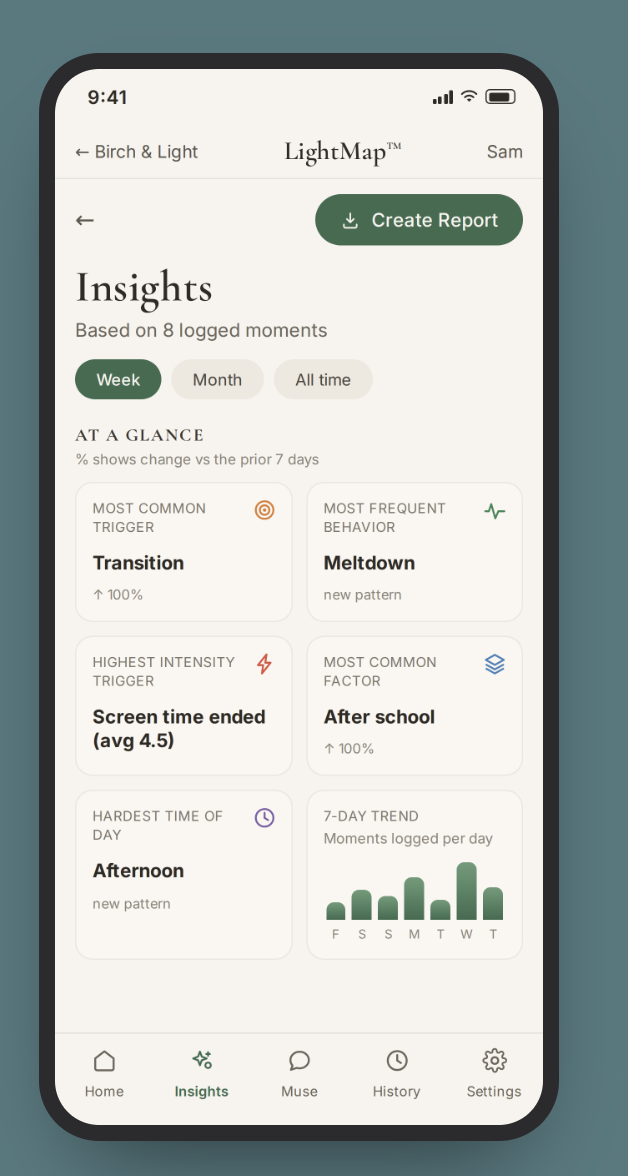

Part of the award-winning Birch & Light Method, honored with the Mom's Choice Gold Award for excellence in family resources.
A story to read together
Sometimes the easiest way in is a story you read side by side.
 The Tower That Looked Fine
A tower in a quiet clearing tries to stay steady through every small thing nobody else seems to notice — until one tiny breath of wind causes her to fall, and a gentle hand begins to gather the blocks back.
Read the story The Boy at the Edge
A boy finds calm by watching the world move from a window. When his stillness is mistaken for defiance, the moment escalates — and he learns that being calm doesn’t always protect you from being told no.
Read the story
If today was one of those days
A few more from the library, free to read.
Researched and drafted with AI assistance, reviewed before publication. Editorial standards