You feel like you are walking on eggshells because your family has reorganized around avoiding outbursts from your child. It works for a day and costs you over months. To stop, find out why the fuse is short, keep accommodations that protect capacity, and reintroduce normal life one small, calm step at a time.
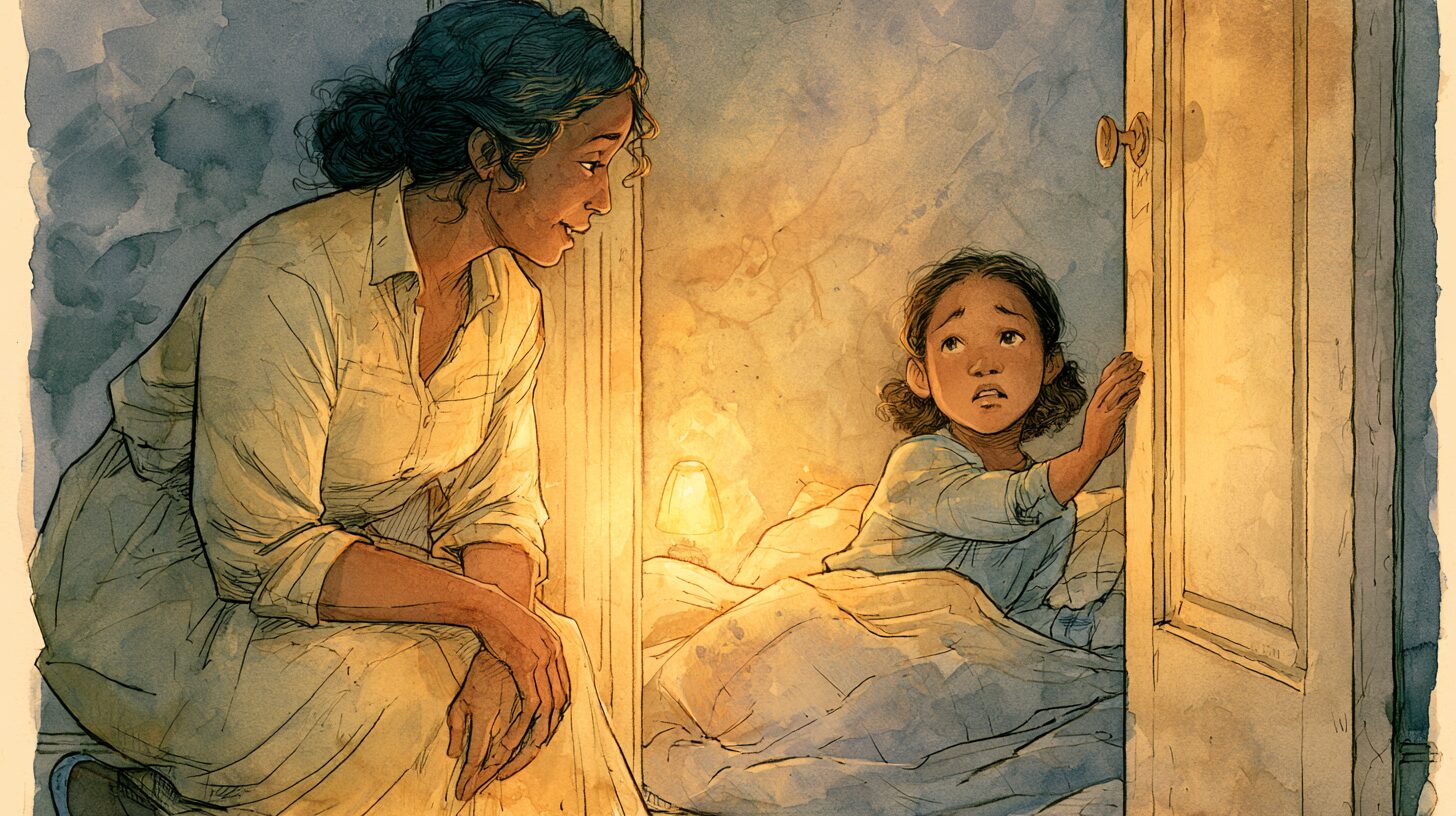
You check their face before you speak. You time requests for the right mood, phrase everything carefully, brief the other parent in hallway whispers about what kind of evening it is. The whole family has quietly reorganized around one question: what will set them off?
If that is your house, two things are true. First, you are not a weak parent, you are a tired one, and the adaptation you have made is what intelligent people do around unpredictable storms. Second, the adaptation has costs you may not have fully counted yet, and there is a way to stop tiptoeing that is not "crack down."
How families end up on eggshells
Nobody chooses this. It assembles itself, one reasonable decision at a time. The explosion over the wrong words teaches you to choose words carefully. The meltdown over the denied request teaches you to deny less. Each accommodation genuinely buys peace that day, and a family running on empty takes the peace. Months later, the accumulated accommodations have become the architecture: siblings silencing themselves, plans canceled preemptively, a household where one nervous system sets the weather for everyone.
Understand what happened mechanically, without blame: your child''s distress is real, your avoidance of triggering it is love plus exhaustion, and the combination has accidentally taught everyone, including your child, that their dysregulation is a force nobody can stand in front of. That lesson frightens them too. A child who senses that the adults are managing around them, rather than able to handle them, is a child who has quietly lost their safest containment. The eggshells under your feet are under theirs too.
The costs worth naming
The eggshell house runs a hidden invoice. Siblings learn their needs are negotiable and their job is to be easy; resentment there compounds for years. Your relationship with your child becomes threat management instead of connection, and they can feel the difference between being loved and being handled. And you, scanning and editing all day, are running a chronic stress load that ends in the kind of depletion where you have nothing left for anyone, including yourself. Peacekeeping is not peace.
While you're here, take the guide
What's Underneath is free: the three body-state triggers under most meltdowns, what to say in the minute before it tips over, and how to reset afterward.

You'll get the guide instantly, plus five free articles in your inbox every week. Real challenges (meltdowns, school mornings, picky eating, big feelings) and how to actually handle them. Unsubscribe anytime.
How do you get off the eggshells without declaring war?
Start with why the fuse is short, not just that it is. Constant explosiveness is a signal, of anxiety, of overload, of a capacity problem at school, of a profile like demand avoidance where ordinary requests genuinely feel like threats, of something that may have a name and better help than tiptoeing. If you have never asked "what is making everything feel unbearable to this kid?", that question comes before any behavioral plan, sometimes with a pediatrician or evaluator involved. Eggshell dynamics are common around kids whose real issue was never addressed, because avoidance was the only tool anyone had.
Then stop treating all triggers alike. Some accommodations are legitimate: not scheduling demands into the after-school crash, warning before transitions, respecting sensory limits. Those are good engineering. But somewhere the list crossed from accommodating a nervous system to obeying a mood, and only you can find the line. Sort your tiptoeing into two piles: things that protect their capacity (keep) and things that only postpone their displeasure (begin, gently, to stop).
Reintroduce normal life in small, survivable doses. Pick one low-stakes thing you have been avoiding, one, and let it happen: the sibling plays the piano, the answer is no to the fourth snack, you say the ordinary sentence without the diplomatic rewrite. There may be a storm. The storm is the extinction burst of a system discovering the old rules are changing, and your job is not to prevent it but to survive it calmly: safe, present, boring, unmoved. "I know this is hard. The answer is still no. I''m right here." Every storm you weather without either caving or exploding teaches the most important lesson available: your feelings are not too big for me. That lesson, repeated, is what eventually lets everyone exhale.
Repair the perimeter. The siblings need airtime that is not about the storm, and explicit permission to have needs. You and your partner need to be one system, because eggshell houses breed the good-cop split, and kids read a divided command structure instantly. And you need actual replenishment, not because self-care is a slogan but because the calm you must project during storms is a resource, and it has to come from somewhere.
Get help sized to the situation. If explosions are frequent, intense, or anyone is getting hurt, this is beyond blog-post scale, and a therapist who works with the whole family system (not just the child) changes these dynamics faster than willpower does. Asking is not failure. It is what the situation is for.
The house you are trying to reach is not one where your child never gets upset. It is one where their upset is a weather event the family can stand in, instead of a climate everyone lives under. The difference between those two houses is not a quieter child. It is adults who found their footing, and it turns out the child needed that even more than the quiet.
Sorting real capacity limits from mood-obedience is easier with data than with dread. LightMap lets you log the explosions and near-misses with their context, so you can see what actually loads the fuse, and which eggshells were never necessary at all.
If you want a companion for seasons like this one, What's Underneath: A Parent's Field Guide to the Hard Moments is a short, calm map for the moments when things fall apart.
Sources: Lebowitz ER, Woolston J, Bar-Haim Y, et al. Family accommodation in pediatric anxiety disorders. Depression and Anxiety, 2013, doi 10.1002/da.21998, which found that parents commonly accommodate anxiety in a child and that more accommodation goes with more severe symptoms. Stringaris A, Cohen P, Pine DS, Leibenluft E. Adult outcomes of youth irritability: a 20-year prospective community-based study. American Journal of Psychiatry, 2009, 166(9), 1048-1054, which found that persistent irritability in youth predicts later depression and anxiety.
For education and reflection, not medical advice. Our terms
See what's underneath
Stop guessing what set it off
LightMap reads your hard days together and gives you answers. Start with one moment today.
Start with 3 moments Not sure where to start? Ask me.Message Tara on WhatsApp. It really is me, I read everything and will personally respond.Click here to message Tara →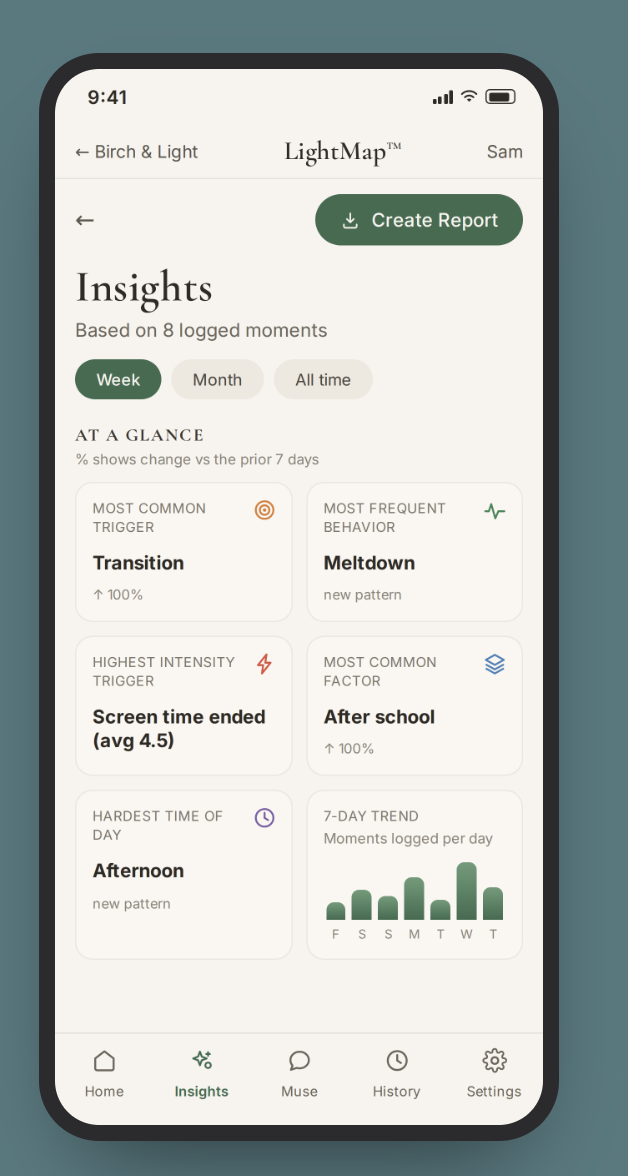

Part of the award-winning Birch & Light Method, honored with the Mom's Choice Gold Award for excellence in family resources.
A story to read together
Sometimes the easiest way in is a story you read side by side.
 The Tower That Looked Fine
A tower in a quiet clearing tries to stay steady through every small thing nobody else seems to notice — until one tiny breath of wind causes her to fall, and a gentle hand begins to gather the blocks back.
Read the story The Boy at the Edge
A boy finds calm by watching the world move from a window. When his stillness is mistaken for defiance, the moment escalates — and he learns that being calm doesn’t always protect you from being told no.
Read the story
If today was one of those days
A few more from the library, free to read.
Researched and drafted with AI assistance, reviewed before publication. Editorial standards