
It's 11:40 at night and one of you is still awake, running the mental list. The note for the teacher. The thing the OT said to try. Whether tomorrow is a "good morning" day or a "leave extra time" day. Which clothes will cause a problem. What to say if the meltdown happens at drop-off again.
The other one is asleep.
This is the invisible load — the constant, unseen mental work of anticipating, managing, and holding a complex child in your mind at all times. And in most families, it isn't shared evenly. One parent carries the running spreadsheet of their child's nervous system, and the other genuinely doesn't know it exists.
Here is what I want you to consider, whichever side of this you're on.
What this often looks like
The invisible load is invisible by definition, so it rarely shows up as a fair fight. It shows up as a slow, lopsided exhaustion that one parent can't explain and the other can't see.
- One parent always knows what's coming — the trigger, the hard transition, the thing that'll set the day sideways — and is quietly steering around it all day long.
- The other parent steps in to "help" and gets it slightly wrong, because they don't have the hundred small data points the first parent is holding, and now there's a mess to clean up on top of everything.
- The carrying parent feels like delegating is more work than doing it themselves, so they stop delegating, and the load gets heavier and more solitary.
- When the carrying parent finally snaps — "I am doing all of this alone" — the other parent is genuinely blindsided, because from where they stand, things have looked basically fine.
That blindsidedness is real, and it's part of the problem. You can't share a weight your partner can't see.
Why it happens
Part of it is just competence becoming a trap. One parent gets good at reading the child — fast, accurate, fluent in their signals — and because they're good at it, everything routes to them. The school calls them. The child seeks them out in distress. The other parent defers, reasonably, to the one who "knows how to handle it." And the expertise that started as a strength becomes a cage.
Part of it is that the load is built from thousands of tiny, unremarkable observations that never get spoken aloud. The carrying parent isn't keeping a list they could just hand over. They're holding a constantly updating sense of their child that lives in their head and would take hours to explain. So they don't explain it. They just keep carrying it.
And part of it is that anticipating a complex child's needs is genuinely invisible work. When it's done well, nothing happens — the meltdown that got prevented leaves no evidence. The parent who prevented it gets no credit, because to everyone else, it was simply a calm afternoon.
What tends to help
- Make the invisible visible — once, in detail. Not in the heat of a fight, but in a calm moment: actually walk your partner through the running list in your head. The morning sequence. The watch-fors. The recovery signs. They can't take on what they've never seen named.
- Hand over whole domains, not tasks. "Bedtime is yours — all of it, including the planning" transfers real load. "Can you help with bedtime tonight" keeps you as the manager and just adds a helper. Ownership is what lightens the weight.
- Let the other parent do it their way, and survive the imperfection. The handoff only works if the carrying parent can tolerate it being done differently — even a little worse at first. If every attempt gets corrected, the other parent learns to stop trying, and you're back to carrying it alone.
- Say the prevention out loud. "I rearranged the whole afternoon so that didn't blow up" makes the invisible work visible. Your partner can't value, or share, what they never knew you did.
While you're here, take the guide
What's Underneath is free: the three body-state triggers under most meltdowns, what to say in the minute before it tips over, and how to reset afterward.

You'll get the guide instantly, plus five free articles in your inbox every week. Real challenges (meltdowns, school mornings, picky eating, big feelings) and how to actually handle them. Unsubscribe anytime.
What tends not to help
Waiting for your partner to notice on their own. The whole nature of invisible load is that it's invisible — expecting the other parent to spontaneously perceive the weight you're carrying sets you both up to fail. They're not ignoring it. They literally can't see it until you show them.
Keeping score also tends to make things worse, even though it's completely understandable. Tallying everything you do that they don't turns a logistics problem into a grievance, and grievances make people defensive, not helpful. The goal is to redistribute the weight, not to win an acknowledgment of how unfair it's been.
And taking it all back the first time the handoff goes sideways guarantees you'll carry it forever. If you reclaim the domain the moment it's imperfect, you've taught both of you that only you can do it — which is the exact belief that built the load in the first place.
When additional support may be needed
If the imbalance has gone on long enough that it's become resentment — if you've moved from tired to bitter, or from blindsided to defensive — it can be worth bringing in a couples therapist before the load itself becomes the smaller of your two problems. The redistribution of parenting work is a common, workable issue. The slow erosion of goodwill underneath it is the part that does lasting damage.
It's also worth getting support if the carrying parent is genuinely depleted — not just tired, but running on empty in a way that sleep doesn't fix. The invisible load of parenting a complex child is heavy enough to flatten a person, and a depleted parent can't pour from an empty cup no matter how much they love their kid.
Where LightMap helps
A lot of the invisible load is data that lives in one parent's head and nowhere else. The patterns, the triggers, the what-usually-comes-before — it's all stored in the mind of the parent who does the noticing, which is exactly why it can't be shared.
Putting some of that into a place you can both see starts to externalize it. When the observations live somewhere outside one person's memory — when both parents can look at the same several weeks and see the same triggers and the same recovery windows — the knowledge stops being one parent's private burden and becomes something the household holds together.
Every behavior is a clue.
When the patterns live somewhere you can both see them, the mental load stops being one parent's alone. Explore LightMap at birchandlight.com/lightmap.
Frequently asked questions
How do I explain a load that's mostly in my head?
Pick one ordinary day and narrate it out loud to your partner — every small adjustment you made, every thing you watched for, every blow-up you quietly prevented. Most carrying parents are surprised how long the list gets when they actually say it, and most partners are surprised it existed at all. You can't hand over a weight you've never described.
My partner says they'll help but I'd rather just do it. Is that wrong?
It's understandable — doing it yourself is often faster and cleaner in the moment. But "faster now" is what builds a load that crushes you later. Handing over a whole domain costs you something up front, in tolerating imperfection and letting go of control, and pays you back in actually being able to share the weight.
What if I'm the parent who didn't realize?
That's an extremely common place to be, and realizing it is the start of fixing it. Ask your partner to walk you through what they're carrying, then take real ownership of a piece of it — not as a helper who checks in, but as the person responsible for that domain. The point isn't guilt. It's redistribution.
For education and reflection, not medical advice. Our terms
See what's underneath
Stop guessing what set it off
LightMap reads your hard days together and gives you answers. Start with one moment today.
Start with 3 moments Not sure where to start? Ask me.Message Tara on WhatsApp. It really is me, I read everything and will personally respond.Click here to message Tara →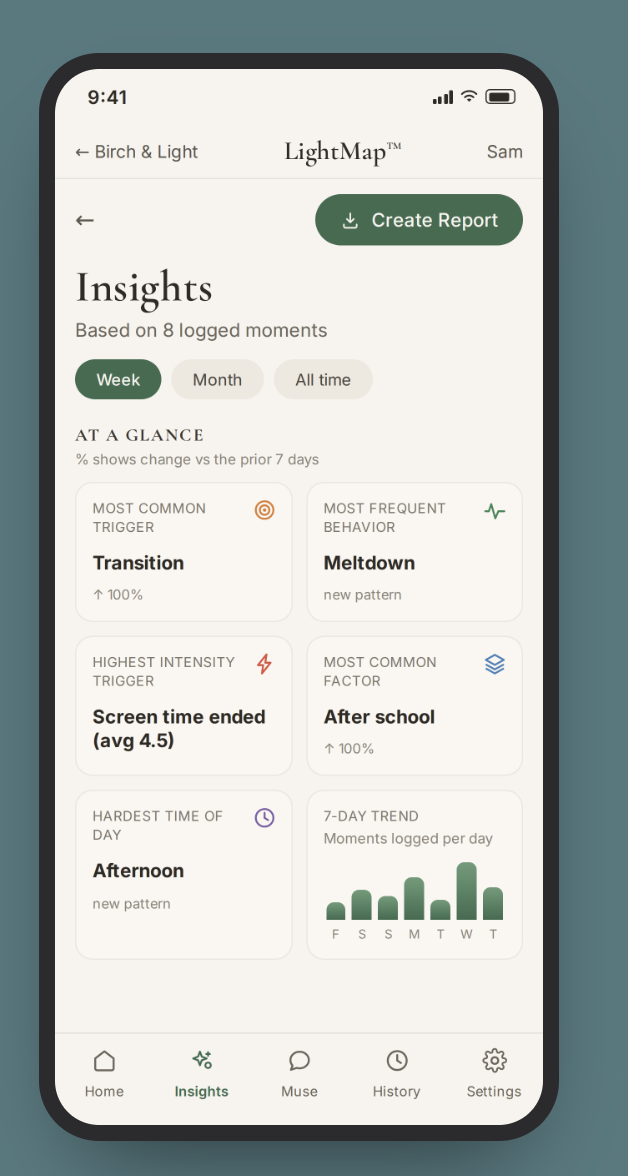

Part of the award-winning Birch & Light Method, honored with the Mom's Choice Gold Award for excellence in family resources.
A story to read together
Sometimes the easiest way in is a story you read side by side.
 The Tower That Looked Fine
A tower in a quiet clearing tries to stay steady through every small thing nobody else seems to notice — until one tiny breath of wind causes her to fall, and a gentle hand begins to gather the blocks back.
Read the story The Boy at the Edge
A boy finds calm by watching the world move from a window. When his stillness is mistaken for defiance, the moment escalates — and he learns that being calm doesn’t always protect you from being told no.
Read the story
If today was one of those days
A few more from the library, free to read.
Researched and drafted with AI assistance, reviewed before publication. Editorial standards