
When nothing works anymore, the strategies were never the part doing the work. Every new system arrives with focused attention, predictability, and a hopeful parent, and those fade with the novelty. Stop swapping systems. Pause the enforcement, study what comes before the hard moments, and ask what is producing the behavior.
The sticker chart worked for two weeks. The consequence system worked for a month. The new routine, the book''s method, the therapist''s script, the thing your sister swears by: each one worked, briefly, and then stopped. And now you are lying awake doing the math every exhausted parent eventually does: we have tried everything, and nothing works anymore.
That sentence deserves to be taken seriously, because the exhaustion is real and earned. But it contains one hidden assumption worth examining, because everything useful is hiding under it: the assumption that the strategies were ever the thing doing the working.
Why does everything work for two weeks and then stop?
Almost any new system produces a bump. Novelty gets a child''s attention. More precisely, every new strategy arrives with a hidden payload: focused parental attention, increased predictability, and a hopeful, regulated parent. Those three ingredients help almost every child, almost every time. Then the novelty fades, the chart becomes wallpaper, your hope thins, and the payload, which was the actual medicine, stops shipping. The strategy gets blamed. The cycle restarts with a new strategy.
If everything works briefly, that is not evidence that your child is strategy-proof. It is evidence that your child responds to attention, predictability, and a regulated you, and that no chart can supply those for longer than a few weeks. That is genuinely good news, even if it does not feel like it yet.
The escalation trap
There is a darker version of the cycle: when strategies stop working, the natural move is to increase the dose. Bigger consequences, longer groundings, more taken away. If you have been down that road, you already know where it ends: a child with nothing left to lose, which is the least cooperative creature on earth, and a relationship that has become mostly enforcement. When removing things stops changing behavior, that is not a sign you need to find the thing they really care about. It is a sign the behavior was never a choice being weighed against costs.
The question underneath
Here is the shift, and it is the whole article: strategies manage behavior, but behavior is an output. When no strategy works for long, stop asking "what system will fix the output?" and start asking "what is producing it?"
A child who cannot be charted into mornings that don''t explode may have mornings that genuinely exceed their capacity. A child whom no consequence can make do homework may be drowning in that subject. A child no reward can make flexible may be running on an anxious or overloaded nervous system for reasons that have a name. "Nothing works" very often means "we have been treating this as a motivation problem, and it is a capacity problem." Motivation problems respond to incentives. Capacity problems respond to support, and they eat incentives for breakfast.
While you're here, take the guide
What's Underneath is free: the three body-state triggers under most meltdowns, what to say in the minute before it tips over, and how to reset afterward.

You'll get the guide instantly, plus five free articles in your inbox every week. Real challenges (meltdowns, school mornings, picky eating, big feelings) and how to actually handle them. Unsubscribe anytime.
What to actually do from here
Call a ceasefire. Two or three weeks, no new systems. Keep the true non-negotiables (safety, school, health), drop the rest of the enforcement apparatus, and spend the reclaimed energy on unremarkable time together. This feels like surrender. It is data collection: what remains when the pressure is off is a much clearer picture of what you are actually dealing with.
Study, don''t manage. During the ceasefire, become a researcher of your own kid. When do the hard moments actually happen? What precedes them? Where are the surprising exceptions, the days it didn''t blow up, and what was different? You have been too busy operating systems to see the pattern. The pattern is the whole game.
Follow what the pattern says. Sometimes it points at something structural: sleep, a school mismatch, a sensory load, anxiety, a profile like demand avoidance that makes standard strategies actively backfire. If so, that is not failure. That is finally aiming at the right target, possibly with professional help, an evaluation, a pediatrician conversation, a therapist who looks under behavior instead of at it.
Rebuild on the actual foundation. The thing every "worked for two weeks" strategy borrowed, connection, predictability, a parent with something left in the tank, is the thing to invest in directly. It is slower than a chart. It is also the only thing that was ever working.
When should you bring in a professional?
If the hard moments keep their shape after a few weeks of ceasefire and observation, or if anyone is getting hurt, bring your notes to your child's pediatrician. Ask about sleep, anxiety, attention, and learning, and ask about parent training in behavior management. The CDC describes it as teaching parents positive reinforcement, structure, and consistent discipline, along with positive ways to interact and communicate with their child. The American Academy of Pediatrics gives the same starting point for everyday discipline: begin with rewarding positive behavior and set rules and expectations in advance.
A week of specific examples gives a clinician far more to work with than the sentence nothing works. Write down when the hard moments start, what came right before, and what helped even a little. Bring the quiet days too, because the exceptions are part of the pattern.
You have not run out of options. You have run out of options in one category, and the exhaustion you feel is the cost of a year spent in the wrong aisle. The parents who come out the other side of "nothing works" almost never found a better system. They found the question the systems were skipping.
The researcher phase is exactly what LightMap was built for: 15-second logs of the hard moments and the quiet ones, tagged with context, until the pattern you''ve been too tired to see is sitting in front of you. Start there before the next system.
Sources: Sege RD, Siegel BS, American Academy of Pediatrics, "Effective Discipline to Raise Healthy Children," Pediatrics, December 2018, doi:10.1542/peds.2018-3112. Centers for Disease Control and Prevention, "Parent Training in Behavior Management," ADHD, reviewed July 30, 2026.
For education and reflection, not medical advice. Our terms
See what's underneath
Stop guessing what set it off
LightMap reads your hard days together and gives you answers. Start with one moment today.
Start with 3 moments Not sure where to start? Ask me.Message Tara on WhatsApp. It really is me, I read everything and will personally respond.Click here to message Tara →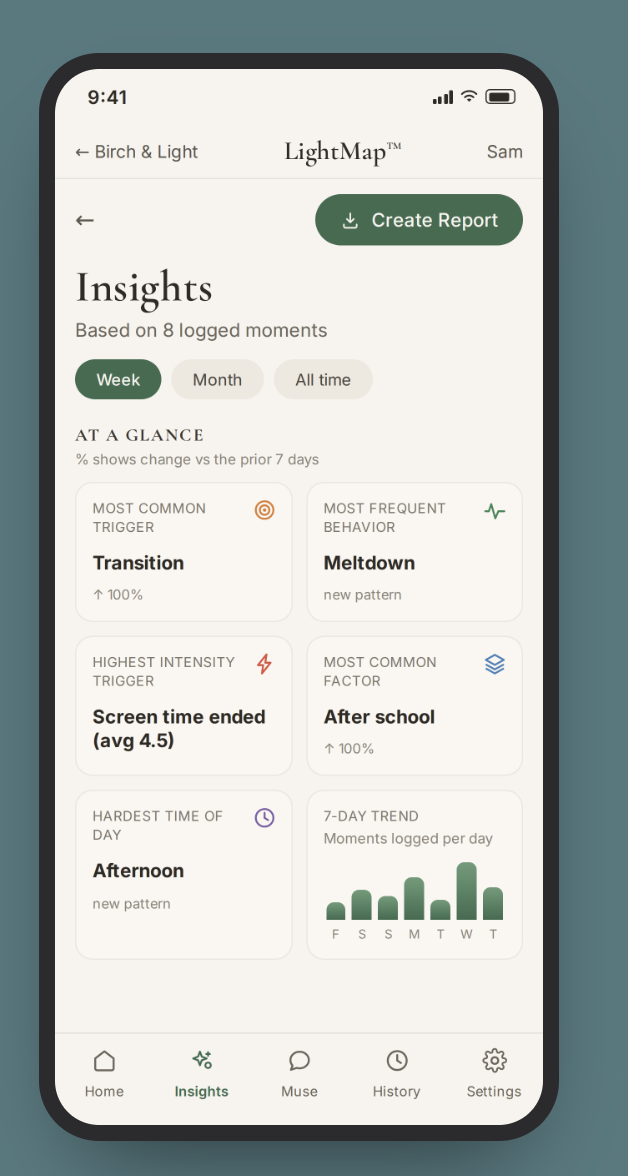

Part of the award-winning Birch & Light Method, honored with the Mom's Choice Gold Award for excellence in family resources.
A story to read together
Sometimes the easiest way in is a story you read side by side.
 June and the Window That Took Time
When June receives special Valentine’s Day window clings from Grandma, she learns that some things take time, help, and persistence.
Read the story Oliver Octopus Used Arm Number Three
Oliver always drew with Arm Number Three. When his teacher tells him to use Arm Number One instead, something hard slowly grows into something strong.
Read the story
If today was one of those days
A few more from the library, free to read.
Researched and drafted with AI assistance, reviewed before publication. Editorial standards