

Someone in a group you trust says a supplement changed everything for their kid. Three other parents agree. You order it that night, because when your child is struggling you will try almost anything, and a bottle on the counter feels like doing something.
Then a few weeks pass and you cannot tell. Some days seem better. Some days do not. Your partner thinks it is working. You are not sure whether you think that or whether you want to think that, and there is no way to rewind and run the month again without it.
This is the part nobody talks about in those threads. The question is rarely whether a supplement can help. The question is how you would know.
Why this is so hard to see
Kids are not stable systems. A child with ADHD, anxiety, PANS, or PDA has good stretches and bad stretches that arrive on their own schedule, driven by sleep, illness, growth, school pressure, hormones, and things you will never identify. That movement happens whether or not anything is in the morning smoothie.
Which means any supplement started during a hard stretch has a good chance of looking like it worked, because hard stretches end. This is not a knock on supplements. It is a knock on our ability to read cause and effect from inside our own houses, while exhausted, while hoping.
Two other things make it harder. Parents who spend money and effort on something want it to work, and that wanting quietly shifts what gets noticed and what gets excused. And most families do not change one thing at a time. The supplement starts the same week as the new bedtime, the summer schedule, the medication adjustment, or the tutor.
Set a baseline before you start
The single most useful thing you can do costs nothing and takes ten minutes.
Before the first dose, pick two or three specific, observable things you would expect to change. Not "mood." Something you could count or rate. Meltdowns per week. Nights it took more than an hour to fall asleep. Mornings that ended in tears. Times you were called by the school.
Write down where each one sits right now, this week. If you have been tracking hard moments already, go back a month and count. If you have not, spend one week writing it down before you start anything, because a baseline you reconstruct from memory later is not a baseline, it is a story your current mood is telling you.
Change one thing
Start the supplement and change nothing else for the trial period. Not the bedtime, not the medication, not the screen rules. If something else has to change, that is fine, but the clock restarts, because you will no longer be able to say which change did what.
This is the rule most families skip, and it is why so many threads end with mixed reviews. Some of those wins are real. Some of them are the four other things that changed the same month.

There's a story for this exact struggle
The Tower That Looked Fine
A tower in a quiet clearing tries to stay steady through every small thing nobody else seems to notice — until one tiny breath of wind causes her to fall, and a gentle hand begins to gather the blocks back.
Free to read. You'll also get five free articles a week. Unsubscribe anytime.
Give it a real window, decided in advance
Pick the length of the trial before you begin, based on what the supplement is supposed to do, and write the date down. Some things work within days. Many take four to eight weeks. Deciding in advance protects you from two opposite mistakes: quitting in week one because a bad Tuesday happened, and staying on something for a year because stopping feels risky.
Put a reminder in your phone for the end date. That is the day you look at your numbers, not your impressions.
Then look at what you wrote, not what you remember
At the end of the window, compare your counts to your baseline. Ask a simple question: is this different enough that I would notice it without wanting to?
If the answer is a clear yes, you have learned something real about your child. Keep going, and know why you are keeping going. If the answer is maybe, that is worth respecting too. Maybe usually means small, and small has to be weighed against the cost, the fight over swallowing it, and the space it takes up in a family that is already managing a lot.
If the answer is no, stopping is not a failure. It is information you paid for, and it narrows the search.
The part that applies to everything
This method is not really about supplements. It is the same method for a new medication, a diet change, a therapy, a new school accommodation, or a bedtime routine you read about at midnight. Baseline, one variable, a window decided in advance, then a look at the record instead of the memory.
It is slower than trying five things at once. It is also the only way to end up knowing something about your particular child rather than collecting other people's answers.
What to bring to your prescriber
One more reason to write it down: your doctor will ask, and "he seems better" is not something they can work with. Numbers from your own kitchen, even rough ones, change that conversation. They also protect your child from stacking six interventions nobody can untangle later.
Before starting anything new, it is worth asking directly: what would we expect to see if this is working, and how long before we should know? A good answer tells you what to watch. No answer tells you something too.
A note on the group threads
When a thread fills up with people saying something was a game changer, they are not lying. They are reporting honestly on an uncontrolled experiment in a moving system, which is what all of us are running, all the time. Their child is not your child, their timing was not your timing, and their baseline was not written down either.
Take the idea. Skip the certainty. Then go find out what is true in your own house.
Running it like an experiment means writing the baseline down before you start. LightMap is built for that, and four weeks later you are reading a pattern instead of arguing with a memory.
For education and reflection, not medical advice. Our terms
See what's underneath
Stop guessing what set it off
LightMap turns scattered hard days into a pattern you can see. Start by logging one moment tonight.
Find out why it keeps happening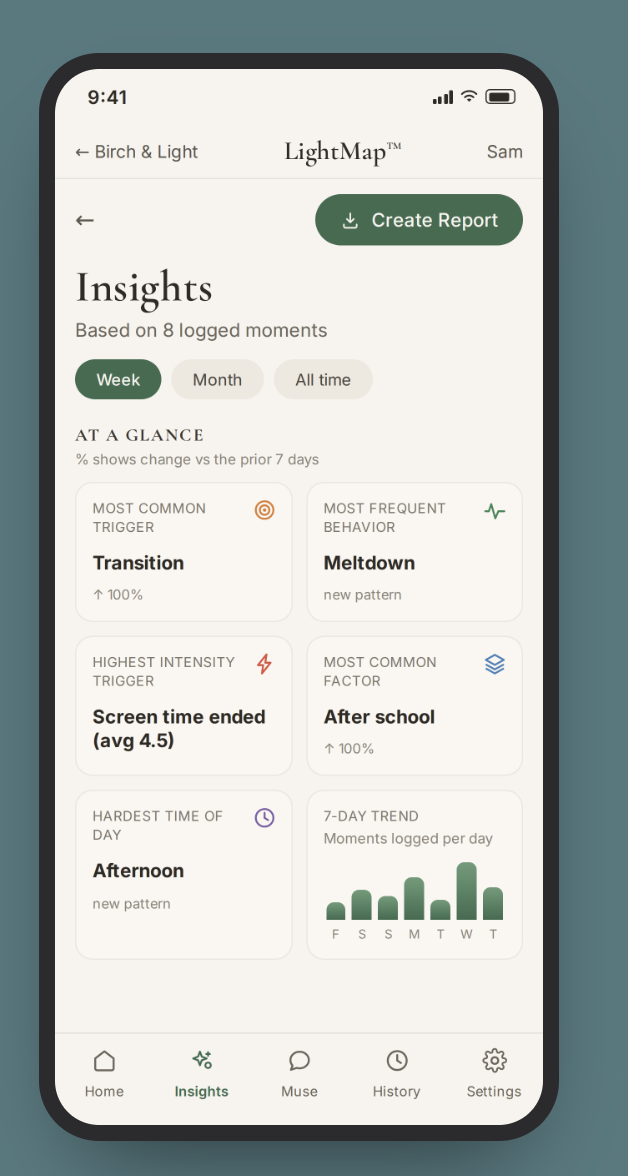

Part of the award-winning Birch & Light Method, honored with the Mom's Choice Gold Award for excellence in family resources.
Before you go, grab the free guide
The 3 body-state triggers under most meltdowns, a script for the 30 seconds before it tips over, and a reset for after. Free.

You'll get the guide instantly, plus five free articles in your inbox every week. Real challenges (meltdowns, school mornings, picky eating, big feelings) and how to actually handle them. Unsubscribe anytime.
A story to read together
Sometimes the easiest way in is a story you read side by side.
- The Tower That Looked Fine
A tower in a quiet clearing tries to stay steady through every small thing nobody else seems to notice — until one tiny breath of wind causes her to fall, and a gentle hand begins to gather the blocks back.
Read the story  The Boy at the Edge
A boy finds calm by watching the world move from a window. When his stillness is mistaken for defiance, the moment escalates — and he learns that being calm doesn’t always protect you from being told no.
Read the story
Researched and drafted with AI assistance, reviewed before publication. Editorial standards