.jpg)
Your child says okay and means it. The gap is between agreeing and starting, which is a separate skill from willingness. Stopping one thing, holding the instruction, and organizing the first step all have to happen before the body moves, and some children cannot cross that gap on command. Shrink the first step and give a runway.
You ask your child to put on their shoes. They say "okay." You wait. Nothing happens. You ask again, a little firmer. Still "okay." Still no shoes. By the third ask your voice has an edge, and you're wondering whether they're ignoring you, testing you, or just not listening.
Here is the reframe that changes everything: in many cases, your child meant "okay" when they said it. The agreement was real. The problem isn't willingness — it's the distance between intending to act and being able to start.
The Gap Between "Okay" and Action
Saying yes is a social reflex. It happens fast, it smooths the moment, and it costs almost nothing. Starting a task is something else entirely. It asks your child to stop what they're doing, hold the instruction in mind, organize the steps, and physically begin — all while their attention is somewhere else.
For a lot of kids, especially those whose nervous systems are easily overloaded, that sequence isn't automatic. The "okay" is genuine. The start is the hard part. What looks like a child choosing not to move is often a child who hasn't been able to cross the gap between agreeing and beginning.
What Might Be Happening Underneath
There's rarely one reason. A few possibilities worth holding at once:
Task initiation is its own skill. Knowing what to do and being able to launch into it are different things. Some kids understand the request completely and still can't find the on-switch.
They were mid-something. Pulling attention off one thing and onto another takes a transition most kids can't do on command, especially if they were absorbed.
"Okay" was the fastest way to end the pressure. Agreeing makes the asking stop. It buys a moment. That isn't manipulation — it's relief-seeking.
The request felt bigger than it sounded. "Put on your shoes" can quietly contain: stop, get up, find the shoes, sit, untie, put on, fasten. To you it's one thing. To them it's seven.
Why Does Repeating Yourself Make It Worse?
When nothing happens, the natural move is to ask again — louder, sharper, more often. But if the issue is starting rather than willingness, more demand lands on a system that's already stuck. The volume goes up; the stuckness gets worse. Now there are two problems: the original task, and the rising tension around it.
The child isn't refusing the shoes. They're frozen at the edge of beginning, and each new reminder makes the edge feel higher.
While you're here, take the guide
What's Underneath is free: the three body-state triggers under most meltdowns, what to say in the minute before it tips over, and how to reset afterward.

You'll get the guide instantly, plus five free articles in your inbox every week. Real challenges (meltdowns, school mornings, picky eating, big feelings) and how to actually handle them. Unsubscribe anytime.
What Can You Do When Starting Is the Hard Part?
None of these are scripts. They're small shifts that lower the height of the start:
Shrink the first step. Not "put on your shoes" but "grab your shoes." One action is easier to launch than a chain of them.
Give the transition a runway. "Shoes in two minutes" lets the brain finish what it's on before switching.
Get alongside, not above. Sometimes starting together — you hand them one shoe — is all the momentum they needed.
Watch for the pattern, not the moment. If "okay but no movement" happens most at transitions, when tired, or around certain tasks, that's information about when starting is hardest — not a verdict on character.
Does an if-then plan help a child start?
Researchers call the gap between intending and doing the intention-action gap. A well-studied way to narrow it is the if-then plan, which psychologist Peter Gollwitzer calls an implementation intention. The plan links a cue to an action in advance: when the timer goes off, shoes go on.
Gawrilow and Gollwitzer tested if-then plans in children with ADHD in 2008. The children who used them improved inhibition of an unwanted response on a Go/NoGo task to the same level as children without ADHD. That task measured response control, not getting started, so it does not prove a plan will fix the shoe problem. It does show that children with ADHD can use a plan made ahead of time to steer behavior that is hard to control in the moment.
Try it in a calm moment, not at the door. Agree on the cue together, keep it to one action, and let your child say the plan out loud: when the timer goes off, I pick up my shoes.
When should you ask for help?
If okay-but-stuck follows your child across home, school, and activities, or comes with trouble holding multi-step directions, bring your notes to the pediatrician or the school. A record of when starting is hardest tells a clinician far more than a general description does.
The Shift Worth Making
The question isn't "why won't my child listen?" It's "what makes starting so hard right here?" One leads to more pressure. The other leads to understanding — and usually, to a child who can finally move.
When you start noticing where the "okay but stuck" moments cluster, a pattern almost always appears. That pattern is the thing worth following.
Every behavior is a clue.
If you're watching a child who agrees and then can't seem to start, LightMap can help you track where the stuck moments cluster — which transitions, what time of day, which kinds of requests — so the pattern beneath them becomes easier to see. Explore LightMap at birchandlight.com/lightmap.
For your child: But I Said "Okay" is about Owen, who means it every time he agrees to stop, and still cannot pull himself off what he is doing.
Sources: Barkley on executive function and task initiation in ADHD; peer-reviewed research on the intention-action gap and initiation difficulty (PMC); research on attention shifting and task switching in children (PMC). Gollwitzer PM, "Implementation intentions: Strong effects of simple plans," American Psychologist, 1999;54:493-503. Gawrilow C, Gollwitzer PM, "Implementation intentions facilitate response inhibition in ADHD children," Cognitive Therapy and Research, 2008;32:261-280, doi:10.1007/s10608-007-9150-1.
For education and reflection, not medical advice. Our terms
See what's underneath
Stop guessing which demand did it
LightMap reads your hard days together and gives you answers. Start with one moment today.
Start with 3 moments Not sure where to start? Ask me.Message Tara on WhatsApp. It really is me, I read everything and will personally respond.Click here to message Tara →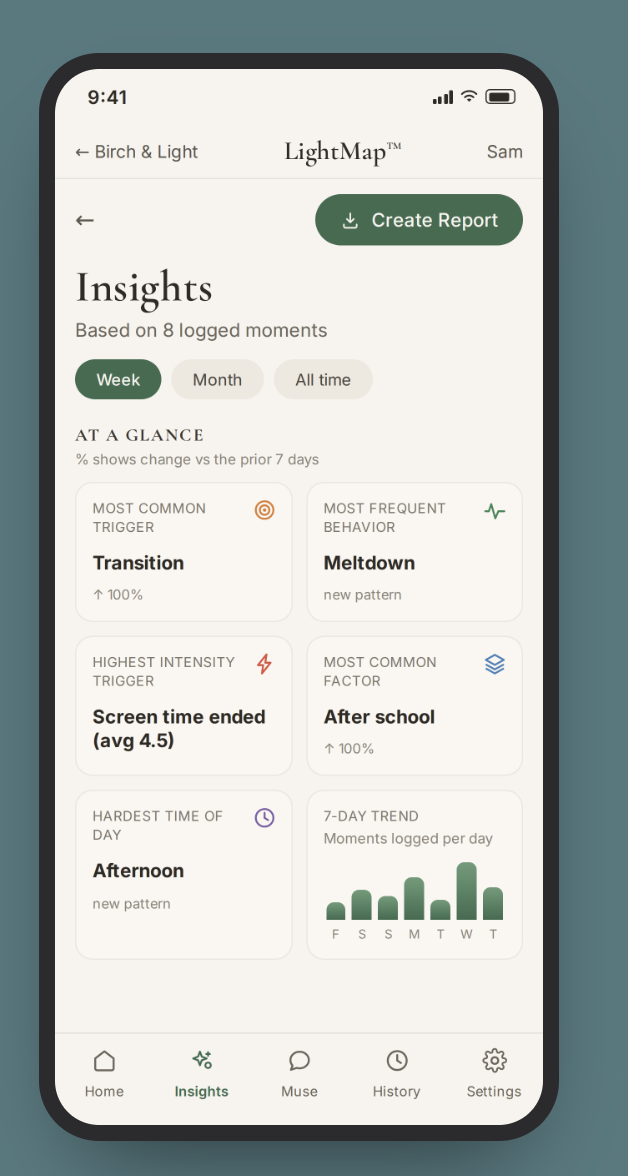

Part of the award-winning Birch & Light Method, honored with the Mom's Choice Gold Award for excellence in family resources.
A story to read together
Sometimes the easiest way in is a story you read side by side.
 The Tower That Looked Fine
A tower in a quiet clearing tries to stay steady through every small thing nobody else seems to notice — until one tiny breath of wind causes her to fall, and a gentle hand begins to gather the blocks back.
Read the story The Boy at the Edge
A boy finds calm by watching the world move from a window. When his stillness is mistaken for defiance, the moment escalates — and he learns that being calm doesn’t always protect you from being told no.
Read the story
If today was one of those days
A few more from the library, free to read.
Researched and drafted with AI assistance, reviewed before publication. Editorial standards