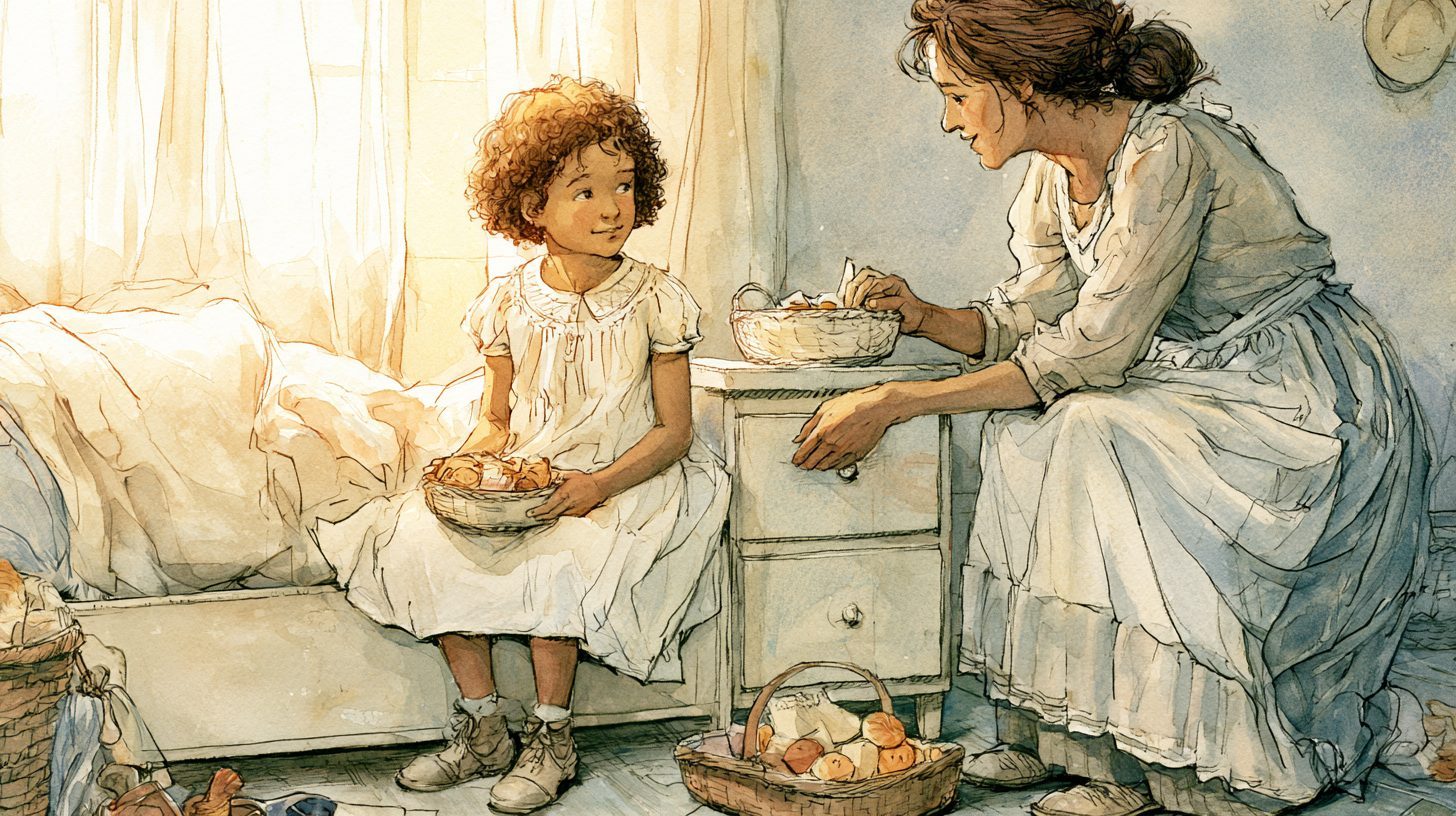
A child who saves empty paper towel tubes, twist ties and a drink carrier is usually collecting, not hoarding. Collecting is ordinary in childhood, and ADHD can make the saving louder and the letting go harder. A few signs mean it deserves a closer look, and they are listed below.
Today it was a drink carrier. Last week it was a shiny clothing tag. You let your child keep the school papers, you thin out the bin every so often, and the bin fills right back up. Everything is special. Everything can be reused. Now the collection is creeping out of their room and into the hallway, and somewhere between the third cardboard tube and the fifth twist tie you started to wonder whether this is going to be a problem.
Is it normal for a child to save trash?
More normal than most parents expect. A review of the research on pathological hoarding in young people noted that up to 60 percent of normally functioning children and adolescents collect things (Aerts et al., 2012). It often starts in the early school years, and what gets collected is rarely valuable. Rocks, bottle caps, wrappers and cardboard are the usual haul.
Why the junk feels like treasure
From the outside it looks like clutter. From the inside there is usually a reason, and it helps to guess which one you are looking at.
It is material. A paper towel tube is a telescope, a tunnel, a sword. A child who says everything can be reused is often being literal. The object is a project that has not happened yet, and throwing it away deletes the project.
It feels good. Shiny, smooth, crinkly and clicky things hold some children's attention in a way little else does. The tag or the tie may be the whole point, not a stand-in for something else.
It is theirs. Children have very little control over their days. A pile they get to decide about is a place where they are in charge. A strong attachment to possessions is part of normal development, and the first treasured object is often a blanket or a stuffed animal.
Deciding is hard. Keeping costs nothing today. Throwing away asks a child to compare, predict and risk regret all at once. For a child with ADHD, that is a lot of executive work for a drink carrier.
Where ADHD comes in
Researchers have noticed that hoarding behaviors and ADHD travel together more often than chance would suggest. In a clinic sample of 99 children and teens with ADHD, aged 8 to 17, inattentive and hyperactive-impulsive symptoms were what separated the young people with clinically significant hoarding from those without. Other obsessive-compulsive symptoms did not predict it (Hacker et al., 2016). A separate study of 431 youths with OCD found that problems with executive function, the planning, organizing and inhibiting skills that ADHD affects, were related to how severe the hoarding was, even after accounting for ADHD symptoms (Park et al., 2016).
Two cautions. Both studies drew on clinic samples and parent or clinician ratings, so they describe young people who were already being seen, not every child with ADHD. And they show a link, not a cause. The most useful reading for a parent is practical: if sorting, organizing and deciding are hard for your child, letting go will be harder, and a plan that takes some of that work off them will help more than a lecture about clutter.
Collecting, or something to look at more closely?
The diagnosis of hoarding disorder rests on three things. Persistent difficulty parting with possessions, whatever their value. Distress at the idea of getting rid of them. And accumulation that clutters living areas enough that they can no longer be used as intended. For children, the diagnostic manual adds a note: because children do not control their living space, a parent keeping rooms usable can hide the problem, so the picture has to account for what the adults are doing (American Psychiatric Association, 2013).
In practice, the number of things matters less than what happens around them. These are the kinds of signs clinicians ask about:
- Real distress, tears or rage, when an item is moved, even one nobody could call special
- Items spreading into shared spaces after you have set limits
- Refusal to let anyone touch the stash, including to clean around it
- Saving things that are dirty, spoiled or unsafe
- A collection that keeps growing and gets more rigid over months, rather than shifting with your child's interests
- Things that are saved but never used, played with or shown to anyone
- Collecting that crowds out friends, play or sleep
If the saving began abruptly, over days, alongside new fears, rituals or a change in personality, that onset pattern deserves a wider look than a tidying plan. The piece on sudden onset OCD in PANS covers it.
What helps
None of this has been tested in a trial for young children. A 2016 review concluded that hoarding disorder holds up as a diagnosis in youth, that no evidence-based treatment exists yet, and that cognitive and behavioral methods look promising in case studies (Morris et al., 2016). So treat what follows as sensible starting points, not a protocol.
Give it a home with a boundary. One bin or one shelf belongs to your child. When it is full, something goes out before something comes in. The limit lives with the container, not with you, which turns a daily argument into a rule about a box. Shared spaces stay off limits, said once, kindly, and held.
Make the decision smaller. Ask which three they want to keep, not which things can go. For some children a photo can stand in for the object. A display shelf makes the best pieces count for more than the pile does, and small pocket-sized treasures can replace the big awkward ones.
Sort together, and never in secret. A purge a child discovers later tends to teach hiding, not letting go, and it spends trust you will need for bigger things. Keep sessions short, after a snack, when nothing else is going on, and let your child hold each item and decide. Stop before the distress peaks, even if the bin is not done.
Give the idea a yes. If everything can be reused, let it be reused. A builder hour once a week, aimed at a marble run or a robot, turns saving into using, and the leftovers are easier to release once the project is finished.
Keep your reaction flat. Disgust or alarm teaches a child that their objects are dangerous to show you. Curiosity about what each one is for keeps them talking, and what they say is the best map of why they keep it.
When to ask for help
Bring it to your child's pediatrician, or to a child psychologist who knows OCD and related problems, if several of the signs above fit, if the saving causes real distress, or if it is limiting where the family can live and move. Ask directly whether the clinician has worked with hoarding behaviors in children, since not every child therapist has. If your child has ADHD, it is worth asking whether executive function has been looked at, because that may be part of what makes sorting and discarding so hard.
The part to hold onto
Most children who save cardboard are doing what children have always done. The job is not to stop the saving. It is to keep the house usable, protect their trust, and notice whether the keeping is joyful or frightening. A child who proudly shows you their shelf is in a different place from one who panics when you walk past it.
If the pattern runs the other way and your child suddenly wants everything gone, that piece covers it, and if the saving is about food, see food hoarding and night eating.
The days you sorted the bin, what your child chose to keep, and how they reacted: log those moments in LightMap, and a few weeks later you can see whether the distress follows the object, the time of day or the kind of day they had.
This is general information for parents, not medical or diagnostic advice. Sources: Aerts L, Janssen EPCJ, Janssen NJJF, Boogaard LH, Fincken JMC, Voogd LPA, van Well GThJ, Schieveld JNM, "Pathological hoarding by children and adolescents," Tijdschrift voor Psychiatrie, 2012, 54(4), 349-357 (up to 60 percent of normally functioning children and adolescents collect). Hacker LE, Park JM, Timpano KR, Cavitt MA, Alvaro JL, Lewin AB, Murphy TK, Storch EA, "Hoarding in Children With ADHD," Journal of Attention Disorders, 2016, 20(7), 617-626, doi 10.1177/1087054712455845 (99 youth with ADHD aged 8 to 17, inattention and hyperactivity-impulsivity differentiated clinically significant hoarding, nonhoarding OCD symptoms did not). Park JM and colleagues, "ADHD and executive functioning deficits in OCD youths who hoard," Journal of Psychiatric Research, 2016, 82, 141-148, doi 10.1016/j.jpsychires.2016.07.024 (431 youths with OCD, executive function related to hoarding severity adjusting for age, gender and ADHD symptoms). Morris SH, Jaffee SR, Goodwin GP, Franklin ME, "Hoarding in Children and Adolescents: A Review," Child Psychiatry and Human Development, 2016, 47(5), doi 10.1007/s10578-015-0607-2 (hoarding disorder supported as a distinct diagnosis in youth, no evidence-based treatment, preliminary case-study support for cognitive and behavioral methods). American Psychiatric Association, Diagnostic and Statistical Manual of Mental Disorders, Fifth Edition, 2013, hoarding disorder criteria A to C and the note on children and living environment.
LightMap by Birch & Light
See what the keeping is really about
LightMap helps you see whether the distress follows the object, the hour, or the day, so you can plan around it.
Get 7 days of LightMap free.
Enter your email and I'll send your link and a short guide to your first week. No card.
No card. No password yet.
7 days free, no card needed.
Or get a free 15 minute LightMap Analysis with TaraFree. No card. 15 minutes.
“LightMap showed me patterns I wasn't connecting before. Things that looked random stopped feeling random.”
 Not sure where to start? Ask me.Message Tara on WhatsApp. It really is me, I read everything and will personally respond.Click here to message Tara →

Part of the award-winning Birch & Light Method, honored with the Mom's Choice Gold Award for excellence in family resources.
For education and reflection, not medical advice. Our terms
Take the guide for later
What's Underneath: the three body-state triggers under most meltdowns, what to say before it tips over, and how to reset afterward.
You'll get the guide instantly, plus five free articles in your inbox every week. Real challenges (meltdowns, school mornings, picky eating, big feelings) and how to actually handle them. Unsubscribe anytime.
More about Neurodivergence
Related reading from the Birch & Light library.
Researched and drafted with AI assistance, reviewed before publication. Editorial standards