.jpg)
It shows up everywhere. He tells his friends how to hold the controller, which strategy to run, what to order, when to leave. He tells the adults in his house how to drive, how to cook, how to do things they have been doing competently for decades, and if the instructions are not followed, things escalate. The friends, loyal ones, are visibly wearing down. The adults are past worn down. And underneath all of it is a teenager who is, by every honest measure, lonely.
If this is your house, the first thing worth saying is that you are likely reading the behavior backwards, which is easy to do, because from the outside it looks like arrogance. It almost never is.
Control is what anxiety looks like when it grows up
In younger children, the need to run every game reads as bossiness. By the teen years the same engine produces something that looks more like command and contempt, but the engine has not changed: for a demand-avoidant nervous system, other people are unpredictable, and unpredictability reads as threat. Directing everyone is not a power grab. It is threat management. Every instruction issued is a variable pinned down. A teen with PDA, especially one carrying trauma on top of it, has a nervous system that treats loss of control the way most of us treat physical danger, and issuing orders is the tool that has always worked to make the alarm quieter.
This is also why it is worst at home. A teen who can hold it together in public, at an activity, around acquaintances, is spending enormous effort to do so, and that effort has a budget. Home is where the budget runs out. The people who get the rawest version are the people whose love he is certain of. It is a terrible compliment, but it is a compliment: he does not mask with you because some part of him believes you will still be there after. That explanation matters, and it also does not make constant correction and cursing acceptable, which we will get to.
The friendship problem is real, and he probably knows
Teens with this profile are frequently caught in a loop they can see but cannot steer out of: they want the friends desperately, the controlling behavior is what discharges the anxiety of having the friends over, and the behavior erodes the very thing they are trying to hold onto. Lecturing him about it after the friends leave tends to fail because it arrives as one more demand, aimed at the exact behavior his nervous system is using to stay regulated. If the instant no to almost anything asked of him is the wider pattern, why demands trigger instant resistance explains the machinery underneath it.
What works better is structural. Steer hangouts toward formats where a directing role is legitimate: he is the game master, the one teaching the thing, the one who plans the outing. A role with sanctioned control satisfies the need without spending the friendship. Keep gatherings shorter than anyone wants, because control escalates as regulation depletes, and a good ninety minutes protects the relationship better than a draining afternoon. Coach through the side door, in the car, days later, framed as information rather than verdict: not "you were bossy," but "I noticed the guys went quiet when the rules kept changing, what do you think that was." And when a friend does push back on him directly, resist the urge to pile on. One natural consequence, delivered by a peer, teaches more than a season of adult commentary, and your job in that moment is to be the safe place he processes it, not a second prosecutor.
While you're here, take the guide
What's Underneath is free: the three body-state triggers under most meltdowns, what to say in the minute before it tips over, and how to reset afterward.

You'll get the guide instantly, plus five free articles in your inbox every week. Real challenges (meltdowns, school mornings, picky eating, big feelings) and how to actually handle them. Unsubscribe anytime.
At home: fewer demands, and a real line
Two things are true at once and the whole strategy lives in holding both.
First, the household demand load probably needs to come down. Not standards, demands: the running stream of instructions, corrections, and questions that a typical day contains. For a PDA nervous system every one of those is a small alarm, and a teen in constant alarm controls harder. Declarative language helps more than it should: "the trash goes out tonight" hangs in the air differently than "take out the trash." Offering the information and walking away, giving him authorship of when and how, routinely gets more cooperation than the direct order, which is maddening and also just true.
Second, being his safe place does not mean being his floor mat. A line about how he speaks to you is not a demand in the PDA sense, it is the architecture of the house, and it holds best when it is boring: stated once, calmly, in a regulated moment, not mid-battle. "I want to hear everything you think. I will not be cursed at. When that starts, I am going to walk away and we will pick it up later." Then actually walk away, without heat, every time. The consistency is the message. Escalation gets no audience; conversation always does.
The part nobody says out loud
If you are the adults absorbing all of this, especially if you are raising him without much backup, the wear is real and it accumulates. A teen with this profile plus trauma is genuinely a lot, and needing support is not a verdict on your love or your competence. If there is a therapist in the picture, or could be, look specifically for someone who works with demand avoidance and trauma together, because standard behavioral approaches tend to read this exact teen as oppositional and prescribe more control from the adults, which reliably makes it worse. And build in relief for yourselves wherever it exists, because the version of you that has slept and had an afternoon off holds the line at home far better than the version running on empty.
He is not trying to lose his friends. He is trying not to drown, with the only stroke anyone ever taught him. The work, slow as it is, is teaching a second one.
Patterns make this workable: when control spikes, what preceded it, how long the visit ran, what the week looked like. LightMap turns those observations into something you can see, and something a PDA-informed therapist can actually use.
Sources: Peer-reviewed research on control-seeking as an anxiety response in children and adolescents (PMC); research on cognitive rigidity and peer relationship strain (PMC); PDA Society (UK); Steinberg on adolescent development (PMC).
For education and reflection, not medical advice. Our terms
See what's underneath
Stop guessing which demand did it
LightMap reads your hard days together and gives you answers. Start with one moment today.
Start with 3 moments Not sure where to start? Ask me.Message Tara on WhatsApp. It really is me, I read everything and will personally respond.Click here to message Tara →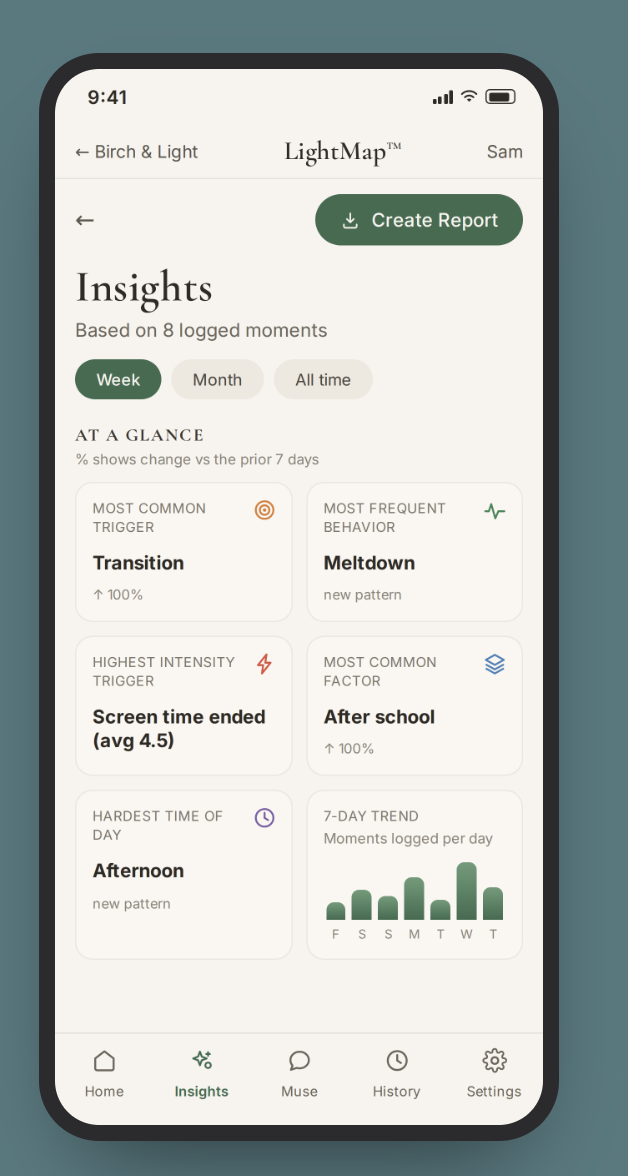

Part of the award-winning Birch & Light Method, honored with the Mom's Choice Gold Award for excellence in family resources.
A story to read together
Sometimes the easiest way in is a story you read side by side.
 Magnolia, Willow, and Pine
When the wind shifts in the clearing and Willow drifts toward Pine, Magnolia learns hurt feelings don’t have to mean closing forever.
Read the story Lyra and the Constellation That Changed
A small star watches her closest friend slowly drift away — and learns that her light was never measured by who stayed beside her.
Read the story
If today was one of those days
A few more from the library, free to read.
Researched and drafted with AI assistance, reviewed before publication. Editorial standards