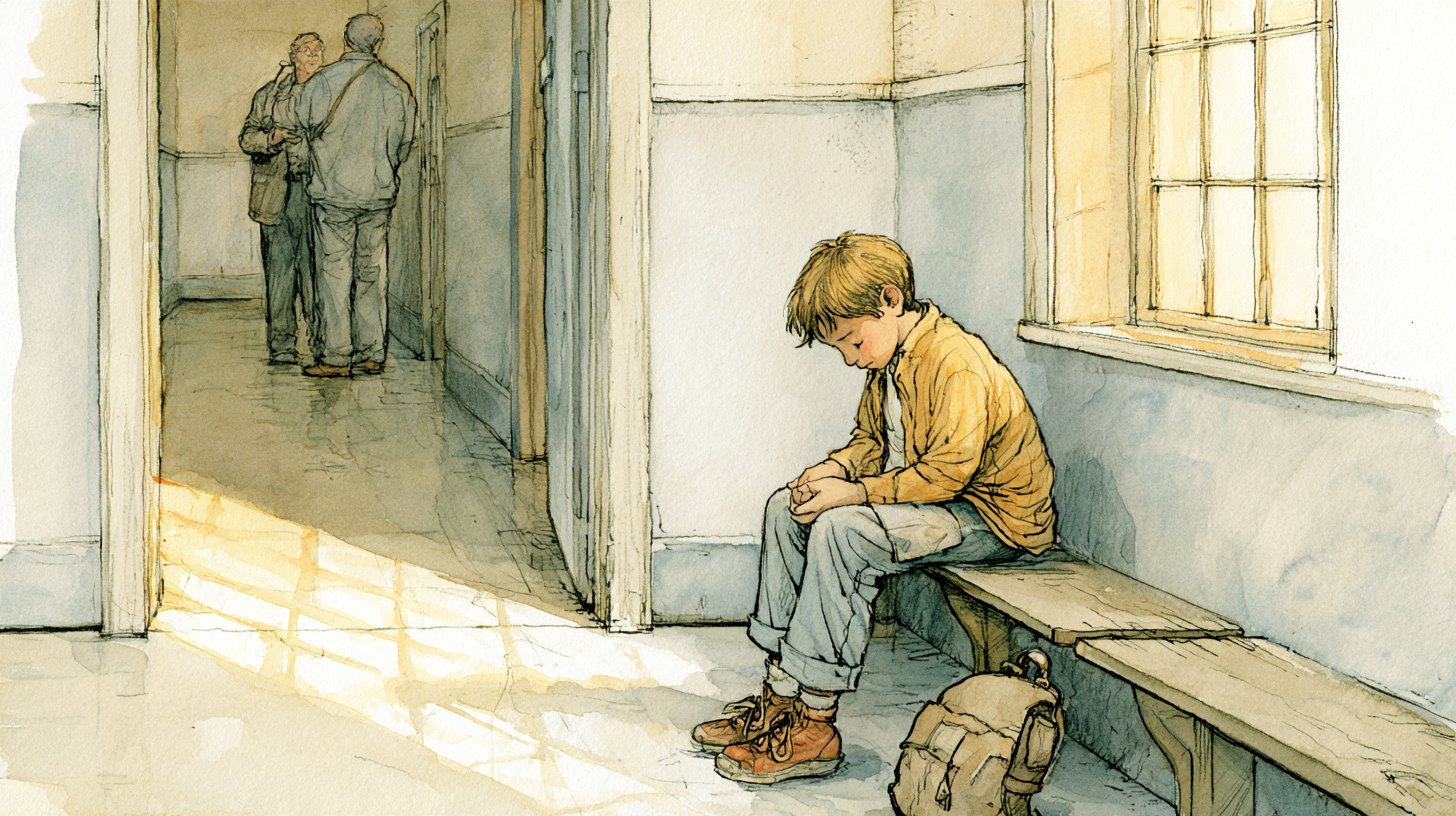
Your child tells you he cannot focus, and that the other kids are on him. The school tells you he is out of his seat, making noise, saying no to the next activity. You take the bullying part to the office and get told they will look into it. Then the next note home is about your child again, and the teacher says it is always him and nobody else.
You are not being asked to choose between those two accounts. They are usually the same story told from different ends.
This is general information about how schools handle these situations in the United States, not legal advice, and it reflects our best reading of the rules and research at the time of writing. State law and district policy vary, and a question about your child specifically belongs with someone who can read his file.
Both things are true more often than not
Students with disabilities are bullied at higher rates than their classmates. The national study most often cited on this looked at two federal longitudinal datasets and found victimization rates of about 25 percent in elementary school and 34 percent in middle school, roughly one to one and a half times the rate for students without disabilities. It also found that a student who was bullied once was at high risk of being bullied again, and that at elementary and middle school age, autistic students carried the highest risk of repeated victimization of any group.
So when a child with a diagnosis says he is being picked on, the base rate is on his side. That is not proof of anything in his particular hallway. It is a reason not to dismiss the report because he is also the child on the behavior log.
Why the school only sees the second half
There is a long-standing category in bullying research for children who are both targeted and reactive. Researchers call them bully-victims, or provocative victims, a group first described in Olweus early work: children who carry the anxiety and low self-esteem of a target along with visible aggression, who often provoke a response and cannot defend themselves well when it comes.
Work on peer victimization in children with ADHD names the consequence directly. Adults, including teachers and parents, may read a child with ADHD as the bully when the aggression they are watching is reactive, meaning it is a response to having been targeted first.
The mechanics of a classroom do the rest. Provocation is quiet and fast. A whisper, a poke under the desk, a chair moved an inch, a laugh at the right moment. The response is loud, late, and visible from across the room. An adult scanning twenty-five children catches the second half of the sequence almost every time, and does not see what preceded it.
Then the reputation compounds. Once a child is the one who gets spoken to, he is the one who gets looked at, and being looked at more means being caught more. That is how a teacher ends up believing, in good faith, that it is always him.
What this does not mean
It does not mean your child did nothing. He may well have hit, shouted or thrown something, and that is still a problem that needs work, and other children in that room need to be safe from it.
Holding both at once is the strongest position you can take into a meeting. A parent who argues that their child is blameless loses the room in about ninety seconds. A parent who says "I am not disputing what he did, I am asking what happened first" is asking a question the school has to answer.
Making the report countable
"I mentioned it to the teacher" and "I filed a report" are different events with different consequences, and the difference is usually whether anything was written down.
Most states require districts to adopt a bullying policy and to have a procedure for reporting, investigating and responding to incidents. The specifics differ a great deal by state, including who receives the report, what timeline applies, and what the school owes you afterward. Your state page on the federal StopBullying site lists what your state actually requires, and the district policy itself is usually posted online or available from the office on request.
What turns a conversation into a report:
- Put it in an email rather than saying it at pickup, so it carries a date
- Name incidents, not impressions: what happened, when, where, who else was present, and who your child says was involved
- Use your district policy language and ask directly whether you are filing a report under it. Ask who the designated person is, if your state names one
- Ask what the investigation found, and ask for the answer in writing
- Keep every reply in one place. A pattern across six weeks reads very differently from six separate conversations that everyone remembers differently
LightMap is useful here for the home side of the record: what he said, when, the state he came home in, and the days it lines up with. You are not building a case. You are making sure that by the time anyone asks what has been happening, the answer is not a recollection.
While you're here, take the guide
What's Underneath is free: the three body-state triggers under most meltdowns, what to say in the minute before it tips over, and how to reset afterward.

You'll get the guide instantly, plus five free articles in your inbox every week. Real challenges (meltdowns, school mornings, picky eating, big feelings) and how to actually handle them. Unsubscribe anytime.
Ask for what came before, not how many times
If the school frames this entirely as behavior, use their own frame. The question that changes the conversation is about antecedents: what was happening in the five minutes before the incidents.
That is what a functional behavioral assessment is designed to look at. It examines what comes before a behavior and what it achieves for the child, rather than counting the behaviors. If a child is reacting to being targeted, an honest assessment of antecedents tends to surface it, because the pattern shows up around the same peers and the same unsupervised minutes.
Ask when it happens, too. Bus, hallway, lunch, recess and the walk to specials are where supervision thins out, and they are frequently missing from a behavior log built entirely from classroom incidents.
Where federal rules come in
If your child is a student with a disability, there is a layer above the district policy. The Department of Education Office for Civil Rights issued guidance in October 2014 on bullying of students with disabilities, and as of September 2026 it remains listed as current policy guidance on the Department site, alongside a plain-language fact sheet for parents.
The guidance describes how that office analyzes a complaint: whether the student was bullied based on disability, whether it was serious enough to create a hostile environment, whether school officials knew or should have known, and whether the school responded appropriately. It also makes a second point that matters more in situations like yours. Even when the bullying is not based on disability, a district still owes a student with a disability an appropriate education, and a decline in that student''s performance or behavior can be the signal that the current plan needs to be looked at again.
Two limits to hold alongside that. These letters are an agency''s explanation of how it enforces existing regulations rather than new law, and they can be withdrawn or revised. And a diagnosis by itself does not make a child a student with a disability under Section 504. That determination belongs to the district. A parent can request an evaluation and is entitled to a decision, to notice of that decision and to a route to challenge it, which is not the same as an automatic right to have the evaluation done.
What to ask your own child
"Are you being bullied" is a hard question for a seven-year-old. It asks him to apply a word he has heard mostly in assemblies, and it invites a yes or a no.
Smaller questions get further. Who sits near you. Who did you play with today. What happened right before you got in trouble. Where were you. Was anyone laughing. Ask them at a low-pressure moment, in the car or at bedtime rather than across a table.
And be careful with "just ignore it." For a child whose reactions are already faster than his brakes, ignoring provocation is a demand on the exact system that is not yet online. It usually reads to him as one more adult telling him the problem is his.
You do not have to establish who started it before anyone acts. You have to get the question asked in writing, by someone whose job is to answer it.
Sources, tied to the claims they support. The victimization rates of about 25 percent in elementary school and 34 percent in middle school, the comparison of one to one and a half times the rate for students without disabilities, the elevated risk of repeated victimization after a first incident, and the finding that autistic students at elementary and middle school age faced the greatest risk of repeated victimization: Blake JJ, Lund EM, Zhou Q, Kwok O, Benz MR, "National Prevalence Rates of Bully Victimization Among Students With Disabilities in the United States," School Psychology Quarterly, 2012;27(4):210-222. The bully-victim or provocative victim category as described in Olweus early work, and the finding that adults may perceive a child with ADHD as a bully when the aggression is reactive: Wiener J, Mak M, "Peer Victimization in Children With Attention-Deficit/Hyperactivity Disorder," Psychology in the Schools, 2009;46(2):116-131. State requirements for district bullying policies and for procedures to report, investigate and respond, and the state-by-state variation in what those policies must contain: StopBullying.gov, U.S. Department of Health and Human Services, "Laws, Policies and Regulations" and the accompanying state pages. The four-part analysis of a disability-based harassment complaint, and the continuing obligation to provide an appropriate education to a student with a disability regardless of the basis of the bullying: U.S. Department of Education Office for Civil Rights, "Dear Colleague Letter: Responding to Bullying of Students with Disabilities," October 21, 2014, with its parent fact sheet, listed as current policy guidance on ed.gov at the time of writing in September 2026.
For education and reflection, not medical advice. Our terms
See what's underneath
Keep the home side of the record
LightMap holds what you saw and what he told you, so the pattern is there when someone finally asks.
Start with 3 moments Not sure where to start? Ask me.Message Tara on WhatsApp. It really is me, I read everything and will personally respond.Click here to message Tara →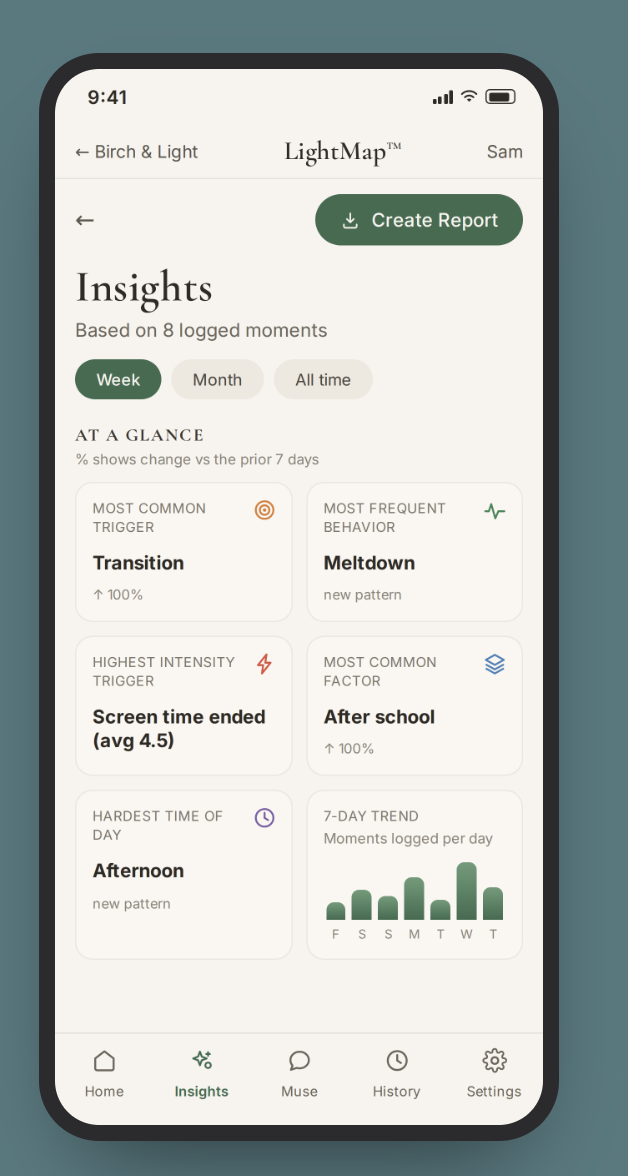

Part of the award-winning Birch & Light Method, honored with the Mom's Choice Gold Award for excellence in family resources.
Researched and drafted with AI assistance, reviewed before publication. Editorial standards