
The children most likely to lose recess are the ones who cannot sit still through a morning of instruction, because many schools can withhold it for behavior or unfinished work. Many state recess laws still allow removal as discipline, so the protection that holds is a 504 plan or IEP that makes recess non-contingent.
Your child came home again and told you they sat inside at a desk while the rest of the class went out.
Maybe the worksheet was not finished. Maybe there was a warning about calling out, then a second warning, then a consequence. Maybe nobody told you at all and you found out three weeks later.
Here is the thing you already know in your body and have never seen written down. The child who cannot hold still through a morning of instruction is the child most likely to lose the twenty minutes designed for moving. The child who blurts is the one who loses the block of unstructured time where blurting is allowed. The child whose executive function collapses around eleven is the one kept in to finish the work that collapsed.
This is not a story about cruel teachers. It is a story about discretion. In a nationally representative survey of public elementary schools, fewer than half prohibited staff from withholding recess for poor behavior, and only about half prohibited withholding it to finish schoolwork. The practice was more common in schools serving lower-income students. Where no policy says otherwise, the call belongs to whoever happens to be standing in the room.
Why does taking recess away backfire?
The American Academy of Pediatrics put it as directly as a policy document can. Recess should be considered a child's personal time, and it should not be withheld for academic or punitive reasons.
The reasoning is not sentimental. Physical activity improves attention, working memory, and mood, and the effect shows up after a single bout of movement rather than only over months. Behavior that gets labeled as acting out is less frequent on days a child has had recess than on days they have not. So removing recess to address classroom behavior removes the intervention and keeps the problem. The next hour gets harder, which produces more of the behavior, which produces another removal.
There is a second cost that almost nobody counts. Recess is where children practice joining, negotiating, taking turns, reading a group, and recovering from a small social failure. For a child who already finds those things effortful, missing recess means missing the only unstructured practice in the entire day. The skills the punishment is meant to teach are the skills the punishment prevents.
And there is a third. A child who is kept in while everyone else files out learns something about themselves in front of an audience, every time.
So what about all these new laws
If you have seen a headline about recess making a comeback, it was accurate. After two decades of shrinking, unstructured play is being written back into state law, and the pace picked up sharply this year. The decline it is recovering from is documented. In 2006, federal survey data showed nearly 97 percent of American elementary schools providing recess for at least one grade. By 2014 that had dropped to under 83 percent, with students averaging fewer than 27 minutes a day.
As of December 2025, researchers at the Johns Hopkins Bloomberg School of Public Health counted recess mandates in twelve states plus the District of Columbia. Another twelve states have physical activity laws, which are broader and can be satisfied by gym class or after-school sports rather than free play. Twenty-six states have no mandate of any kind.
Two states joined in 2026. Oklahoma doubled its requirement to forty minutes a day for kindergarten through fifth grade, passing the House 86 to 1, and that law forbids taking recess away as discipline. Pennsylvania added a thirty-minute daily elementary requirement through its July budget, and that one does allow teachers to withhold recess as a disciplinary action. Kansas passed a thirty-minute mandate that also banned disciplinary removal, and the governor vetoed it on the grounds that curriculum belongs to the state board of education rather than the legislature. The veto was sustained.
You may also see it reported that these laws now run through middle school. They mostly do not. The overwhelming majority stop at fifth or sixth grade. What did change is guidance: in June 2026 the AAP updated its policy statement to recommend recess for students of all ages, including middle and high school, with multiple breaks of at least twenty minutes. That is a recommendation to schools, not an obligation on them.
The sentence that matters more than the minutes
Take New Jersey, which passed one of the earliest laws and is often held up as a model. Since the 2019-2020 school year, districts have owed every student in kindergarten through fifth grade at least twenty minutes of daily recess, held outdoors when feasible, and the law is explicit that recess cannot be used to satisfy physical education requirements.
Then comes the exception. A student may not be denied recess for any reason except as a consequence of violating the district's code of student conduct. A student cannot lose it more than twice in one week, and the school has to provide restorative justice activities during that time. Separately, recess can be withheld on the advice of a medical professional or school nurse, or under the terms of a 504 plan.
Read that as a parent of a child who is dysregulated by ten in the morning and the shape of the problem is obvious. Codes of student conduct are written around blurting, refusing, leaving a seat, arguing with an adult, touching another child. For a lot of neurodivergent kids those are not a series of choices. They are what a day looks like when the demands exceed the capacity.
The protection is real, and the loophole is shaped like your kid.
Even where the minutes are mandated they do not reliably arrive. In one state that requires forty minutes, a review of published elementary schedules from the 2023-2024 school year found average daily recess totaling about thirty-four minutes, with upper grades getting less than lower grades. In a study of low-income elementary schools in California, only 56 percent provided more than twenty minutes a day. No federal system tracks whether a recess law changes what happens inside a building.
While you're here, take the guide
What's Underneath is free: the three body-state triggers under most meltdowns, what to say in the minute before it tips over, and how to reset afterward.

You'll get the guide instantly, plus five free articles in your inbox every week. Real challenges (meltdowns, school mornings, picky eating, big feelings) and how to actually handle them. Unsubscribe anytime.
What can you do before it happens again?
The state law will not protect your individual child. The plan will. Here is the order to work in.
Find out what has already happened. Email the teacher and ask three specific questions: how many times has my child missed all or part of recess this year, what was the reason each time, and what did they do instead. Ask in writing rather than at pickup, and ask for a number rather than an impression. In most buildings nobody has been counting, and the act of asking starts the counting.
Read your own state's exception, not just its headline. The minutes are the part that gets reported. The removal clause is the part that will affect your child, and it usually sits one sentence further down. If your state allows removal for code-of-conduct violations, get a copy of the code and read what counts.
Get it into the 504 or the IEP. This is the piece most parents never learn. State recess laws generally carve out an exception for medical advice and for 504 plans, which means the plan can override the classroom default. A plan is a binding document. A conversation at pickup is not.
You can request a 504 or IEP team meeting in writing at any time. You do not need to wait for the annual review, and you do not need a new diagnosis. Ask for language along these lines, adapted to your child:
Recess and movement breaks are non-contingent. They will not be withheld, shortened, or delayed as a consequence of behavior, incomplete or missing work, or as an intervention or make-up period. Unfinished work will be completed at another time in the day. If a safety concern requires removing the student from the play area, the team will be notified in writing the same day and an equivalent movement opportunity will be provided.
The phrase doing the work there is non-contingent. It means the break is not something the child earns or forfeits. Without that word, a plan that simply says "movement breaks" leaves a staff member free to treat them as a privilege.
Ask for a functional behavior assessment if the same behavior keeps costing recess. A pattern of the same consequence for the same behavior is evidence the consequence is not working. An FBA asks what the behavior is accomplishing for the child, which is the question that has to be answered before any plan will hold.
Know why the discipline process will not help you here. Under Section 504 and IDEA, a school owes you a manifestation determination before a disciplinary removal that amounts to a significant change in placement, which generally means more than ten consecutive school days or a pattern of removals totaling more than ten days in a year. Losing recess does not reach that threshold. That is why it is used so freely, and why the plan is the only real lever. Do not wait for a formal process to catch it, because none will.
Bring a pattern, not an anecdote. A school hears one complaint about one Tuesday and files it. A school hears that recess has been removed nine times in six weeks, always before eleven, always on days with no scheduled movement break, and it becomes a problem the team has to solve. Log the dates as they happen. Six weeks of notes will do more in a meeting than any amount of explaining.
The thing to hold onto
The direction of travel is good. Pediatricians, researchers, and legislators across the political spectrum have landed on the same conclusion at roughly the same time, which does not happen often.
But a law that guarantees twenty minutes to the class is not a law that guarantees twenty minutes to your child. The gap between those two things is where a lot of our kids live. Closing it, in one building, for one student, still comes down to a parent putting one sentence into one document.
Sources: Johns Hopkins Bloomberg School of Public Health, Bloomberg American Health Initiative, "Play, Policy, and Potential: A Toolkit to Support Advancing Recess in Schools Through State Laws" and accompanying state fact sheets, December 2025. Murray R, Ramstetter C, Woolridge D, Brickman CW, American Academy of Pediatrics Council on School Health, "The Crucial Role of Recess in School: Policy Statement," Pediatrics, June 2026;157(6):e2026077025. Oklahoma Senate Bill 1481 (2026). Pennsylvania school code provisions enacted in the July 2026 state budget. Kansas House Bill 2763 (2026), vetoed April 2026, veto sustained. New Jersey Revised Statutes 18A:35-4.31 and New Jersey Department of Education Comprehensive Health and Physical Education recess law FAQ. Section 504 of the Rehabilitation Act of 1973 and its implementing regulations at 34 C.F.R. Part 104, including 104.35 and 104.36; Individuals with Disabilities Education Act, 20 U.S.C. 1400 et seq. Howie EK, Harden SM, Lemus J, Stone B, Barr-Anderson DJ, Long CR, "When to Eat and When to Play: Variations in Recess and Lunch Scheduling Within a State 40-Min Recess Policy," Journal of School Health, 2025. Thompson HR, London RA, "Not all fun and games: Disparities in school recess persist, and must be addressed," Preventive Medicine Reports, October 2023, analysis of 153 low-income California elementary schools, 2021-22 school year. Tsai MM, Olarte DA, Hager ER, Cohen JFW, Turner L, "Prevalence of Recess and Supportive Practices at a Nationwide Sample of Public Elementary Schools in the United States," Journal of School Health, 2024;94(4):366-373, doi 10.1111/josh.13368. Centers for Disease Control and Prevention, School Health Policies and Practices Study, 2006 and 2014, as reported by Ramstetter C and Murray R in American Educator. State requirements and federal guidance change; confirm your own state's current law and its exceptions, and consult your district's special education office or a parent advocate about your child's plan.
For education and reflection, not medical advice. Our terms
See what's underneath
Bring answers, not a worry
LightMap reads your hard days together and gives you answers. Start with one moment today.
Start with 3 moments Not sure where to start? Ask me.Message Tara on WhatsApp. It really is me, I read everything and will personally respond.Click here to message Tara →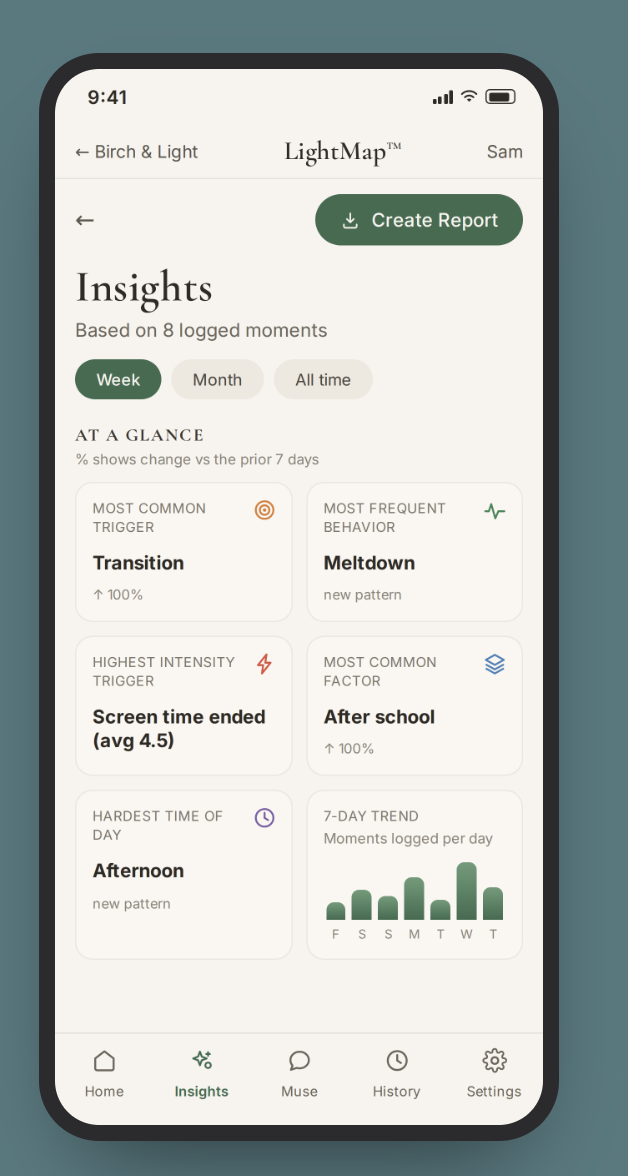

Part of the award-winning Birch & Light Method, honored with the Mom's Choice Gold Award for excellence in family resources.
If today was one of those days
A few more from the library, free to read.
Researched and drafted with AI assistance, reviewed before publication. Editorial standards