

You start to notice it only after you stop looking day to day. For a stretch, maybe a few days, maybe over a week, your child is regulated, connected, almost easy. You exhale. And then it turns. A crash arrives, and it is not a bad afternoon, it is a long stretch of total dysregulation that lasts and lasts before the good days return. Once you have seen the pattern a few times, it is unmistakable, and it is one of the loneliest things to describe, because the people around you are measuring hours and days while you are watching something that moves in weeks.
If that is your child, you are not imagining it, and you are not the only one tracking it. Cyclical dysregulation is real, and understanding it changes what you do with both the good stretches and the hard ones.
Tired of guessing what set your child off? Log tonight's moment in LightMap.
Why some kids move in cycles instead of lines
Most advice about regulation assumes a fairly steady baseline that good support nudges upward. But a lot of neurodivergent children, autistic kids and ADHD kids especially, do not run on a steady line. They run on a cycle: a build, a peak, a crash, a slow rebuild. The reason has to do with how much energy it costs these kids to hold themselves together.
Every day, an autistic or ADHD nervous system spends effort the rest of us spend without noticing: filtering noise, managing transitions, decoding social cues, holding still, coping with sensation. During a good stretch, your child has reserves, and the holding-together works, so you see the regulated, connected kid who is genuinely there. But the reserves are finite, and they draw down. When they run low enough, the system can no longer maintain the effort, and it drops into a crash. The crash is not a behavior problem or a regression of everything you built. It is a depleted nervous system that has to bottom out and rest before it can refill. Then, slowly, it rebuilds, and the cycle begins again.
What this has to do with burnout
The crash phase is what many parents and clinicians would recognize as a form of burnout. Autistic burnout is usually discussed in teens and adults, but the same mechanism shows up in younger children, just on a faster loop. The good stretch is the child running on available energy. The crash is the bill coming due. Seen this way, the cycle stops looking like your child being unpredictable or two different children, and starts looking like one child whose capacity rises and falls.
This reframe matters, because it changes what the crash asks of you. If the crash is depletion, then the response is not more correction, more demands, or a hunt for what you did wrong during the good week. It is the opposite: lower the load, reduce demands, protect rest, and let the bottom happen so the rebuild can start. You cannot discipline a depleted system back into regulation any more than you can scold someone out of exhaustion.

There's a story for this exact struggle
The Tower That Looked Fine
A tower in a quiet clearing tries to stay steady through every small thing nobody else seems to notice — until one tiny breath of wind causes her to fall, and a gentle hand begins to gather the blocks back.
Free to read. You'll also get five free articles a week. Unsubscribe anytime.
The good stretch is part of the cycle too
Here is the counterintuitive part. The crash is often set up during the good days. When your child is regulated and capable, it is tempting, and completely understandable, to pack those days: the outing you have been putting off, the birthday party, the visit, the catch-up on everything that is hard during a bad stretch. But a child running well is still spending reserves, often faster, because good days invite more demand. Sometimes the enormous good week is what funds the crash that follows.
This does not mean walling off the good days. It means spending them with some awareness. A regulated stretch is a chance to bank rest and connection, not only to cash in on productivity. Protecting some downtime even when your child seems fine can, over time, soften the size of the crash.
Why tracking it is the most useful thing you can do
A pattern that moves in weeks is nearly invisible in the moment and obvious on paper. If you can see a rhythm, a crash that arrives on a roughly regular interval, that regularity is information. A predictable cycle suggests something with a driver behind it, and the driver is worth finding.
Keep a simple log: mark each day as regulated, mixed, or crashed, and alongside it note sleep, illness, big demands or events, changes in routine, and, where relevant, any physiological cycles. Over a couple of months a shape usually emerges. Sometimes the crash tracks with accumulated demand. Sometimes it tracks with sleep debt, or illness, or a physiological rhythm. A clear log is what lets a good clinician tell the difference between burnout cycles, a sensory or demand load that keeps overspending, and a physiological trigger that deserves a medical look. Without the log, the cycle stays a mystery. With it, it becomes a question someone can actually answer.
The bottom line
If your child cycles between real regulation and a hard crash, you are watching capacity rise and fall, not a child who is inconsistent or a plan that keeps failing. The crash is depletion, and it asks for less, not more. The good stretch is worth spending with care, not just filling. And the pattern itself, once you track it, is the most useful thing you have, because a rhythm you can see is a rhythm someone can help you understand. You noticing this at all is the hard part, and you have already done it.
A cycle only becomes visible once it is written down against dates. LightMap is a place to log the hard days, and a few months in the timing either shows itself or rules itself out.
This is general information for parents, not medical or diagnostic advice. A regular, marked cycle of dysregulation is worth discussing with your child's clinician, especially if the timing is consistent.
For education and reflection, not medical advice. Our terms
See what's underneath
Next time, you will know what set it off
LightMap turns scattered hard days into a pattern you can see. Start by logging one moment tonight.
Find out why it keeps happening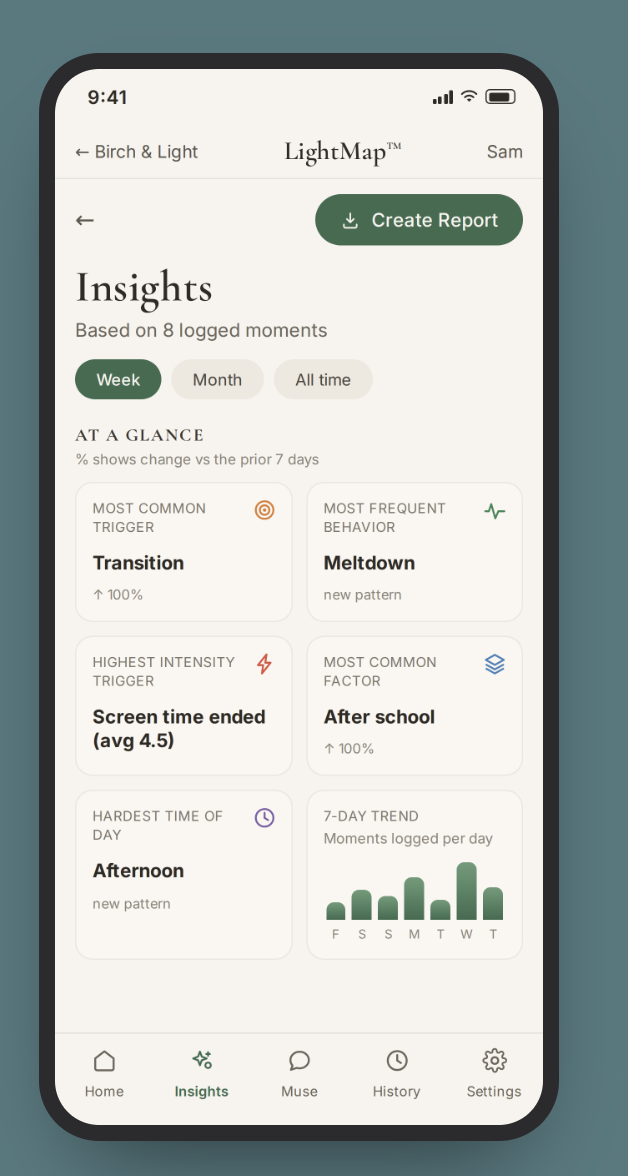

Part of the award-winning Birch & Light Method, honored with the Mom's Choice Gold Award for excellence in family resources.
Before you go, grab the free guide
The 3 body-state triggers under most meltdowns, a script for the 30 seconds before it tips over, and a reset for after. Free.

You'll get the guide instantly, plus five free articles in your inbox every week. Real challenges (meltdowns, school mornings, picky eating, big feelings) and how to actually handle them. Unsubscribe anytime.
A story to read together
Sometimes the easiest way in is a story you read side by side.
- The Tower That Looked Fine
A tower in a quiet clearing tries to stay steady through every small thing nobody else seems to notice — until one tiny breath of wind causes her to fall, and a gentle hand begins to gather the blocks back.
Read the story  The Princess and the Witch Inside
Esme is loved, but a fast protective part keeps rushing in before she gets a turn. A quiet visitor helps her meet the witch inside — not as an enemy, but as a worried protector — and find her way back to the people she wanted to be with all along.
Read the story
Researched and drafted with AI assistance, reviewed before publication. Editorial standards