.jpg)
Bedtime falls apart in summer because school removes the fixed wake time, the early light, and the routine that hold a child's body clock steady. Without those anchors, bedtime drifts and sleep shrinks, and a child already near their limit turns irritable by day. A steady wake time and the same wind-down routine hold the clock in place.
It starts innocently. School's out, the evenings are long and light, and there's no reason to be rigid about bedtime anymore. So it drifts — a little later each night, the routine gets loose, weekends and weekdays blur together. And within a couple of weeks you have a child who won't settle at night, won't wake in the morning, and is somehow more irritable, more reactive, and more prone to falling apart during the day than they were when school was in session.
It can feel like a coincidence — like your child just got harder over the summer. But the timing usually isn't a coincidence. For a child whose nervous system already runs close to its limits, sleep is not a soft, flexible thing you can loosen without cost. It is part of the foundation that everything else stands on. And when summer quietly erodes it, the cracks show up everywhere.
Why Sleep Is Load-Bearing
For any child, sleep matters. But for a child who is sensitive, easily overwhelmed, or already working hard to regulate, sleep does extra structural work, and losing it costs more.
A well-rested nervous system has margin — a buffer of capacity to absorb frustration, manage transitions, tolerate sensory input, and recover from upsets. Sleep is largely how that margin gets rebuilt each night. A child who sleeps well wakes with a full reserve to draw on through the day's demands.
Take sleep away, even a little, and the margin shrinks. The same child, under-rested, hits their limit faster, recovers slower, and reacts bigger to smaller things. Nothing else changed — the world is asking the same of them — but they're trying to meet it with a depleted reserve. What looks like "summer made them harder" is often just "summer thinned out the buffer that was helping them cope."
Sleep isn't a nice-to-have for a sensitive child. It's the nightly rebuild of the capacity they spend all day drawing down.
Why Does Summer Erode Sleep So Easily?
Summer attacks sleep from several directions at once, which is why it unravels faster than parents expect.
The anchors disappear. The school year enforces sleep through hard edges — a fixed wake time, a known bedtime, a routine that runs on rails. Summer removes the edges, and without them, bedtime drifts and the body's clock loses its reference points. In one study of elementary school children, sleep midpoint shifted later by an average of 1.5 hours over the summer.
The light works against you. Long summer evenings mean it's bright when it's time to wind down, and the body takes its cues from light. A child being asked to sleep while the sky is still glowing is fighting their own biology.
The rhythm gets erratic. Late nights, variable wake times, naps that appear and disappear, weekends that look nothing like weekdays — the inconsistency itself is destabilizing. A nervous system that craves predictability loses one of its most important regular rhythms.
The days are more activating. Summer often brings more stimulation, more outings, more excitement — and a more activated child is a harder-to-settle child at night, which pushes bedtime later still, compounding the problem.
While you're here, take the guide
What's Underneath is free: the three body-state triggers under most meltdowns, what to say in the minute before it tips over, and how to reset afterward.

You'll get the guide instantly, plus five free articles in your inbox every week. Real challenges (meltdowns, school mornings, picky eating, big feelings) and how to actually handle them. Unsubscribe anytime.
The Cycle It Creates
What makes this worth taking seriously is that it feeds itself. Less sleep shrinks the daytime margin, so the child is more dysregulated during the day. A more dysregulated, more activated child is harder to settle at night, so they sleep even less. The thinner reserve makes the next day harder, which makes the next night harder. Within a couple of weeks, a small initial drift has compounded into a child who seems transformed — and the original cause, a loosened bedtime, is no longer obvious as the root.
The good news embedded in that cycle: because sleep is upstream of so much, steadying it is one of the highest-leverage things you can do. Fix the foundation and a surprising amount of the daytime difficulty often eases with it.
How Do You Get Bedtime Back on Track?
Protect the anchors even as everything else loosens. Summer should feel different — later nights sometimes, more flexibility — but a roughly consistent wake time and a roughly consistent bedtime hold the body's clock steady underneath the flexibility. For a school-age child, the American Academy of Sleep Medicine recommends 9 to 12 hours of sleep in every 24, which gives you a target to work backward from. You can loosen a lot if you keep the anchors. It's losing the anchors entirely that does the damage.
Keep the wind-down routine intact. The sequence that signals sleep to the body — the same steps in the same order — matters more in summer, not less, precisely because the external cues (darkness, a tiring school day) are weaker. A reliable routine supplies the cue the season took away.
Manage the light. Darkening the room against the long evening light helps the body do what the sky won't let it. Dimming things in the last stretch before bed supports the natural wind-down that summer evenings disrupt.
Watch the activation curve toward evening. Front-loading the stimulating, exciting parts of the day and letting the evening genuinely calm gives an easily-activated child a runway to settle, rather than asking them to drop from high stimulation straight into sleep.
Treat a rough patch as a signal, not a new normal. When the days start getting harder, look at the nights first. Sleep is so often the upstream cause that checking it early can save weeks of escalating difficulty.
The Shift Worth Making
If your child got harder over the summer, it's worth looking at bedtime before concluding anything about your child. Loosened sleep doesn't announce itself — it shows up indirectly, as irritability, reactivity, and daytime meltdowns that seem to come from nowhere. But for a sensitive nervous system, the nightly rebuild of capacity is foundational, and quietly eroding it unravels everything built on top.
Steadying sleep isn't about being rigid or refusing your child a real summer. It's about keeping the foundation intact underneath the flexibility — so the season's freedom doesn't come at the cost of the regulation your child needs to enjoy it.
Every behavior is a clue.
If your child's days got harder as the bedtimes got looser, LightMap can help you track the connection between sleep and the next day's regulation — so the pattern beneath it becomes easier to see. Explore LightMap at birchandlight.com/lightmap.
For your child: When Axel's Engine Stayed On is about a boy who comes home from a huge day too tired to settle, with his engine still running.
Sources: Moreno JP et al., "Later sleep timing predicts accelerated summer weight gain among elementary school children: a prospective observational study," International Journal of Behavioral Nutrition and Physical Activity, 2021;18(1):94. Paruthi S et al., "Recommended Amount of Sleep for Pediatric Populations: A Consensus Statement of the American Academy of Sleep Medicine," Journal of Clinical Sleep Medicine, 2016;12(6):785-786.
For education and reflection, not medical advice. Our terms
See what's underneath
Next time, you will know what set it off
LightMap reads your hard days together and gives you answers. Start with one moment today.
Start with 3 moments Not sure where to start? Ask me.Message Tara on WhatsApp. It really is me, I read everything and will personally respond.Click here to message Tara →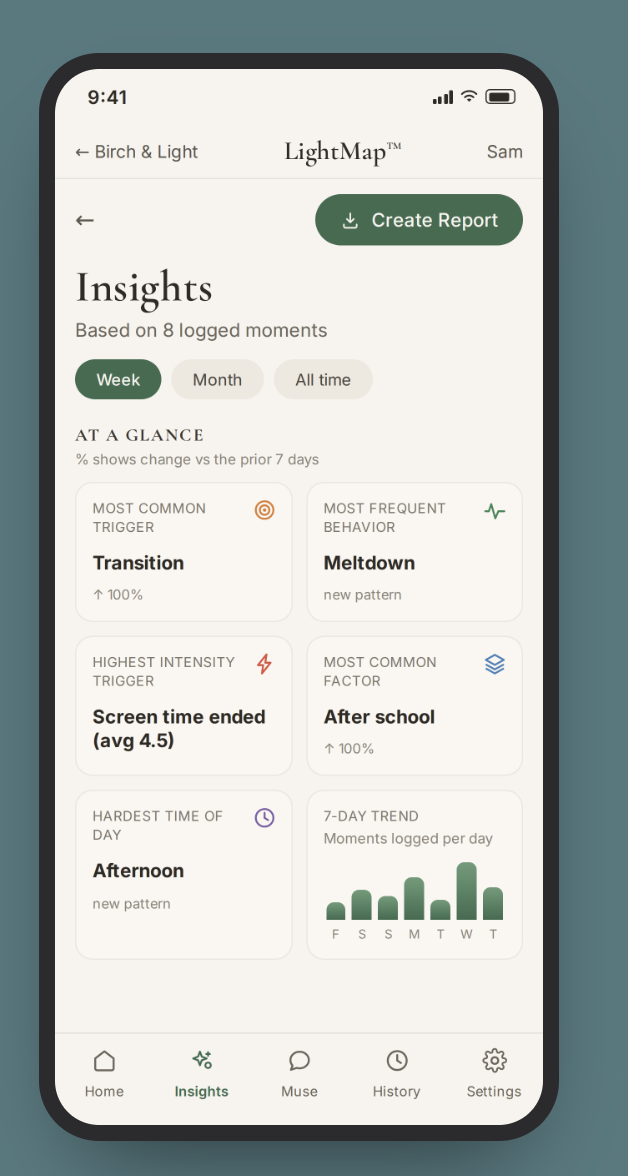

Part of the award-winning Birch & Light Method, honored with the Mom's Choice Gold Award for excellence in family resources.
A story to read together
Sometimes the easiest way in is a story you read side by side.
 The Mouse Who Heard Everything
Mina Mouse hears every creak the old house makes at night. The story gently shows that her brain isn’t broken — it’s working overtime to keep her safe — and what changes when someone sits beside her in the dark.
Read the story The Tower That Looked Fine
A tower in a quiet clearing tries to stay steady through every small thing nobody else seems to notice — until one tiny breath of wind causes her to fall, and a gentle hand begins to gather the blocks back.
Read the story
If today was one of those days
A few more from the library, free to read.
Researched and drafted with AI assistance, reviewed before publication. Editorial standards